


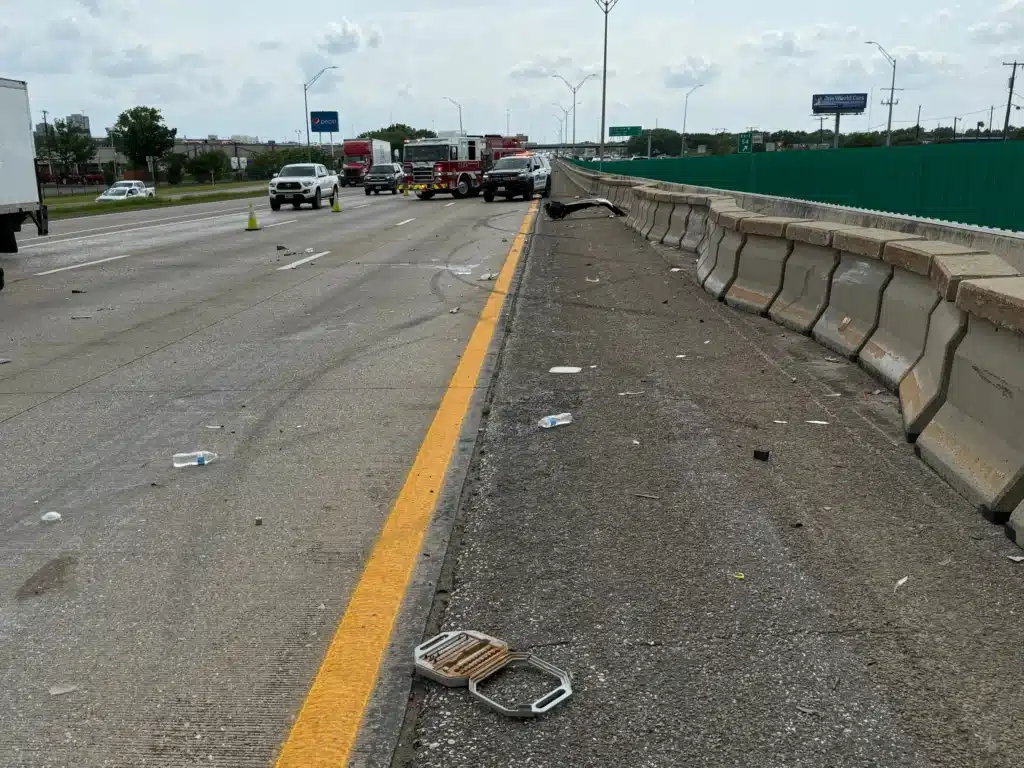
Texas lets you recover if your own share of responsibility is no higher than 50 percent, but your recovery is reduced by that percentage. At 51 percent, recovery is barred. The rule itself is straightforward. The real work is proving whose version of the crash is supported by the record.

About this article
Written by Josh Alexander and reviewed by Matthew Graham, who defended insurance carriers before he joined our firm. The Texas law cited here was checked against the official statute text in September 2026, each case result against its published case page, and each caller quote word for word against the recorded call. Callers are not named, and identifying details are left out. This is general information, not legal advice, and it does not create an attorney client relationship.
The question behind every fault dispute
Can You Still Recover When You Were Partly at Fault?
Yes, provided you carry half of the blame or less. Texas follows a rule known as proportionate responsibility, often called comparative negligence or comparative fault. Your own percentage of fault comes off your recovery. Above 50 percent, Texas law bars recovery altogether.
| Your share of fault | What happens |
|---|---|
| 0 percent | You may recover your damages in full, subject to insurance limits and other case specific issues |
| 20 percent | Your damages are reduced by 20 percent |
| 50 percent | You may still recover, but your damages are cut in half |
| 51 percent or more | Recovery is barred; the other party owes you nothing |
The 51 percent line matters because a disputed percentage is not just a negotiating detail. It can shrink a case, or wipe it out entirely.
The short version
An insurance adjuster’s fault percentage is not a court ruling. It is the carrier’s position based on the information it has, the story it heard first, and the evidence it believes it can use.
The Texas 51 Percent Rule
The governing statute is Civil Practice and Remedies Code 33.001. It bars an injured person from recovering damages once that person’s share of responsibility tops 50 percent. That means exactly 50 percent fault is still recoverable.
Example
Assume your total damages are $100,000. Damages means the full value of your losses before any reduction; medical bills, lost pay, vehicle repairs, and pain and suffering all count. Under section 33.012, the reduction works like this:
Example on $100,000 of total damages · real cases turn on their own facts, injuries and insurance
| Your share of fault | Calculation | Potential recovery |
|---|---|---|
| 0 percent | $100,000 minus $0 | $100,000 |
| 20 percent | $100,000 minus $20,000 | $80,000 |
| 30 percent | $100,000 minus $30,000 | $70,000 |
| 50 percent | $100,000 minus $50,000 | $50,000 |
| 51 percent | Recovery barred | $0 |
That calculation is only the beginning. Insurance limits, prior settlements, available coverage, medical proof, and the number of responsible parties can all affect what is actually collected. Our guide to what Texas car accident lawsuits are worth covers how limits shape the final number.
How We Think About Fault
When someone calls our office and says, “The other driver is blaming me,” we do not begin by arguing over a number. We start with the questions that can actually change the number:
- What did the vehicles look like immediately after the impact?
- Is there business, traffic, dashcam, apartment, rideshare, or home security footage?
- Did anyone independent see what happened?
- What does the report say, and what facts does it rely on?
- Did either driver make a statement before speaking with an insurer?
- Is there vehicle data, phone evidence, or a commercial driver record to preserve?
- What has the insurer already been told, and what evidence has it not seen?
A fault percentage can be no stronger than the proof underneath it.
What Our Intake Calls Show
Between June 10 and September 29, 2026, we reviewed 155 recorded intake calls involving vehicle crashes. Fault, blame, or an insurer’s liability decision came up in 71 of those calls, or 46 percent. In 37 of them, 24 percent of all the crash calls, the caller raised it in their own words.
155
Recorded crash intake calls reviewed
71 46%
Fault, blame or liability came up
37 24%
Raised by the caller in their own words
People were not simply asking, “Who was at fault?” They were often facing one of the same recurring problems:
- The other driver was telling a different story than the caller
- The police report did not assign fault, or the officer never spoke to a witness
- The carrier said it was still investigating and had not accepted liability
- The caller accepted part of the blame, but not all of it
- The claim had been denied, or was likely to be, with nothing to break a word versus word dispute
- The caller had video, photographs, or a witness and wanted to know whether it was enough
One caller had rear ended a slow car just past a blind curve on the highway, after a truck in the next lane sped up and blocked the merge. The caller put the shared fault problem in a single sentence: “I’m having difficulty with being 100% at fault, if that makes sense.” That is exactly the question proportionate responsibility answers.
What we learn from that pattern
Fault disputes do not begin in a courtroom. They often begin when the first story reaches the insurer, when an important piece of evidence is not preserved, or when an unanswered defense theory becomes the carrier’s reason to discount the claim.
Method note. The figures above come from a review of those calls. A call counted when someone on it discussed who was at fault or to blame, or whether an insurer had accepted, denied, or was still investigating liability. Our intake script includes a question about whether the caller thinks the other driver is responsible, so the 71 includes calls where only our staff used those words; the 37 counts only calls where the transcript shows the caller using them. No caller is identified, and individual results and experiences vary.
Who Actually Decides Fault?
An insurance adjuster can assign a percentage, accept liability, deny liability, or offer to pay only part of a claim. But that does not make the percentage final.
Before a lawsuit
The insurer evaluates the available evidence:
- Police report and crash diagram
- Statements from both drivers
- Witness information
- Photos and video
- Vehicle damage
- Traffic citations
- Medical records and claimed injuries
- Available insurance coverage
The carrier may call its conclusion “accepted liability,” “comparative negligence,” “shared fault,” or “insufficient evidence.” Regardless of the label, the important question is the same: what evidence supports that decision?
In a lawsuit
A judge or jury ultimately assigns percentages of responsibility if the case goes to trial (section 33.003). An argument that you share the fault is generally an affirmative defense; Texas Rule of Civil Procedure 94 lists contributory negligence among them. The other side must plead it and support it with evidence that you failed to use reasonable care and that your conduct helped cause the collision or your injuries. It is not enough to say you “should have seen” something or “could have avoided” the crash.

From Matthew Graham’s desk
Our litigation practice is led by Matthew Graham, who describes his background this way: “I spent more than a decade defending insurance carriers. I know exactly how they evaluate a file, where they will dig in, and how to make them blink.”
That background shapes how we read a file. A comparative fault argument does not have to be perfect to affect an offer; it only has to sound plausible until someone forces the carrier to identify what supports it. So we want to know whether the percentage comes from video, a witness, vehicle evidence, a photograph, or simply the other driver’s story.
Matthew Graham
Managing Litigation Attorney
What We Preserve First
In a disputed fault crash, time matters. Video can be overwritten, witnesses become difficult to locate, vehicles are repaired, and an insurer’s version of the event can harden before the full record exists.
1. Video
We look for footage from nearby businesses, intersections, apartment complexes, homes, dashcams, rideshare vehicles, and commercial vehicles.
A camera does not need to capture the impact to matter. Video showing traffic flow, vehicle positions, signal timing, lane movement, weather, or the seconds before a collision can be enough to challenge a false narrative.
2. Independent witnesses
A neutral witness can break a “word versus word” dispute. But a witness who leaves without giving contact information may be impossible to find later. If someone stops, get:
- Full name
- Phone number
- Email address
- A short description of what they saw
- Their location when they saw it
3. Vehicle evidence
Damage location and crush patterns can test what each driver says happened. The vehicles themselves may also contain event data recorder information showing speed, braking, steering, or other data near the crash; federal rules set what those recorders capture (49 CFR Part 563).
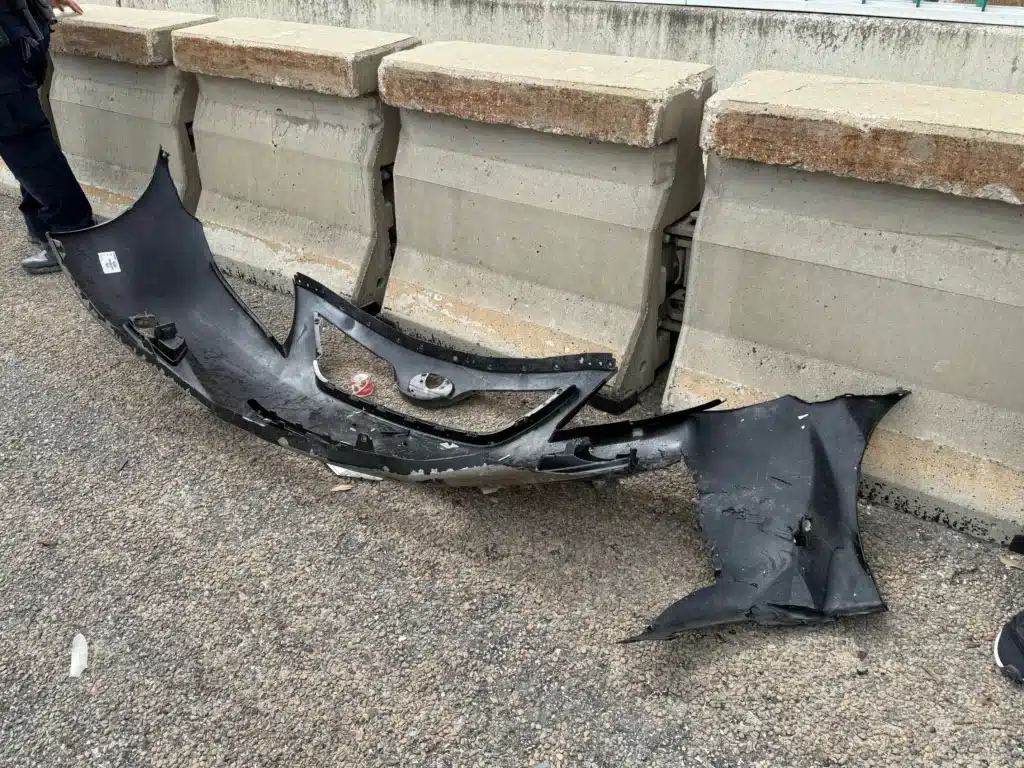
Commercial cases can involve even more sources of evidence, including onboard video, driver logs, dispatch records, inspection records, GPS data, and company communications. What to save yourself is listed in our guide to gathering crash evidence.
4. The carrier’s stated reason
If an insurer pins 30 percent of the fault on you, asks for a recorded statement, or denies your claim, ask for the reason in writing. We want to know:
- What percentage did the insurer assign?
- What evidence did it rely on?
- What witness statements does it claim to have?
- Does it rely on the crash report?
- Is it arguing speed, following distance, distraction, weather, a lane change, or another theory?
- Has it reviewed the evidence you possess?
The first step in responding to a blame shifting argument is identifying the actual argument.
The Fault Defenses We Expect
Insurance companies and defense lawyers return to the same themes. A theme is not proof. It is a starting point for investigation.
Common fault defenses · and the questions that test them
| What the insurer may argue | What we ask next |
|---|---|
| “You should have seen the other vehicle.” | From where? At what distance? With what sightline? How many seconds were actually available? |
| “You were in the truck’s blind spot.” | Did the truck driver signal, keep a proper lookout, check mirrors, or make a safe lane movement? |
| “Rain or weather caused the crash.” | Did weather actually cause it, or did a driver fail to slow down, stay awake, brake, steer, or maintain control? |
| “Both drivers were moving, so it is 50/50.” | Who had the better opportunity to see, yield, stop, or avoid impact? |
| “The police report blames you.” | What underlying facts support that opinion, and what does independent evidence show? |
| “There is no proof.” | Has anyone obtained nearby video, preserved vehicle data, found witnesses, or compared the damage to the story? |
| “You stopped suddenly.” | Was the stop necessary? What was traffic doing ahead? Did the rear driver maintain a safe following distance? |
| “You had a green light too.” | Who had the protected movement? Who was turning? What did the signal phase require? |
Case file$600,000
“Blind Spot” Was the Defense
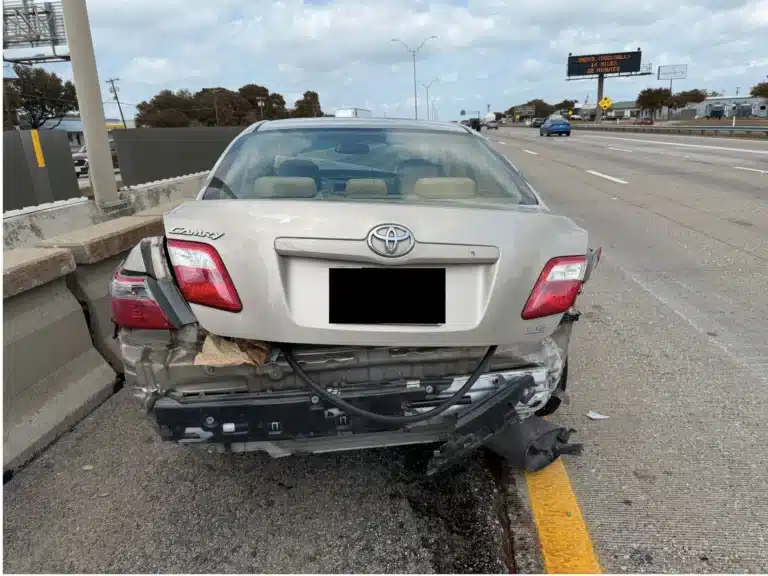
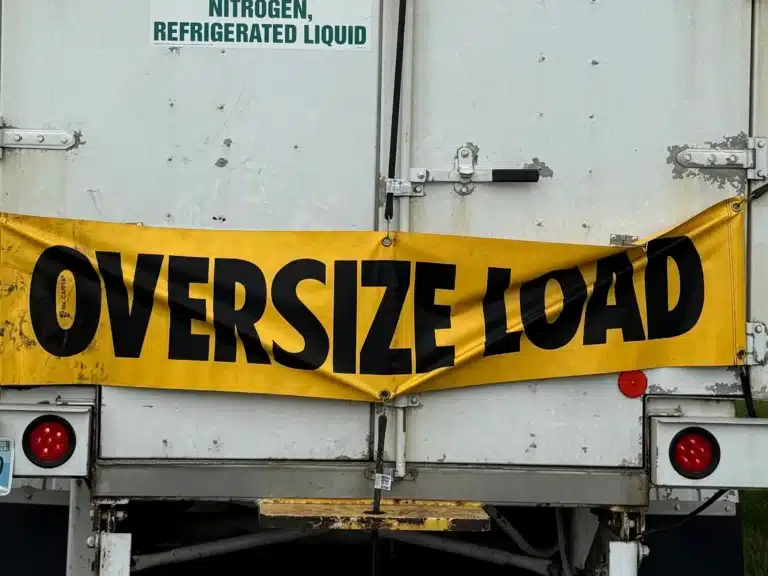
The claim. In one commercial truck case on Interstate 30, the truck driver argued that our client’s Camry had been sitting in the truck’s blind spot.
What we tested. We did not accept “blind spot” as the conclusion. We looked at whether the truck driver’s lane movement, the crash report, and witness accounts supported that explanation.
What mattered. The crash report identified no contributing factor for the Camry, and it listed two factors for the tractor trailer: an unsafe lane change and failing to control speed. Witnesses described the 18 wheeler swerving across lanes.
The result. After the trucking company’s insurer opened with a low offer, the case resolved for $600,000.
Lesson from the file. “Blind spot” is not a complete defense. The real questions are whether the commercial driver made a safe lane change, maintained a proper lookout, used mirrors and signals, and had room to move safely.
Past results do not guarantee a similar outcome. Injuries, evidence and coverage were specific to this client.
Rear End Fault Is Not Always Automatic
The driver in the rear often begins with a difficult position because Texas requires drivers to maintain enough distance to stop safely (Transportation Code 545.062). But “rear end crash” is not the end of the investigation. The other side may argue:
- The front driver cut in abruptly
- The front vehicle stopped without reason
- Brake lights were defective
- A third vehicle created an emergency
- Road conditions made the crash unavoidable
- The front driver reversed
- The collision occurred in a chain reaction
We look for what happened in the last seconds before the collision, not simply where the damage appeared.
Case file$100,000
No Police Report Did Not Mean No Proof

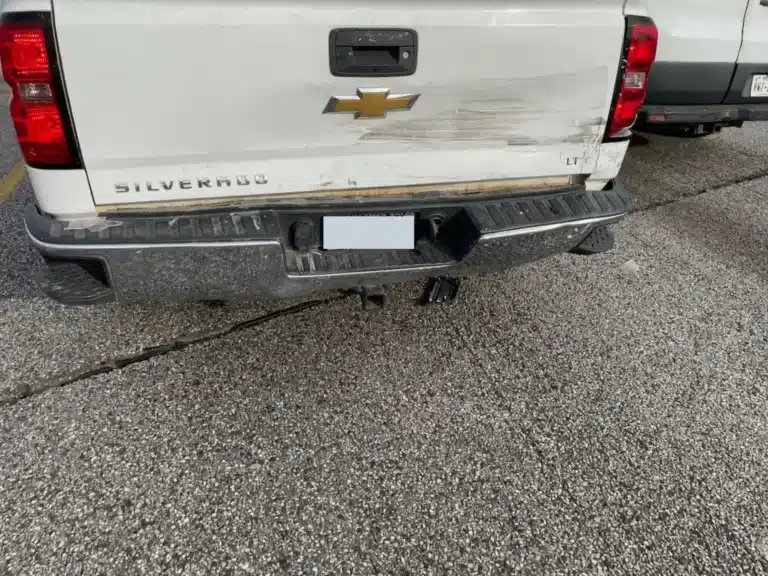
In one rear end case, there were no officer fault codes to frame the claim. That did not mean there was no case. Photos became important because they documented the vehicles and scene when no police conclusion existed for the insurer to rely on. The case resolved for $100,000.
Lesson from the file. A missing police report creates an evidence problem, not automatically a liability problem. When there is no report, photographs, witness information, repair records, messages, admissions, and video become more important. Our no police report guide covers what to gather.
Past results do not guarantee a similar outcome.
Left Turns and Lane Changes
Left turn crashes produce some of the most common fault disputes because both drivers may claim a green light.
A green signal does not always mean a protected right to turn. One driver may be proceeding straight through a solid green while another faces a flashing yellow arrow and must yield before turning across traffic.
Case file$82,500
The Green Light Was Not the Whole Story
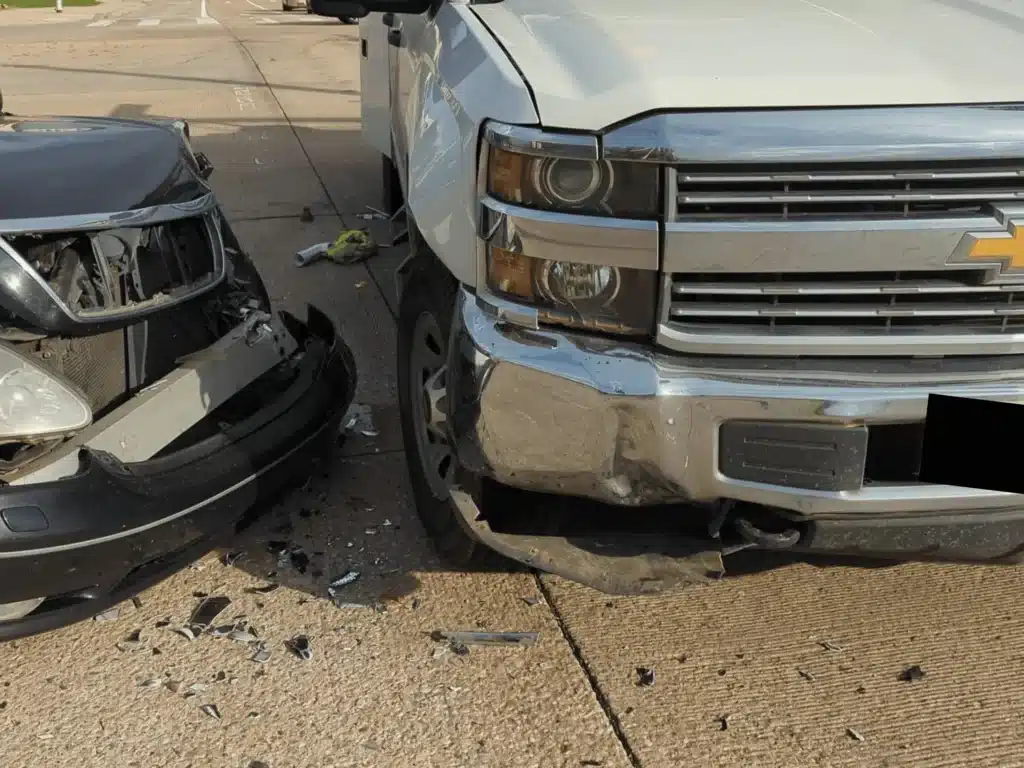
In a Plano commercial vehicle case, our client drove through on a solid green while the driver of a company pickup, facing a flashing yellow arrow, turned left across his path. The report found the turning driver failed to yield, and both a traffic camera run by the City of Plano and an independent witness supported that conclusion.
The case resolved for $82,500 after suit was filed.
Lesson from the file. “We both had green lights” is often the beginning of the analysis. We look at which driver had the protected movement, which one was turning across traffic, what the signal required, and whether independent evidence supports either version.
Past results do not guarantee a similar outcome.
Parking Lots and Backing Collisions
A parking lot crash is not automatically 50/50. These cases often involve:
- A driver reversing out of a space
- Two cars reversing at the same time
- A driver leaving a gas pump
- A blind corner or blocked sightline
- Bright sun or poor lighting
- A disputed claim about who started moving first
- Security camera footage that may be overwritten quickly
In a shared fault parking lot case, we reconstruct the final seconds:
- Who was moving?
- Who had the clearer view?
- Who had time to stop?
- Was one driver backing across an established lane of travel?
- Did the other driver have a duty to yield?
- Is there a gas station, store, apartment, or home security camera nearby?
The fact that both cars were moving does not answer those questions.
Bad Weather Does Not Excuse Careless Driving
Rain, fog, darkness, wet pavement, and glare are often cited as reasons a crash was unavoidable. But weather is usually context, not a free pass.
A driver still has a duty to adjust to conditions. That may mean slowing down, increasing following distance, using headlights, maintaining control, and pulling over rather than driving while dangerously fatigued. Our guide to bad weather car accidents goes further.
What we look for in a weather defense
- Did the driver brake?
- Did the driver steer to avoid impact?
- Was the vehicle speeding for conditions?
- Was the driver drifting between lanes?
- Did the driver report fatigue, distraction, or poor visibility?
- Did witnesses see erratic driving before the crash?
- Does vehicle data show no meaningful attempt to avoid the collision?
A wet roadway does not explain why a driver crossed into another lane, failed to react, or continued driving when they could not do so safely.
When It Is Word Versus Word
The hardest cases are not always the ones with the worst damage. They are the cases where each driver has a different story, the police report does not assign fault, there is no video, and no neutral witness is available.
We are candid about that problem. If nothing can break the tie, the insurer may deny the claim, and litigation may not change the result. But “word versus word” is not always truly a tie. The tie can be broken by:
- A recorded admission at the scene
- A text message or call made shortly after the collision
- Damage that does not match the other driver’s account
- A nearby camera
- A witness who was not listed on the report
- Vehicle data
- Phone records
- Prior inconsistent statements
- A commercial driver’s logs or onboard systems
One caller told our team they were recording damage after a rear end crash when the other driver admitted on video that the collision was their fault. That type of statement can matter: Texas law keeps an expression of sympathy out of evidence, but not a statement of fault (Civil Practice and Remedies Code 18.061). Another caller had a witness who said they saw the other driver back into the caller’s car, but the officer never spoke to that witness, and the caller never got the witness’s name or number.
Lesson: If a neutral witness stops, treat that contact information like evidence. It may decide whether the claim is denied or proved.
When More Than Two Drivers Share Fault
A crash with several vehicles can involve more than one responsible driver, an employer, a commercial carrier, a vehicle owner, a contractor, or a person who caused the sequence and then left the scene.
Texas can divide responsibility among the people and entities that helped cause the harm. As a general rule, each defendant pays only its own percentage, but a defendant whose share tops 50 percent can be held liable for everything you are entitled to recover, and the statute has other narrow exceptions (section 33.013). What you actually collect also depends on the coverage available. That means a case can become less about “which one driver caused it” and more about identifying everyone who helped create the crash. Our multi car accident guide walks through chain reaction claims.
Case file$600,000
Find the Driver Who Started the Chain
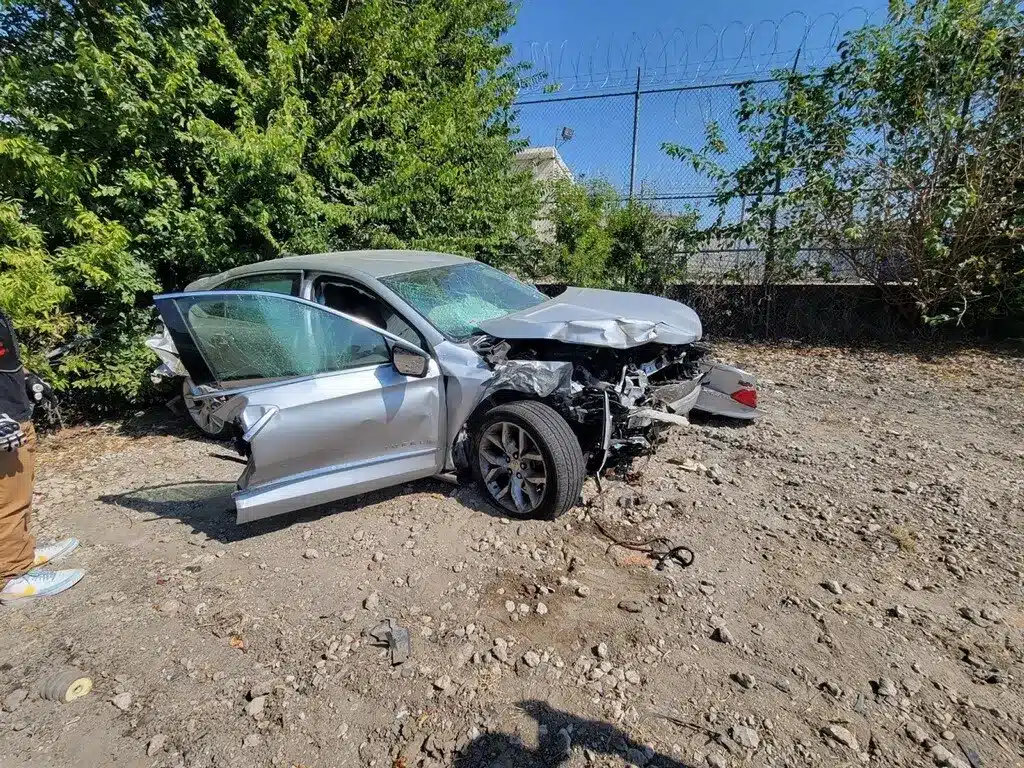
In a Rockwall County commercial crash, a company driver failed to slow down and struck our stopped client from behind. That impact drove her forward into another car, then forced her into the path of oncoming traffic, where a second driver hit her head on. Five vehicles were involved in all.
The final impact was not the whole story. The question was who began the chain of events that put the vehicles in their final positions.
The case resolved for $600,000.
Lesson from the file. In a chain reaction collision, we map the crash in order: who struck whom, when, from which lane, and what earlier impact changed the path of the vehicles. The final collision may not identify every responsible party.
Past results do not guarantee a similar outcome.
The “Empty Chair” Problem
A defendant may try to point blame at someone who is not part of the lawsuit: a hit and run driver, an employer, a contractor, another motorist, or a person the defense says caused the event. Texas lets a defendant designate that person as a responsible third party (section 33.004).
Lawyers sometimes call this the “empty chair” defense. That matters because fault assigned to someone outside the case may affect what can actually be collected. That is why we work to identify every potentially responsible person early, rather than accepting the first insurer’s narrow version of the crash.
What If Both Drivers Were Hurt?
Both drivers can make claims. Each claim is evaluated separately. For example:
- If you are 30 percent at fault and the other driver is 70 percent at fault, you may recover 70 percent of your damages.
- The other driver, being over 50 percent responsible, cannot recover from you for their own damages.
- If both drivers are 50 percent responsible, each may be able to recover half of their own damages, subject to available coverage and other facts.
A shared fault crash is not a single claim with a single winner. It can involve two different injury claims, two different damage calculations, and multiple available policies.
If an Adjuster Says You Are 30 Percent, or 51 Percent, at Fault
A percentage from an insurer should trigger questions, not panic.
Ask for the basis
Ask the adjuster to identify the facts and evidence supporting the percentage. Request:
- The written liability decision
- The crash report, or at least its number
- The insurer’s stated reason for assigning fault
- Any photographs or witness information it relied on
- The names and contact information of the assigned adjuster and supervisor
- A copy of any recorded statement you gave
Treat the other insurer’s request for a recorded statement with care
Your own insurer may require cooperation under your policy. But the other driver’s insurer represents the other driver’s financial interests, not yours.
Before you give the other carrier a recorded statement, understand what it is seeking. Fault questions can be framed in ways that invite a person to guess, accept blame, or make an incomplete statement under stress. Our article on handling insurance companies in Texas covers adjuster calls in more detail.
Do Not Rush to Sign a Release
A release can end the claim. A check labeled as a full and final settlement may have the same practical effect. If the fault picture changes later because video appears, a witness is found, or medical care becomes more serious, it may be too late to reopen the case.
Preserve your own coverage options
If the other carrier disputes fault, your own policy may matter. Depending on what you purchased, you may have:
- Personal injury protection
- Collision coverage
- Uninsured or underinsured motorist coverage
- Medical payments coverage
Using collision coverage may require payment of a deductible, but your insurer may later seek reimbursement from the responsible carrier.

From Josh Alexander’s case review
Josh Alexander writes on his attorney page that under the 50 percent rule, “insurers often look for ways to shift blame. They may point to a statement, a prior injury, a social media post, a split-second decision, or an incomplete piece of evidence. My job is to make sure that fault is evaluated using the entire record.”
In practice, that review does not begin with the percentage the adjuster assigned. It begins with what the roadway looked like, where the vehicles were damaged, who saw the collision, what evidence still exists, and whether the insurer’s version makes physical sense. The goal is not to argue louder than the other side. It is to build a record that makes the other side’s argument harder to maintain.
Josh Alexander
Founder and Managing Attorney
When a Fault Dispute Requires a Lawsuit
Most cases resolve without trial. But insurers price settlement offers based on the risk they believe exists. If they believe they can persuade a jury that you were partly at fault, or over 50 percent at fault, that risk may be built into the offer.
When a carrier denies liability or refuses to move off a weak fault argument, filing suit can allow your lawyer to use formal discovery. That may include:
- Written questions answered under oath
- Requests for documents
- Requests for video and digital evidence
- Depositions under oath
- Requests for phone, vehicle, and company records
- Expert analysis of crash mechanics, vehicle data, or roadway conditions
Litigation is not the right move in every case. But it gives both sides access to tools that are unavailable while an insurer simply says it is “still investigating.” Our page on whether you can sue for a car accident in Texas explains when that step makes sense.
Frequently Asked Questions
Is the rear driver always at fault in Texas?
No. The rear driver often faces a difficult argument because every Texas driver has to keep enough space to stop in time. But a rear end crash can involve a cut off, a sudden unnecessary stop, brake light problems, a chain reaction, a reversing vehicle, or another fact that affects fault.
What if I was exactly 50 percent at fault?
You may still recover. The bar applies only above 50 percent. At 50 percent, your damages are reduced by half.
Does a police report decide fault?
No. A crash report can be important evidence, but it does not make the final legal decision. The report may contain an officer’s opinion, witness statements, diagrams, contributing factors, and factual observations. Its weight depends on the facts and other available evidence.
Does a ticket prove I caused the crash?
Not necessarily. A citation can matter, but it does not automatically resolve a civil injury claim. The facts surrounding the alleged violation, the evidence, and the relationship between the violation and the crash still matter. Paying a fine only ticket counts as a no contest plea, and a no contest plea cannot be used as an admission in the civil case (Code of Criminal Procedure 27.02 and 27.14).
Can I apologize after a crash?
You can check on someone and express concern. But avoid making broad conclusions about fault before you understand what happened. A statement such as “I’m sorry this happened” is different from saying, “It was my fault; I never saw you.” Texas law keeps the first kind out of evidence; the second can be used against you.
Does not wearing a seat belt mean I caused the crash?
No. Seat belt use does not cause a collision. But the other side may argue that failure to use a seat belt worsened injuries, which can become a separate issue about damages. The Texas Supreme Court allowed that argument in Nabors Well Services v. Romero (2015), but only where the evidence shows the nonuse caused or worsened the injuries.
Does my share of fault still matter if the other driver was uninsured?
Yes. Your own UM/UIM coverage (uninsured and underinsured motorist), if you bought it, may help, but your own percentage of fault can still affect what you recover. Our guide to who pays when an uninsured driver hits you walks through an example.
What is the deadline to sue after a Texas car accident?
The usual filing deadline for an injury lawsuit in Texas is two years, but exceptions can apply (section 16.003). Claims against a government body can carry far shorter notice requirements, sometimes six months or less (section 101.101). A fault dispute does not stop the deadline from running. Our page on Texas car accident filing deadlines lists the exceptions.
What to Bring to a Fault Review
If an insurer has blamed you or denied your claim, bring whatever you have; a perfect file is not required before speaking with a lawyer.
The most useful items
- The crash report or report number
- Any denial letter, liability letter, email, or text from the insurer
- The adjuster’s name and claim number
- Photos and video from the crash scene
- Photos of both vehicles before repair
- Witness names and contact information
- Medical records and bills received so far
- Your insurance declarations page
- Any dashcam footage
- Any messages or statements from the other driver
- A timeline of what happened before, during, and after the crash
Talk With a Texas Injury Lawyer About a Fault Dispute
If an insurer says you share the blame, says your case is “word versus word,” or assigns you more than 50 percent fault, the evidence should be reviewed before you accept the decision.
At J. Alexander Law Firm, we examine the full record: the crash report, every photo and video, the witnesses, the vehicle damage, available insurance, statements, and the actual theory behind the insurer’s percentage.
24/7 · Free consultation · No fee unless we win
A Free Review of the Insurer’s Fault Decision
J. Alexander Law Firm serves injured clients throughout Texas: Dallas · Houston · San Antonio · Fort Worth · Arlington · Canton. Se habla español.