


The short answer
Yes. Texas Penal Code section 49.031 makes it illegal to knowingly possess an open alcohol container in a vehicle's seating area on a public highway. The rule covers drivers and passengers. Under section 12.23, the Class C misdemeanor carries a fine of up to $500.
Key points
Putting the cap back on a bottle does not necessarily make it closed under Texas law.
Possessing several open containers during one incident counts as one offense.
An officer charging someone under the open container law must issue a citation and notice to appear. The Class C penalty is a fine, not jail.
The public highway rule applies whether a vehicle is being driven, standing still or parked.
Does an open container in the car decide fault in a Texas crash?
When the container rule applies
An open container
A bottle or can containing alcohol counts as open if it is open now, was opened before, has a broken seal or has been partly emptied. That matters even if you put the cap back on.
Even a nearly empty can can count if it still holds alcohol, under Texas Penal Code section 49.031. A person sitting in a parked car on a public highway can violate the rule by knowingly holding an open beer in the seating area.
Pulling onto a highway shoulder does not necessarily put you outside the rule. Texas Penal Code section 49.031 includes the highway's right of way.
Storage and passenger exceptions
A trunk, a locked glove compartment and similar locked storage are outside the seating area. If the vehicle has no trunk, the space behind its last upright seat is outside that area too. The law also makes exceptions for passengers in buses, taxis and limousines used mainly to carry people for pay, and for passengers in the living quarters of a motor home, camper or RV.
Possession and DWI
The offense concerns the person who knowingly possesses the container. An ordinary car passenger does not receive an exception just for being a passenger.
In a DWI case, section 49.04 generally sets a 72 hour minimum jail term. The minimum rises to six days when trial proof shows the driver had an open container within immediate reach during the offense.
For an injury claim, see our page on claims when a drunk driver hits your car.
The claim and the crash report
The driving question
- For a crash claim, I want to know who possessed the container and how each driver acted.
- A container in the car does not answer that driving question. For DWI, Texas Penal Code section 49.01 defines intoxication as not having your normal mental or physical abilities because of alcohol or other substances, or having an alcohol concentration at or above 0.08.
The report entries
- On Texas crash reports, officers use section 38 with the Factors and Conditions codes.
- It has distinct entries for code 45, had been drinking, and code 67, intoxicated alcohol.
- Neither code means an open container was present.
- Although the report has no separate code for an open container, its narrative or a charge may mention one.
Counts and their limits
What the crash counts show
These TxDOT CRIS counts measure reportable crashes with the listed alcohol entries. They do not count open containers or determine fault.
Through November 9, 2026, the counts were 3,759 for had been drinking and 14,148 for intoxicated alcohol. Through November 9, 2025, they were 4,096 and 13,975, respectively.
One crash can carry both labels. Officers are still submitting 2026 reports, so I cannot fairly compare the years yet.
Questions about your claim
An insurer response
Matthew Graham asks "what are their arguments" when he reviews an insurer's response. He is our Managing Litigation Attorney. Before treating a container in your car as proof of responsibility, I would check the evidence of how you drove if an insurer points to it.
Fault and damages
Our explanations of negligence per se and how Texas divides fault cover those separate issues. A container on the floor alone does not reduce the damages your injuries support.
Time and insurance questions
Two years is the usual filing limit for an injury suit under section 16.003. Before answering questions about your drinking from an insurance adjuster, you can talk with us.
Read it as text
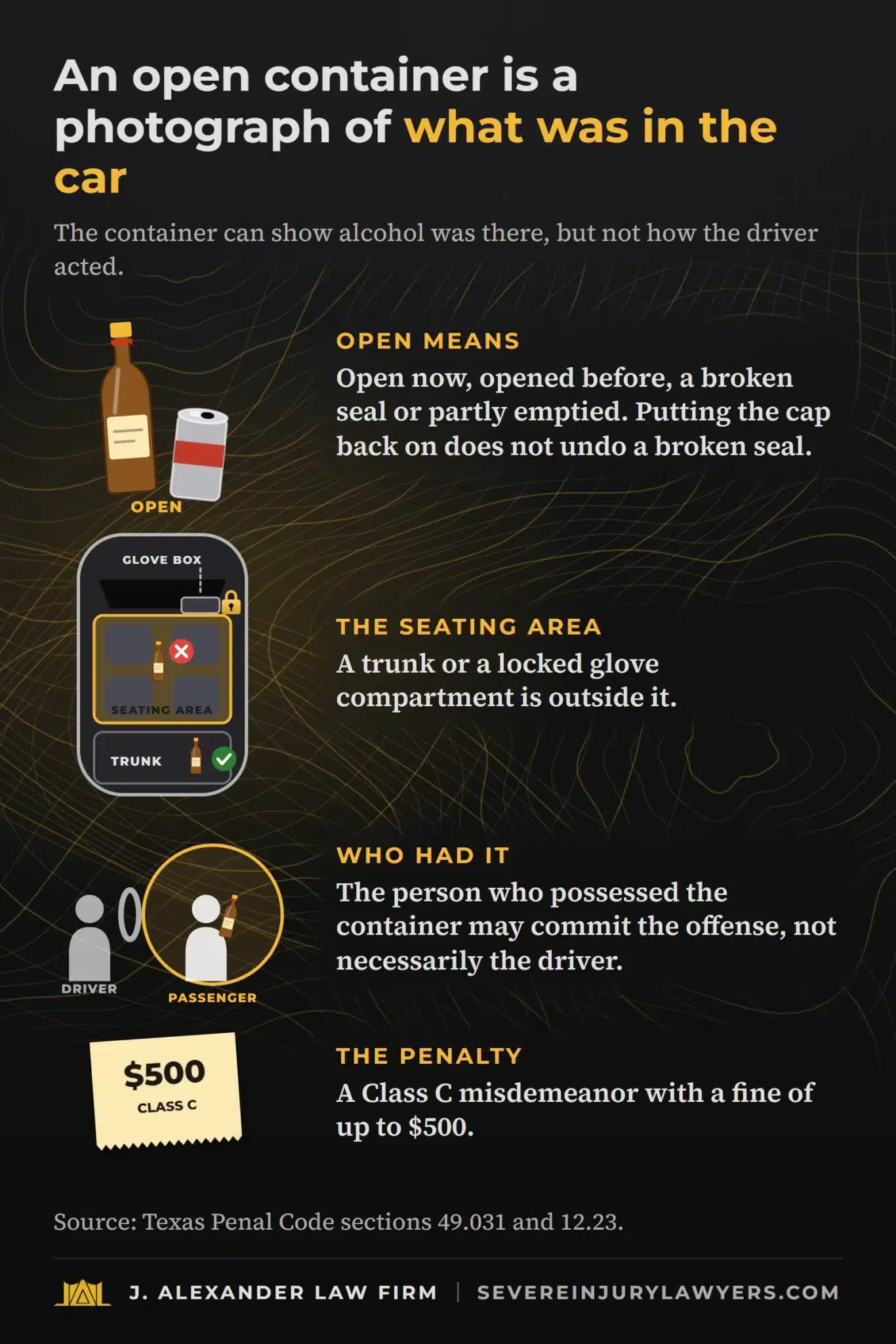
The container can show alcohol was there, but not how the driver acted.
- Open means: Open now, opened before, a broken seal or partly emptied. Putting the cap back on does not undo a broken seal.
- The seating area: A trunk or a locked glove compartment is outside it.
- Who had it: The person who possessed the container may commit the offense, not necessarily the driver.
- The penalty: A Class C misdemeanor with a fine of up to $500.
Texas Penal Code sections 49.031 and 12.23.
Example
Open bottle after a Texas crash
Say you are in the passenger seat when another car hits yours on a Texas street. An opened bottle of beer lands on the floor. Later, the adjuster asks whose bottle it was, and you worry that your answer will hurt your injury claim.
If the officer believes a driver had been drinking, the Texas crash report might include code 45. The narrative could mention the bottle.
Those entries are worth checking, but they do not decide responsibility for the crash. Code 45 does not establish that an open container was present.
The adjuster might claim that drinking affected a driver's actions and argue that responsibility should be shared. I would want to know which driver the report identifies and what evidence shows about how each car moved. A bottle in the passenger area does not answer those questions by itself.
My first question about the bottle is who knowingly possessed it. Texas Penal Code section 49.031 also turns on where the container was and whether it had been opened.
Replacing the cap is like closing an envelope after opening it: the seal has still been broken. Write down where the bottle was found and who held it.
Check the report narrative for the officer's account.
A person's share of responsibility can reduce a recovery, and either driver's conduct may matter. I understand why the bottle worries you. Its presence calls for a closer look at possession and at how the collision happened.
Read next on our site
Among Texas laws that shape a car accident claim, I also watch the dram shop rule on when a business may owe crash damages for serving an obviously drunk customer.