



Short answer
What do you need to legally ride a motorcycle in Texas?
For a motorcycle on Texas public roads, the usual requirements are a Class M license, an approved rider safety course, liability insurance and the equipment Texas law calls for.
Texas riders generally need a Class M license and 30/60/25 liability insurance to ride on public roads. Coverage that may pay for your own injuries is a separate choice. After a crash, the other driver's insurer looks at your license and motorcycle policy early. That's why those are the first two things I ask you about if you're hurt.
The insurer may say a riding rule you broke contributed to your motorcycle wreck. My question is whether that broken rule played a part in your crash. For example, say you stopped for a red light and a car struck the back of your motorcycle.
A missing mirror did not cause that impact. Read about how partial responsibility affects a Texas claim.
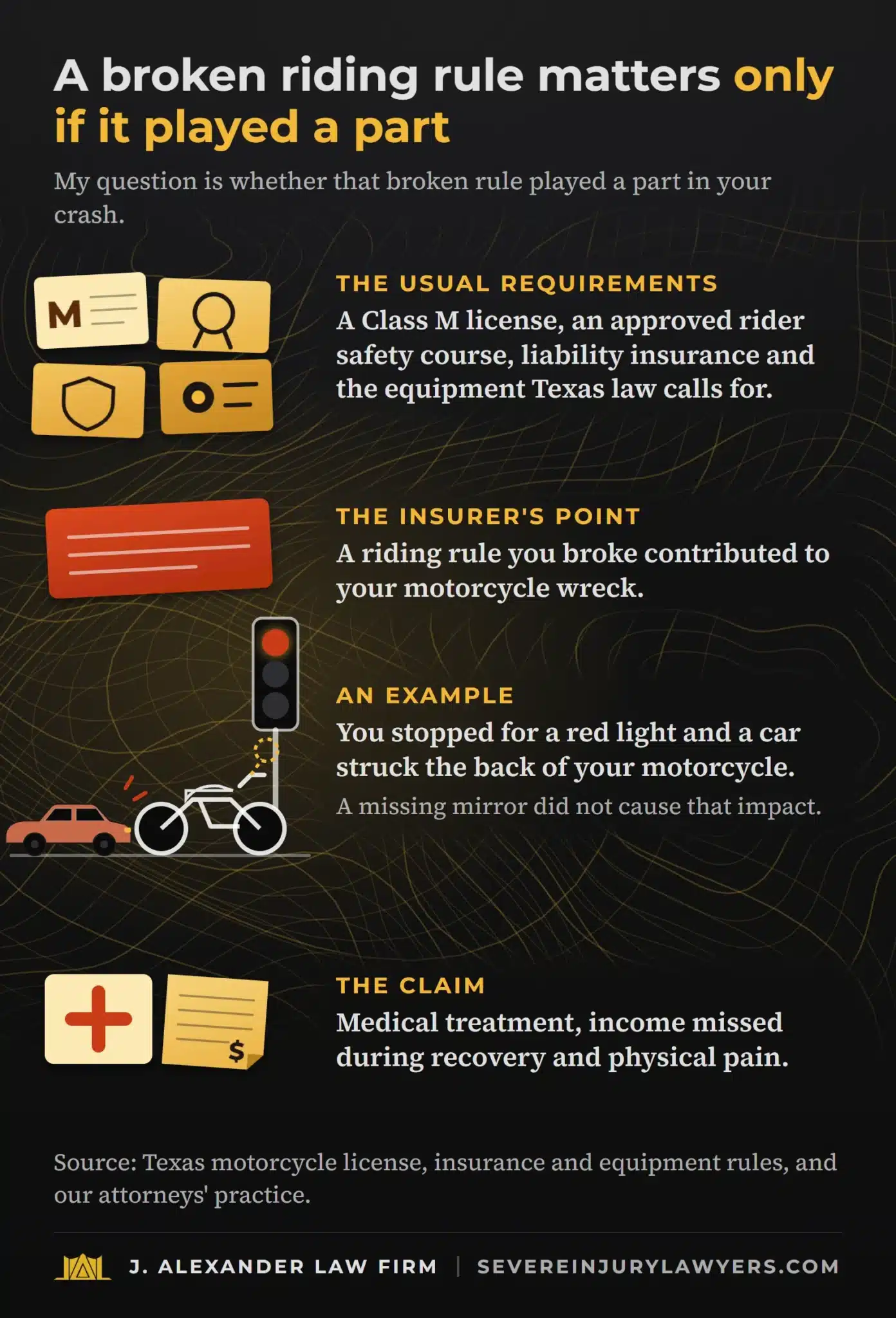
Read it as text
My question is whether that broken rule played a part in your crash.
- The usual requirements: A Class M license, an approved rider safety course, liability insurance and the equipment Texas law calls for.
- The insurer's point: A riding rule you broke contributed to your motorcycle wreck.
- An example: You stopped for a red light and a car struck the back of your motorcycle. A missing mirror did not cause that impact.
- The claim: Medical treatment, income missed during recovery and physical pain.
Texas motorcycle license, insurance and equipment rules, and our attorneys' practice.
When I build a rider's claim, I can include losses such as medical treatment, income missed during recovery and physical pain. Read about the different losses recoverable after a Texas wreck.
For a closer look at riding rules, read my discussions of lane splitting in Texas and the Texas motorcycle helmet law. For statewide numbers, see the Texas motorcycle crash data study.
Texas motorcycle laws at a glance, and what each means for a crash claim | Texas Department of Public Safety, Texas Department of Licensing and Regulation, Texas Department of Insurance and Texas Transportation Code sections 545.416, 601.072 and 661.003, read Nov 11, 2026
| Rule | Where the rule comes from | What it means for a claim |
|---|---|---|
| Class M license | Texas DPS and the TDLR rider manual: a valid Class M license is needed before a motorcycle goes on a public highway. | An adjuster on the other side may check your license for Class M. Fault is still shared out by what each driver did to cause the crash. |
| Safety course | Texas DPS: applicants take a TDLR approved motorcycle safety course, and the completion certificate is good for 24 months. | Bring the course certificate when you call us. For a rider 21 or older, finishing the course is one route to the helmet exemption. |
| Liability insurance | Texas Department of Insurance: Motorcyclists must show financial responsibility just as car drivers must. The minimum liability coverage is 30/60/25, the same as for a car. Mopeds need the same coverage. | Liability coverage pays people you injure. It does not pay your own injuries or damage to your motorcycle. |
| Uninsured and underinsured motorist coverage | Texas Department of Insurance: Auto insurers are required to make uninsured and underinsured motorist coverage available. The coverage stays in place if you do not decline it in writing. | It can pay when whoever hit you is uninsured, is insured for less than your losses, or leaves the scene and cannot be identified or found. Check your policy to see whether it is included. |
| Helmet | The TDLR rider manual states that helmets meeting Federal standard 218 are required for operators and passengers. A person 21 or older is excepted after an operator training course or with a health insurance plan (Transportation Code section 661.003(c)). | An insurer may raise helmet use when reviewing a motorcycle injury claim. |
| Passengers | Transportation Code section 545.416 sets the seating, footrest and handhold rules and a minimum passenger age of five. | A passenger injured in a motorcycle crash may have an injury claim of their own. |
| Equipment | The TDLR rider manual lists a horn, mirror, brakes, tires, exhaust system, tail lamp, stop lamp, license plate lamp, rear red reflector and head lamp. | Photograph the motorcycle's lights, mirror and tires before repairs so its condition on the crash date is recorded. |
The table covers rules that may come up in injury claims, not every Texas traffic law.
Do you need a motorcycle license in Texas?
Yes. On Texas public roads, you generally need a motorcycle license, even for a three wheel motorcycle, moped or motor driven cycle. Riding without Class M does not, by itself, prevent you from making a claim based on another driver's mistakes. What each driver did matters when responsibility is assigned.
As an adult applying for a Texas motorcycle license, you generally need to complete a rider safety course approved by TDLR, the Texas licensing and regulation agency. The course may let you skip the knowledge test.
Afterward, you may be able to skip the skills test if you hold a valid, unrestricted Texas license of Class A, B or C.
Adults moving to Texas may qualify for the skills test waiver if their motorcycle license was issued by another state and is valid and unrestricted. Bring your course certificate when we meet so I can see your training.
Applicants ages 15 through 17 must bring a parent or guardian. They need 32 hours of classroom driver education, proof of school enrollment or a diploma, and a passing skills test. At 15, an I restriction limits the motorcycle to 250cc or less.
A skills test at 16 can remove that restriction. Section 545.065 does not ban a 250cc motorcycle from every highway.
It lets the Texas Transportation Commission or a local authority prohibit motorcycles of 250cc or less on limited access or controlled access highways within its jurisdiction, with official traffic control devices posted where the prohibition applies.
Under Section 545.424, riders under 17 with restricted motorcycle licenses cannot ride after midnight and before 5 a.m. for 12 months after original licensing, unless a parent or guardian can see them or the ride is necessary for work, school activities or a medical emergency.
A J learner license permits riding only with a licensed motorcycle operator age 21 or older. Section 545.424 also bars a rider under 17 with a restricted motorcycle license from using a phone while riding, except in an emergency.
Our review of TxDOT reportable crash records starts January 1 and ends November 9, 2026. The records counted 7,762 motorcycles. Officers recorded both Class C and M for 2,995 operators, Class C for 2,837 and no license for 640.
Those entries do not prove what license a rider held or establish fault. The actual license matters for that reason. As more reports arrive, the 2026 total may change.
Motorcycles in Texas crashes by the operator's recorded license class, with crash dates through November 9, 2026 | TxDOT CRIS public query, covering 2026 through November 9, pulled November 12, 2026
| License class recorded for the operator | Motorcycles | No proof of financial responsibility shown |
|---|---|---|
| Class C and M | 2,995 | 417 |
| Class C | 2,837 | 1,150 |
| Unlicensed | 640 | 472 |
| Other or out of state | 415 | 147 |
| Class A and M | 267 | 35 |
| Class A | 163 | 56 |
| Unknown | 161 | 80 |
| No data | 142 | 57 |
| Class M | 65 | 9 |
| Class B and M | 58 | 1 |
| Class B | 19 | 5 |
| All motorcycles | 7,762 | 2,429 |
Each row counts motorcycles (Vehicle Body Style 'motorcycle', police motorcycles not included) in reportable crashes. License class is the class the officer recorded from a Texas driver license, and the field holds one class code per operator. 'Other or out of state' is the code CRIS uses for an out of state license or another entry. The field shows the class recorded, not whether the rider held any other valid license. 'No proof' means the operator did not show the officer proof of financial responsibility, not that the motorcycle was uninsured. Expect these 2026 counts to grow, since crash reports keep arriving for weeks.
Matthew Graham, who once defended motorcycle claims for insurers, tells me insurers raised a rider's missing Class M license early, even though fault depends on what each driver did. So I ask about your license before the insurer does.
If you take the course on a three wheel motorcycle, your resulting license is limited to that type of motorcycle. Under Section 521.085(b), someone licensed in Class A, B or C may drive an autocycle or a qualifying enclosed three wheel passenger vehicle without Class M.
Before accepting an argument about a rider's license, I want to know which kind of three wheel vehicle the rider used.
Section 521.025 requires riders to carry an appropriate license while riding. For a first violation, the offense is a misdemeanor and the fine cannot exceed $200. If you rode without a license or insurance, tell me when you first contact us.
That gives me time to understand the insurer's argument before it comes up. Read what a missing license or policy changes after a Texas crash.
Rode without a Class M and got hit? Ask me how the license question fits into your claim.
Call 469-807-7480What insurance is required for a motorcycle in Texas?
Texas motorcycle liability insurance limits under Section 601.072 are known as 30/60/25. The usual limits are $30,000 for injuries to one person, $60,000 altogether when a crash hurts more than one person, and $25,000 for property damage. Riding without insurance can lead to a fine. Even so, I know of no Texas statute that stops you from asking the person who caused your wreck to pay just because you rode without insurance.
Mopeds and motor driven cycles need liability coverage too.
Section 601.191 generally sets a first conviction fine of $175 to $350 for failing to meet the requirement. After a prior conviction, the fine is $350 to $1,000. The fine is a traffic matter. A ticket does not settle fault for the wreck.
This insurance requirement does not apply to all terrain vehicles, dirt bikes, mini bikes and golf carts that cannot be used on public roads. Read what Texas minimum insurance covers after a crash.
Some callers tell us their policy has liability coverage only. That coverage pays for harm you cause to other people, not for your own injuries. One caller told us:
From our intake
"My policy is liability only."
A caller, 2026
Do I need uninsured motorist coverage on a motorcycle in Texas?
No. Coverage for uninsured or underinsured motorists is optional in Texas. Insurers must provide it unless the named insured declines it in writing. It can help when the other motorist is uninsured or carries too little for your losses. If a rider says he does not have uninsured motorist coverage, I want to see the form he signed to decline it.
This coverage may help with injury losses for you and a passenger if the motorist is uninsured or lacks enough coverage. It may also apply if the driver flees and cannot be identified.
When the person responsible for your crash has no insurance and your own policy lacks uninsured motorist coverage, your claim is against that driver personally. Read how payment may work when a Texas driver is uninsured.
In Fort Worth, our client was waiting in his car for a red light to change when a pickup hit him. Police charged the pickup driver with DWI. The pickup's policy excluded that driver and did not cover the crash.
Our client's own policy paid the full limit for uninsured motorists. The Fort Worth uninsured motorist result involved a car driver and does not predict payment on a motorcycle claim.
Bring me the declarations page from the policy that lists your motorcycle. Think of it as your policy's table of contents. It shows whether your policy includes uninsured or underinsured motorist coverage, along with the limits. If you have a separate car policy, check which policy lists your bike.
Have your motorcycle policy handy but unsure what it covers? Let me help you find the uninsured motorist line.
Call 469-807-7480Do you need mirrors on a motorcycle in Texas?
Yes. Texas requires one mirror on a motorcycle. A mirror on each side is a good idea.
A motorcycle made after 1975 must be ridden with its headlight on. Section 547.306 permits motorcycle LED underglow only if the light is steady amber or white, with no other type of light. Extra reflectors are worth considering too. After a crash, I use photos of the mirror and headlight to address an insurer's questions about the equipment.
Taking a passenger? Your bike must be designed for more than one rider and have footrests and handholds the passenger can use. Section 545.416 generally requires passengers to be at least five, but a younger child may ride in a sidecar.
For help after a motorcycle wreck, read about the claim process from our Texas motorcycle accident lawyers.
What do I need for a motorcycle accident claim in Texas?
Keep your license status, training and motorcycle coverage records together, along with photos of your bike.
When you first reach out, our intake team asks which license you have and which policy covers your bike. Our case managers keep your course certificate, bike policy papers and license in your claim file. Keep these items together now, before paperwork or damaged parts go missing:
We check your filing deadline early because some cases have exceptions or different deadlines, and it keeps running while the insurer handles your claim. Read more about Texas motorcycle injury filing dates.
Call me before the other side's insurer records your account or presents a release for you to sign. Our video on responding to an adjuster after a wreck can prepare you for that conversation. The person who takes your first call is on our intake team, and questions about the law go to an attorney.
Example
Motorcycle crash without Class M
Suppose a rider's sister phones me one evening. The day before, a pickup pulled out of a grocery store lot and hit her brother's motorcycle.
He is home with a cast, and the pickup driver's adjuster has already asked about his license. He holds Class C, but it has no motorcycle authorization.
A rider generally needs Class M or motorcycle authorization on a license to ride on Texas public roads. His Class C alone does not meet that rule. The adjuster might raise the missing authorization when discussing the claim, so I want to see the license itself and understand where he was riding.
A missing Class M is a little like a missing parking permit on a car struck while parked. Either can bring a separate traffic issue, but neither alone explains the impact.
I would ask how the pickup entered the road and what the rider was doing as it approached. The rider's actions matter as well as the pickup driver's.
I would also check the motorcycle policy's declarations page for liability limits and any uninsured or underinsured motorist coverage. Before repairs, have someone take pictures of the bike's mirror, lights and tires if that can be done safely. Those details give us a starting point for the equipment questions an insurer might raise.
His sister is worried the license problem ends his claim. The licensing issue is separate from the question of responsibility for the wreck.
If his riding contributed, an assigned share could reduce what he recovers. The pickup driver's actions still matter too.
24/7 | Free consultation | No fee unless we win
Bring your license and your motorcycle policy, and I will read both with you.
J. Alexander Law serves injured clients throughout Texas: Dallas | Houston | San Antonio | Fort Worth | Arlington | Canton. Se habla español.