



Short answer
Do you have to wear a helmet on a motorcycle in Texas?
Yes. On Texas public roads, riders and passengers need helmets unless they are at least 21 and meet the training or health insurance condition. If you are younger than 21, the exception does not apply to you. A violation is a misdemeanor that carries a $10 to $50 fine.
On Texas public roads, both the motorcycle operator and passenger need a helmet, though an exception may apply at age 21. If you went without one, you can still have a claim for the harm another driver caused. On your first call with me, I go through your injuries one by one and ask whether a helmet might have kept each injury from happening or made it less serious.
Texas helmet rules cover motorcycles and mopeds of any size, and a violation can bring a small fine, not jail. Texas Transportation Code section 661.0015 applies the helmet rules to an open autocycle. Those rules do not apply if the autocycle has a partially or fully enclosed cab.
When you bring me a helmet ticket, I read it alongside the crash report because the ticket does not tell me who caused the crash.
Find licensing and insurance rules in our Texas motorcycle laws for riders. For statewide figures, see our Texas motorcycle crash index.
Who can ride a motorcycle without a helmet in Texas?
If you are at least 21, you can ride without a helmet as the operator or passenger if you completed an approved motorcycle safety course or have a health plan that covers injuries from a motorcycle collision. Section 661.003 does not set a minimum amount the plan must cover. Bring me your course certificate or proof your health plan covered motorcycle crash injuries when the crash happened.
Texas law directs the state's Department of Insurance to set standard proof of health coverage for issuance to riders 21 or older with a qualifying health plan. If insurance is your exception, ask your health plan whether it issues that proof.
Keep any proof you have of coverage on the crash date.
Under section 661.003(c) of the Texas Transportation Code, an officer cannot issue a helmet citation or make an arrest if the person who would need a helmet is at least 21 and presents sufficient proof of course completion or qualifying health coverage.
Expect the adjuster to ask early whether you met the Texas motorcycle helmet exception, so I ask you first. If you met it, the adjuster cannot say you violated the helmet law.
An officer cannot stop or hold a rider or passenger just to check whether the person completed the course or has qualifying insurance. Section 661.004 allows an officer to stop and hold either person to inspect whether protective headgear meets safety standards.
Passengers must also meet the age and exemption conditions to ride without a helmet.
Under Texas Transportation Code section 661.003(b) and (c), a driver can also be ticketed for carrying a passenger without a helmet that meets the safety standards on a public street or highway, unless the passenger qualifies for the exception.
The Texas motorcycle laws page explains the rules for passengers and children.
What happens if I ride a motorcycle without a helmet?
You can bring a Texas injury claim against the motorist who caused your crash, even if you wore no helmet. Going without one does not by itself cause a collision or prevent a claim.
Matthew Graham defended motorcycle claims for insurers and saw how they pressed the helmet issue. He says an insurer might point out that you rode without a helmet to leave you feeling at fault for the wreck, even if the driver turned across your path.
An adjuster may argue your settlement should be smaller for an injury because you rode without a helmet, but my first question is which injury a helmet would have changed. Going without a helmet does not justify denying your whole claim, and a missing helmet did not damage your motorcycle or your gear.
If an insurer brings up your missing helmet, it is asking to put a share of fault on you. You can read how that share can affect your recovery under the Texas rules for shared fault.
With evidence to support your claim, you may recover money for treatment, missed income, and the pain caused by your injuries. Read more about losses that Texas motorcycle crash claims can address.
How does comparative fault apply to riding without a helmet in Texas?
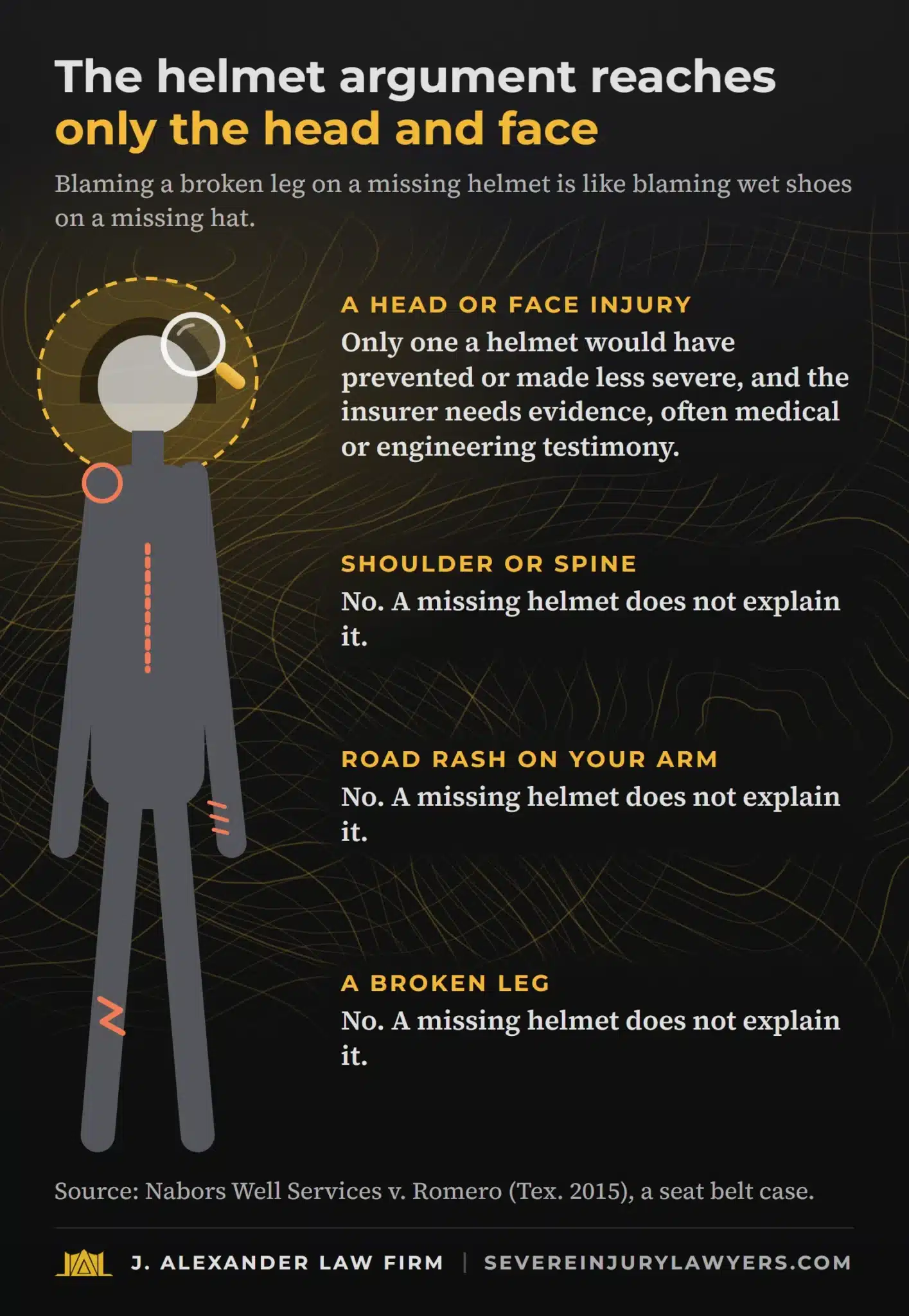
The insurer's helmet argument can affect only a head or face injury that a helmet would have prevented or made less severe. The insurer needs evidence to support that point, often medical or engineering testimony. The argument cannot reach injuries a helmet could not have changed, such as a broken leg or road rash.
If something you did before a crash caused or contributed to your own injuries, a Texas jury can hear relevant evidence about it. That rule comes from Nabors Well Services v. Romero, a 2015 Texas Supreme Court case about seat belts, not helmets.
Though the rules differ for people in cars, I expect insurers to use that reasoning against motorcycle riders. Read how a missing seat belt affects a Texas claim.
In the seat belt case, the other side had to connect the injury to not wearing a belt. The judge should first examine that proof without the jury in the room. Medical or engineering testimony is often needed, but not in every case. Before accepting an insurer's helmet argument, we need to know what medical or engineering evidence supports it.
If an adjuster says your missing helmet affects your whole claim, I ask what evidence connects it to each injury. Say the crash broke your leg, hurt your shoulder or spine, and left road rash on your arm.
Blaming a broken leg on a missing helmet is like blaming wet shoes on a missing hat. A missing helmet does not explain any of those injuries.
Read it as text
Blaming a broken leg on a missing helmet is like blaming wet shoes on a missing hat.
- Injury: A head or face injury Can the helmet argument reach it?: Only one a helmet would have prevented or made less severe, and the insurer needs evidence, often medical or engineering testimony.
- Injury: Shoulder or spine Can the helmet argument reach it?: No. A missing helmet does not explain it.
- Injury: Road rash on your arm Can the helmet argument reach it?: No. A missing helmet does not explain it.
- Injury: A broken leg Can the helmet argument reach it?: No. A missing helmet does not explain it.
Nabors Well Services v. Romero (Tex. 2015), a seat belt case.
Being exempt from the helmet law does not necessarily end the argument. The seat belt ruling lets a jury consider whether someone who broke no law used reasonable care. That does not mean the person caused the collision. I prepare an answer for each injury even when the rider was exempt.
Are you under 21? If so, you broke the helmet rule whether you were driving or riding as a passenger. Even so, the seat belt ruling's reasoning limits the helmet argument to injuries a helmet could have prevented or made less severe. Your overall share of responsibility still determines whether you can recover.
Is the adjuster tying your whole claim to the missing helmet? Walk me through each injury and what the records show.
Call 469-807-7480What does the helmet code on a Texas crash report mean?
Texas crash reports include a helmet use field. Its choices include not worn, worn and damaged, and worn without damage.
A report can be wrong about helmet use. If you wore a helmet but the report says you did not, I use the helmet, photographs and ambulance or hospital records to ask for a correction.
When you call us about your motorcycle wreck, we ask for the report early and look at the helmet box. To understand those entries, use our Texas crash report decoder.
In one helmet camera case, video captured a car entering the path of a young rider. No police report documented the collision.
Keep your helmet, gear and motorcycle as they were after the crash. Do not clean, repair or throw them away. Keep any photographs and camera video you have.
Does the crash report mark your helmet as not worn when you wore one? Bring me the report and the helmet.
Call 469-807-7480What kind of motorcycle helmet is legal in Texas?
A motorcycle helmet in Texas should meet FMVSS 218, the federal safety standard for motorcycle helmets.
Choose a helmet that fits snugly and fasten it when you ride. Check it for cracks, loose padding, frayed straps and exposed metal. If the strap was not fastened or the helmet did not meet the standard, I expect the insurer to bring that up.
If your helmet met the standard and was fastened, the missing helmet argument does not apply. Evidence still matters in deciding who caused the wreck.
What should I do after a motorcycle accident without a helmet in Texas?
Get examined and make sure each injury is recorded. Keep proof of any exemption that applied when you rode without a helmet.
Put your health first. Medical records made soon after the wreck document where you were hurt and can help us determine whether a helmet could have made a difference to a particular injury. Our case managers request your medical records and crash report.
For a Texas motorcycle injury, you usually have until the wreck's second anniversary to file a lawsuit. An exception may change your deadline. Let us check it now instead of waiting for the helmet dispute to finish. Read more about Texas crash filing deadlines.
When the other driver's adjuster asks to record you discussing your helmet use or sends a release, come to me or our Texas motorcycle accident lawyers before you respond. You can also watch the video about calls from adjusters after crashes to learn what to expect. Bring your questions to any member of our team, and an attorney can answer the legal ones.
Example
Motorcycle passenger without a helmet
Take a woman in her twenties sitting in a hospital hallway the morning after a Texas motorcycle crash. She rode behind her husband without a helmet.
Her wrist is splinted, her shins are scraped, and she has stitches above one eyebrow. She wants to know whether riding bareheaded means she cannot be paid.
I would check her age when she rode. Under section 661.003, a passenger at least 21 can qualify for an exception if she completed an approved motorcycle safety course or had a health plan covering motorcycle crash injuries. Keep the course certificate or proof of coverage that applied when the crash happened.
An adjuster might argue that the missing helmet made an injury worse. The insurer may draw on a Texas seat belt decision, even if she qualified for the helmet exception.
That decision dealt with seat belts, not motorcycle helmets. Riding bareheaded alone does not establish that she caused the crash.
I would consider her injuries one by one. Asking whether a helmet could have changed a wrist injury is like checking a smoke detector after a pipe bursts.
The detector matters for fire damage. A helmet question calls for evidence about an injury the helmet could have prevented or reduced.
Medical or engineering testimony may help make that connection.
A person's overall share of responsibility can affect a recovery. Her wrist and shins are outside the helmet argument, but an assigned share could still affect the claim as a whole. Even the cut above her eye needs evidence connecting it to the missing helmet before that argument can count against her.
24/7 | Free consultation | No fee unless we win
Helmet or no helmet, bring me the crash report.
J. Alexander Law serves injured clients throughout Texas: Dallas | Houston | San Antonio | Fort Worth | Arlington | Canton. Se habla español.