



Short answer
What are the 5 rules for hours of service regulations?
The five rules cover driving time, the duty window, rest before driving, a break and weekly duty hours. Under federal rules, a driver normally can drive for 11 hours after 10 uninterrupted hours off duty. Driving must stop once 14 hours have passed since the driver came on duty. For a trip within Texas, a driver usually can drive for 12 hours after 8 uninterrupted hours off duty, but must stop driving after 15 hours on duty. The trucking company's conduct may matter in a fatigue claim because a carrier generally cannot allow a driver to exceed these limits.
On a freight trip crossing state lines, a truck driver can usually spend 11 hours driving during a 14 hour window. A truck driver whose trip stays within Texas can usually drive 12 hours. After a Texas truck crash, I review the log alongside supporting trip records hour by hour to work out which driving limit applied and whether the truck driver followed it. The trucking company generally needs to keep those records for only six months, so making sure they are preserved is my first job on a truck driver fatigue claim.
Driving time is the time a driver spends behind the wheel. Under 49 CFR 395.3(a)(3)(ii), property carrying truck drivers generally need a 30 minute interruption after 8 hours of driving. Off duty, sleeper berth and working without driving time can count, alone or combined.
Qualifying short haul drivers are excepted. The duty clock starts when the driver comes on duty and keeps running during other work, even when the truck is stopped.
The log may show that a driver stayed within one limit but went over the other, so both need a close look.
Truck driver hour limits: federal rule and Texas intrastate rule | 49 CFR 395.3 and 37 Tex. Admin. Code 4.12, as set out in the Texas DPS guide A Texas Motor Carrier's Guide to Highway Safety (revised May 2021). Property carrying trucks.
| Rule | Truck crossing state lines (federal rule) | Truck staying inside Texas (intrastate rule) |
|---|---|---|
| 1. Driving limit | 11 hours | 12 hours |
| 2. Duty window | Driving stops 14 hours after the driver comes on duty | Driving stops when 15 duty hours are reached |
| 3. Rest before driving | 10 consecutive hours off duty | 8 consecutive hours off duty |
| 4. Break | 30 consecutive minutes once 8 hours of driving time have passed | Not required |
| 5. Weekly cap | 60 hours on duty across 7 days, or 70 hours across 8, restarted by 34 consecutive hours off duty | 70 hours in 7 days, with a 34 hour off duty restart |
Exceptions exist for short haul drivers, sleeper berth rest and some industries, so the log decides which limit applied on the day of a crash.
A driver's daily log totals may look fine, but the entries could show that the driver was well into the duty window or past a limit when the truck crashed. That's why I look at each hour leading up to the wreck, not just the daily totals.
Think of a bank account with enough money at month's end, even though its balance dipped below zero earlier.
A claim may seek payment from the driver or trucking company for your pain, treatment bills, and income you lost. Learn more about these types of losses at recoverable losses after a Texas wreck.
Breaking a trucker's hours limit and driving carelessly while tired are different issues. Either may support a fatigue claim. Read what Texas law says when a driver falls asleep at the wheel.
When do the hours of service regulations apply?
The truck driver's trip helps show which hours rules apply. Federal hours rules generally cover trucks hauling freight across state lines. Texas sets separate hours limits for covered trips that stay within Texas.
Once I know the kind of trip, I check the truck's weight. Federal rules can apply to an interstate truck or combination weighing 10,001 pounds or more, or rated at that weight. For a Texas intrastate trip, state rules generally cover trucks weighing or rated over 26,000 pounds. Other vehicle types may also be covered, and exceptions can apply.
I check the part of the crash report for commercial vehicles to see what kind of trip the truck was on. In our Ellis County case on Interstate 45, the report listed interstate commerce and put the actual gross weight at 80,000 pounds.
Those entries pointed me toward the federal rules. Under 49 CFR 395.3(b) and (c), drivers hauling property cannot drive after 60 duty hours in 7 consecutive days if their carrier does not operate trucks daily, or 70 in 8 days if it does.
A restart takes at least 34 consecutive hours off duty.
Your report may have similar entries, and the Texas crash report decoder shows where to find them.
A Texas intrastate driver who drives more than 12 hours or keeps driving once 15 hours on duty have passed must stay off the road for 8 straight hours.
Under 37 Texas Administrative Code Section 4.12(b)(2), covered intrastate drivers cannot drive after 70 hours working or driving in 7 consecutive days. They may restart after at least 34 consecutive hours off duty. A violation puts the driver out of service until it ends.
I review the records to see whether the driver went past either limit.
A broken hours rule can support a fatigue claim, but it does not prove the claim by itself. The driver's and trucking company's conduct still matters. In JNM Express v.
Lozano, the driver said his boss instructed him to falsify his log before a trip, and he fell asleep and crashed during that trip.
The Texas Supreme Court noted that Texas courts had considered federal trucking rules in injury cases, including whether a rule violation can itself count as negligence, known as negligence per se. The Court did not decide whether the hours violation established negligence per se in that case.
Have the crash report? Read me its commercial vehicle section so we can identify the hour rules that applied.
Call 469-807-7480What is the purpose of a log book?
A truck driver's log records the driver's on duty and off duty time across each 24 hour period. The log is the first record I ask for because it lets me compare driving and rest with the limits. Many truck drivers use an electronic logging device, or ELD, to record those hours, though some exceptions allow a different kind of record.
The formal name for a log is a record of duty status. When a carrier must use an ELD, it has to choose one from the federal registered list. Under 49 CFR 395.26, the device records details automatically, including the date, time, location, miles and engine hours.
Those details let me compare the device's entries with what the driver entered. While the truck is moving, the device makes an entry at least once an hour if the driver's duty status has not changed.
The federal ELD compliance date was December 18, 2017, but some truck drivers remain exempt from using an ELD, so do not assume the truck has one.
How far can a truck driver go without a log book? The rule does not set a limit based on road miles. The short haul exception uses a radius of 150 air miles from the driver's normal reporting location instead of measuring the distance driven on roads.
To use the short haul exception, the truck driver generally has to return to the reporting location and be released within 14 consecutive hours. The carrier has to keep time records for six months, noting when the driver reports, the total hours on duty and the release time.
If the carrier says the truck driver used the exception, I ask for those records because they show the driver's hours when there is no daily log.
A local delivery or dump truck driver may have time records instead of a daily log. Our plain word trucking terms can help you identify unfamiliar records.
Can truck drivers falsify electronic logs?
Yes. A truck driver can falsify a paper or electronic log, even though federal rules forbid false reports about duty status and require the original ELD information to stay stored. Since a log can be wrong, I read it alongside the other records the trip produced.
I compare the driver's log with fuel receipts, dispatch messages and other trip records. Say a fuel receipt is stamped at an hour the log shows the driver resting in the sleeper berth. That mismatch may mean the log is wrong for that hour.
If the driver was working then, the driver may have had less rest than the rules call for.
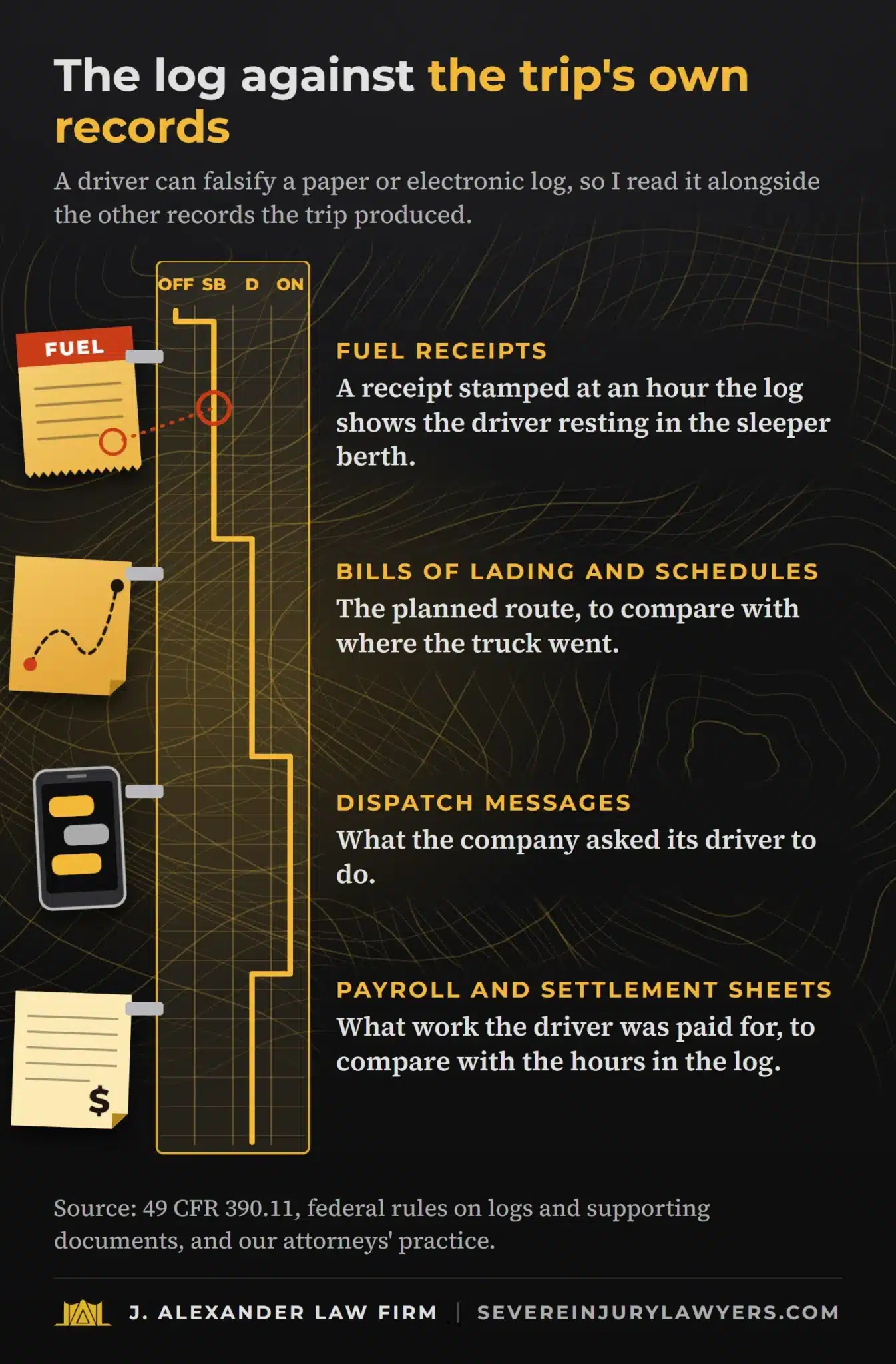
Read it as text
A driver can falsify a paper or electronic log, so I read it alongside the other records the trip produced.
- The record: Fuel receipts What it can show: A receipt stamped at an hour the log shows the driver resting in the sleeper berth.
- The record: Bills of lading and schedules What it can show: The planned route, to compare with where the truck went.
- The record: Dispatch messages What it can show: What the company asked its driver to do.
- The record: Payroll and settlement sheets What it can show: What work the driver was paid for, to compare with the hours in the log.
49 CFR 390.11, federal rules on logs and supporting documents, and our attorneys' practice.
Federal rules require carriers to keep certain supporting documents they create or receive while doing business (49 CFR 395.11). Dispatch messages can show what the company asked its driver to do. A carrier cannot pressure a driver to sign off on a false log.
Under 49 CFR 390.11, the company must also require drivers to follow the rules that apply to them. Even if the company says the driver's hours were entirely the driver's doing, the company's duty still matters.
A carrier generally has to keep logs and supporting documents for only six months from receipt. In most cases, the lawsuit deadline is two years, so those records may be gone by then without the carrier violating that retention rule.
That gap is why preserving the records comes first for me. Someone who knowingly falsifies a log may be prosecuted for a crime.
Once a company truck is in a wreck, the carrier starts safeguarding its own records. When fatigue may be involved, we send our preservation letter on the same day you hire us. It gives the company written notice to keep the truck and trailer, electronic data, driver's logs and dash camera video.
The trucking accident claims guide explains more about records a carrier may hold. The records I compare with the log include:
- Bills of lading, itineraries and schedules can show the planned route. Comparing them with the driver's log helps me see where the truck was scheduled to go and where it went.
- Dispatch and trip records can help show the location of the driver and truck at a given hour.
- Expense receipts, including fuel receipts, can show activity during an hour the log marks as rest.
- Messages between the trucking company and its driver can reveal the instructions the driver received and how the driver replied.
- Payroll records and settlement sheets can show what work the driver was paid for. We can compare that with the hours the driver listed in the log.
Think the driver's log does not match the trip? Let me know what caught your attention and when.
Call 469-807-7480Can you prove truck driver fatigue caused an accident?
Yes. The proof can include the officer's report, camera footage, and trip records. In our Interstate 45 case, the officer listed fatigue or sleep as a factor, and video from the truck showed the driver sleeping.
Under 49 CFR 392.3, a driver generally cannot drive when fatigue makes driving unsafe. The rule also says a carrier cannot require or allow that driving. That matters when a company lets a worn out driver keep going.
This year, in crashes dated up to November 9, 2026, CRIS shows officers marked 'fatigued or asleep' for a commercial motor vehicle driver in 294 reportable Texas crashes, including 3 fatal crashes, but 294 is a floor because recent crash reports are still being filed and the count will rise.
Of those crashes, 123 (41.8%) happened in the six hours before 6:00 a.m., and the hour with the most was 6:00 to 6:59 a.m., with 34.
The only fatigue entry in CRIS, 'fatigued or asleep,' is an officer's judgment about that driver, not proof that fatigue caused the crash or a finding of fault.
CRIS does not publicly track driver duty time, hours of service or log books, so only the driver's log and trip records can show whether the hour limits were kept.
When Matthew worked truck claims for insurers, he saw them collect a driver's logs and related trip records soon after a crash. Since the other side gets those records early, I ask for them early too, while the trucking company still has to keep them.
Commercial vehicle drivers marked 'fatigued or asleep' in Texas crashes, by hour, 2026 to November 9 | TxDOT CRIS public query, January 1 to November 9, 2026, pulled November 11, 2026
| Hour of the crash | Crashes | Suspected serious injury crashes |
|---|---|---|
| 12:00 to 12:59 a.m. | 17 | 1 |
| 1:00 to 1:59 a.m. | 16 | 1 |
| 2:00 to 2:59 a.m. | 20 | 2 |
| 3:00 to 3:59 a.m. | 27 | 2 |
| 4:00 to 4:59 a.m. | 22 | 4 |
| 5:00 to 5:59 a.m. | 21 | 1 |
| 6:00 to 6:59 a.m. | 34 | 1 |
| 7:00 to 7:59 a.m. | 21 | 2 |
| All hours | 294 | 22 |
Only the eight hours from midnight to 7:59 a.m. are listed, so those rows fall short of the all hours total. Counts this small can swap places with a handful of late reports, so the hours are not ranked.
A driver may follow the hours shown in the log and still be too fatigued to drive safely. But going over an hour limit alone does not show that fatigue caused the crash. I look for evidence connecting fatigue to the collision, including camera video, the officer's account, and when it happened.
How We Showed Driver Fatigue
For our case on Interstate 45, both the officer's report and the truck camera supplied evidence about whether the driver was tired.
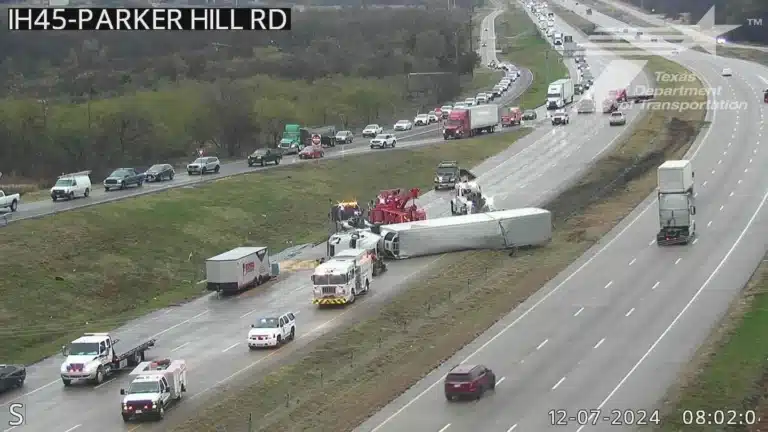
Near Palmer in Ellis County, on I-45
Truck Driver Asleep Before Fatal Crash
Before sunrise in 2024, the driver nodded off while driving.
The tractor trailer crossed all lanes, hit the median cable barrier, rolled onto its side, and came to rest across two lanes.
A man on his way to work struck the overturned truck and died there.
The officer recorded the driver as fatigued or asleep, while video from the truck's dashboard camera captured him asleep at the wheel. We represented his family and estate. The case resolved while the lawsuit was underway.
Call me about your truck driver fatigue concerns. Call 469-807-7480
Who is at fault if you hit a truck parked on the shoulder?
A crash with a parked 18 wheeler does not, by itself, put all the fault on you. The truck's location, why the driver stopped, and whether warning devices were in place can all affect fault. We can review the driver's log to see if it helps establish when the stop happened.
A driver may pull onto an improved right shoulder to stop or park when doing so is necessary and safe (Transportation Code section 545.058(a)). If the truck was left in the traveled lanes, different rules apply outside business and residential districts.
Outside those districts, a driver generally may leave a truck in the traveled lanes only when all three conditions are met (section 545.301(a)). Pulling off the roadway must be impracticable, passing traffic must have clear space, and the truck must be visible for at least 200 feet in both directions. I consider each condition when reviewing the stop.
When a truck stops on a highway or shoulder for a reason other than traffic, its flashers must go on immediately, and warning devices must be placed within 10 minutes (49 CFR 392.22).
On a divided highway, one device goes on the traffic side, within 10 feet of the truck's rear. The other two go behind it at 100 and 200 feet, in the lane or shoulder it occupies.
That spacing gives drivers coming up behind the truck a warning before they reach it.
Where did the truck stop, and how long had it been there? Why did the driver choose that spot? Were the flashers on and the warning devices in place? The answers can matter as much to fault as the duty hours recorded in the log.
When a truck driver reaches the driving limit, federal rules generally call for 10 straight hours off duty. For trips entirely within Texas, the state generally calls for 8 straight hours off duty.
Needing rest does not change the rules about where the driver can stop or how to warn traffic. If some fault for hitting the truck is assigned to you, our Texas comparative fault rules page explains what that means for your claim.
For the time allowed to file a lawsuit and possible exceptions, read the Texas filing deadline rules.
Save the crash report, and write down the carrier's name and USDOT number. That number tells us whose records to request. If the truck's insurer wants to record you or sends you a release, let me review it before you respond.
For more about those conversations, read calls from adjusters after a wreck. You can bring questions about driver hours or logs to anyone on our team, and our intake team or your case manager will pass them to me.
Example
Truck driver hours after a crash
Imagine sitting on a guardrail before dawn after an 18 wheeler drifts across your lane. In the dark, you watch the truck driver rub his eyes and climb slowly down from the cab. You wonder if he was too tired to drive.
I would start with the freight trip and the truck. A covered trip across state lines generally follows federal hours rules.
A covered trip entirely within Texas generally follows the state's separate limits. Exceptions can matter.
For a covered interstate trip, I would trace each hour from the start of duty and count the driving time separately. The usual limits are 11 hours driving and a 14 hour window after coming on duty.
Think of a parking meter inside a garage that locks at a set hour. Time left on the meter does not help once the garage closes.
A driver with only 10 hours behind the wheel may still be past the duty window. For a covered Texas trip, I would check the 12 hour driving limit and the 15 hours allowed on duty.
Next, I would compare the log with fuel receipts and dispatch messages, hour by hour. A receipt stamped during logged rest may raise a question about that entry.
Carriers generally must retain logs and supporting records for six months after receipt. That is why we send a preservation letter when you hire us.
You may worry that you cannot prove the driver was tired. Going over an hours limit alone does not establish that fatigue caused the crash. What you saw at the cab and the time of the wreck can matter, along with the records we ask the carrier to keep.
Blamed for hitting a truck parked on the shoulder? Let me check how the truck was lit and marked.
Call 469-807-748024/7 | Free consultation | No fee unless we win
Give me the truck's DOT number, and I will ask for its logs.
J. Alexander Law serves injured clients throughout Texas: Dallas | Houston | San Antonio | Fort Worth | Arlington | Canton. Se habla español.