


The short answer
No. Adults may drive in Texas wearing headphones or earbuds. Section 545.156 still requires drivers to yield when an emergency vehicle approaches immediately with its required signals on. A fine can follow a conviction for not yielding the required passage to an emergency vehicle. When the failure to yield causes a collision that injures someone else, section 542.4045 sets a different fine. In an earbud claim, my first question is whether missing a siren or horn changed how the crash happened.
Key points
A police car using a lawful siren or lights can bring the yield rule into play.
Move as near the right edge as you can and stay clear of intersections.
Remain stopped until the emergency vehicle passes, unless an officer gives different directions.
Texas does not issue a ticket just for driving in earbuds.
Can wearing earbuds make you at fault in a Texas crash?
When a Texas wreck brings up questions about a driver's attention or response to an emergency vehicle, I consider whether earbuds played a part. Adults can drive with headphones, earphones, earbuds or AirPods in one ear or both, so I look at the driving itself. Texas Transportation Code Section 545.4251 prohibits using a phone to read or send messages while driving unless stopped. Using the phone to start music is an affirmative defense under that section. Texas traffic law has no separate earbud rule for commercial drivers, though our truck driver cell phone rules discussion covers federal phone rules. Teens face a stricter phone rule, and some cities limit phone use. You can read about both in our discussion of whether Texas is a hands free state.
When an ambulance or fire truck approaches immediately with its siren and lights on, drivers must yield. Keep your car parallel to the road and pull as close as you can to its right edge or curb, away from intersections. Unless a police officer gives other directions, stay stopped there until the vehicle has gone by. The same duty applies if a police car approaches immediately using its siren or lights lawfully. For a stopped ambulance, police car, tow truck or qualifying TxDOT vehicle using required signals, Section 545.157 applies even without a siren. Unless an officer directs otherwise, leave the closest lane if at least two lanes go your way, or slow down. I check for lights a driver might have seen ahead or in the mirrors, since earbuds may block a siren without blocking the flashing lights. Slowing down under Section 545.157 means going 5 mph or less where the limit is under 25 mph, and at least 20 mph below the limit elsewhere. A first violation brings a $500 to $1,250 fine, or a Class A misdemeanor when it causes bodily injury to someone else.
Read it as text
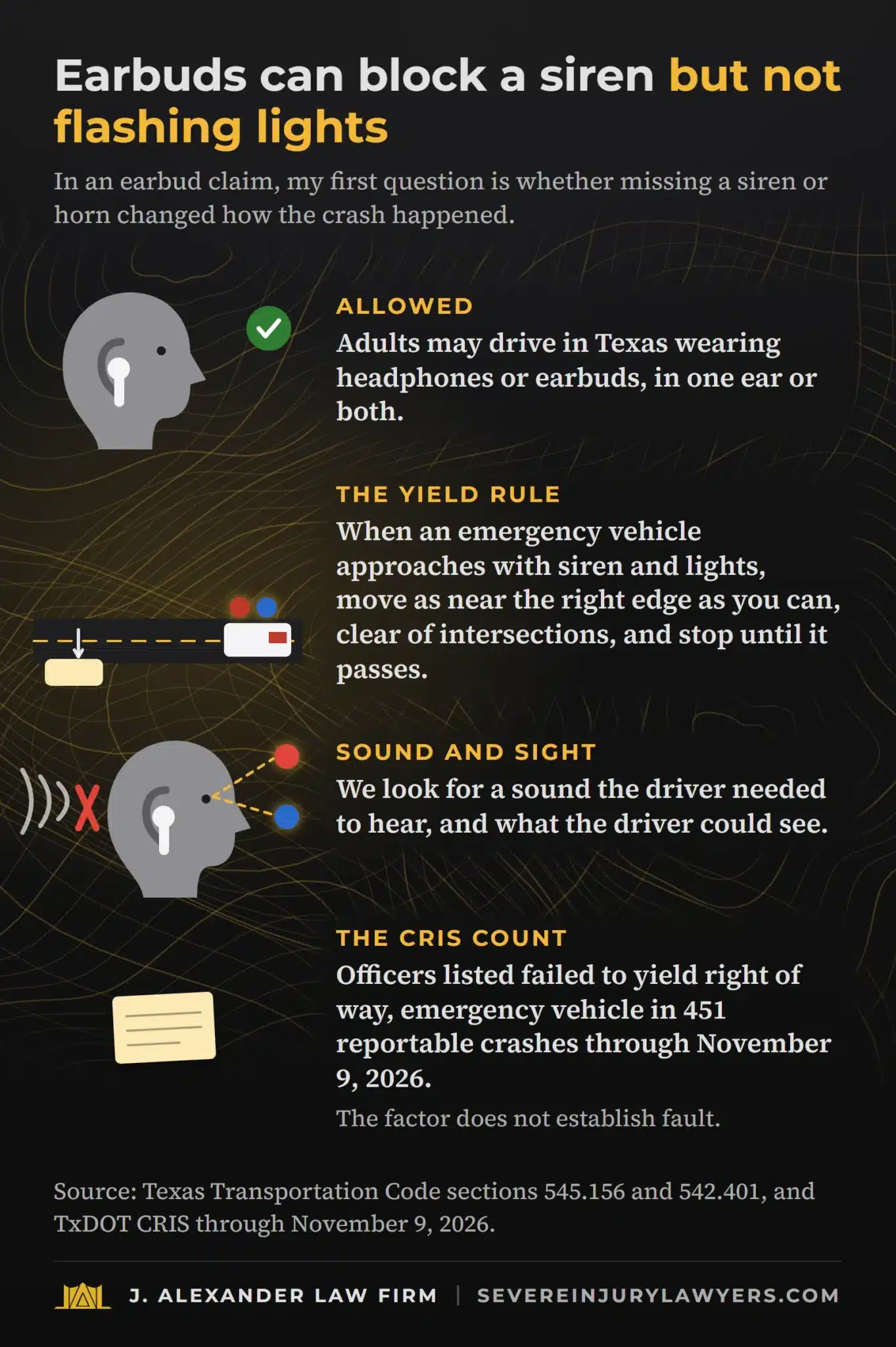
In an earbud claim, my first question is whether missing a siren or horn changed how the crash happened.
- Allowed: Adults may drive in Texas wearing headphones or earbuds, in one ear or both.
- The yield rule: As an emergency vehicle approaches with its siren and lights on, pull close to the right edge, stay clear of intersections and stop until it passes.
- Sound and sight: We look for a sound the driver needed to hear, and what the driver could see.
- The CRIS count: Officers listed failed to yield right of way, emergency vehicle in 451 reportable crashes through November 9, 2026. The factor does not establish fault.
Texas Transportation Code sections 545.156 and 542.401, and TxDOT CRIS through November 9, 2026.
Our TxDOT CRIS search found 451 reportable Texas crashes from January 1 through November 9, 2026, with the factor "failed to yield right of way, emergency vehicle" recorded by officers. During the corresponding months of 2025, the figure was 518. The factor officers recorded does not prove fault, and without a headphones or earbuds field in CRIS, the figures cannot show whether drivers wore them. The 2026 count is incomplete while reports continue to arrive, and we cannot yet compare the 2026 figure with 2025. Our discussion of crashes involving government vehicles covers claims involving ambulances, police cars and other government vehicles.
Matthew Graham worked in insurance prior to joining our firm and saw insurers cite earbuds as evidence of distraction, including in wrecks where sound had no role. We look for a sound the driver needed to hear and whether witnesses, dash camera audio or the driver's words at the scene show the driver missed the sound. Say a driver wearing two earbuds enters an intersection as a fire truck comes through with its siren sounding and lights flashing. Earbuds can muffle a siren like a closed window, but the driver's eyes can still catch the flashing lights. If the driver could see the lights in time, the driver had to yield regardless of what was playing, unless a police officer directed otherwise.
Fault in a Texas crash depends on what both drivers did, including how each responded to an emergency vehicle. An earbud crash claim can be affected by a driver's traffic violation. I check whether the driver yielded to an ambulance, fire truck or police car when required. A claim can rest on a missed yield without evidence of earbuds, provided the missed yield is linked to the crash and injuries. An earbud wearer may share blame, and our share of responsibility discussion explains the effect on a claim. Without a yield violation, I look at whether the earbud wearer paid the attention reasonable care required.
An injury claim after a Texas wreck may include pay missed from work, treatment bills and changes to everyday life, even if earbuds played no part in the crash. While the earbud question is being sorted out, our office keeps track of the two year clock in section 16.003.
Example
Earbuds and a Texas crash
Picture yourself driving through a Texas intersection with earbuds in. A fire truck approaches with its lights flashing and siren sounding.
You collide with the truck and are hurt. Later, its insurer asks about your earbuds.
The officer might mark a failure to yield on the Texas crash report. I take that entry seriously, but it does not decide fault by itself. A report is a snapshot of the officer's findings, not a recording of every moment leading up to the crash.
The insurer may argue that your earbuds kept you from hearing the siren and that you should have yielded. An adult can legally drive with earbuds in Texas. The question is whether wearing them affected your response and contributed to the crash.
My first look is at section 545.156 and what happened as the fire truck approached. The rule requires a driver to yield when a fire truck approaches immediately with the required signals, unless an officer directs otherwise.
Could you hear the siren or see the lights in time? Save any dash camera audio and note what you recall about the signals, your earbuds and any directions from an officer.
Both drivers' actions matter when responsibility is shared. Your own conduct could affect your claim, and the fire truck driver's actions matter too. Wearing earbuds alone does not settle the question, even if the adjuster brings them up.
Read next on our site
You can also read about your duties under car accident laws in Texas.