



Short answer
Who has the right of way when exiting a highway in Texas?
In Texas, drivers on the frontage road must yield to a vehicle exiting the highway. You may call the frontage road a feeder, service road or access road. Section 545.154 of the Texas Transportation Code requires frontage road drivers to yield to vehicles entering or about to enter from the highway. They must also yield to vehicles leaving or about to leave the frontage road for the highway. Think of a person lawfully stepping off the curb into a crosswalk: traffic already on the road must wait, just as frontage road traffic must wait for the car coming down the ramp. When two cars meet at a ramp, that rule is where I begin.
In Texas, drivers on a frontage road must yield at the ramps to a driver exiting the highway. The answer is different at a turnaround, a red light or a side street. The point of impact after a frontage road crash helps me determine who had the duty to yield.
Does the crash location matter?
The answer changes with the location. Your crash may have happened at a turnaround beneath an overpass, a light at a cross street, or a side street or driveway. The table shows which driver must yield at each spot.
Knowing who had to yield is only the first half. After a ramp crash, our team collects proof of both drivers' actions to assess how Texas law allocates fault under its 51 percent rule.
Who yields on a Texas frontage road, by spot | Texas Transportation Code sections 545.154 and 545.060(a). Texas Department of Transportation, Sign Guidelines and Applications Manual. Texas Department of Public Safety, Texas Driver Handbook, revised January 2026, chapters 4 and 5.
| Where the two vehicles meet | Who has to wait |
|---|---|
| An exit ramp joins the frontage road | Frontage road traffic |
| A vehicle leaves the frontage road for the entrance ramp | Frontage road traffic |
| The exit ramp keeps its own lane on the frontage road | TxDOT recommends no yield sign. Each driver keeps to one lane and leaves it only when safe |
| A rural frontage road with two way traffic | Frontage road traffic, at both kinds of ramp |
| A right turn on a steady red light | The turning driver, after a full stop |
| A left turn on a steady red light, one way street onto one way street | The turning driver, once fully stopped |
| A flashing red light | Every driver facing it, after a full stop |
| A left turn on a flashing yellow arrow | The turning driver |
| Two vehicles move into the same lane where three or more lanes run one direction | The vehicle coming from the right |
Our page on yielding rules discusses stop signs, driveways and left turns across oncoming traffic.
Do you have to yield on a frontage road if there is no yield sign?
Yes. Section 545.154 puts the duty on frontage road traffic without making it depend on a sign. A missing yield sign does not by itself remove that duty.
A caller said they were struck from behind as they left SH 360 for the service road. Another described two cars already on the service road, both trying to enter the highway. To figure out which rule applies to your crash, I ask which lanes the cars occupied and where they hit.
A ramp with a separate lane
Section 545.154 does not make an exception just because an exit ramp keeps its own lane. If the ramp has its own lane and neither stream has to give way, TxDOT does not recommend a yield sign, so you may not see one.
On roads with at least two clearly marked traffic lanes, section 545.060(a) directs drivers to keep the entire vehicle inside a single lane whenever practical and cross its boundary only when safe. The ramp rule applies to rural frontage roads carrying traffic in both directions too.
Say you leave the exit ramp and a frontage road driver hits your passenger side as you move over. If the ramp kept its own lane, the defense may argue that you left it unsafely, so I look at the lane striping where the ramp ends.
What road details can help?
Photograph the signs and lane lines when you can do so safely, and include the spot where the ramp lane ends. Street view images may also show the road layout the adjuster will examine. Our team marks each car's position on that layout before I discuss fault with the adjuster, so we can test the lane argument against the road itself.
Did the exit ramp keep its own lane? Send me your photos of the lane markings.
Call 469-807-7480Who is at fault in a U turn accident in Texas?
A turning driver who does not yield to cars already in the roadway will often be at fault. In our Jersey Village case, a marked turnaround lane did not erase the duty to yield.
Who goes first at a turnaround?
A driver taking a turnaround must let vehicles already moving in the lanes ahead go first. TxDOT designs these turnarounds for highways with one way frontage roads, and their layouts differ: some give turning cars an added lane or an acceleration lane, while others end at a stop or yield sign. At your crash location, our team checks where the turnaround lane ends to see how the layout helps show who had to wait.
What crash reports show
2,210
Crossover crashes
For crashes through November 9, 2026, the crash report form does not list a U turn as a code under contributing factors or collision types. The form has a place to mark a crossover, a turnaround connecting frontage roads over or under a highway.
Reports marked a crossover in 2,210 reportable crashes. The table below shows the movements of the vehicles in those crashes.
35,709
Service and frontage road crashes
Across service and frontage roads, reports list 35,709 reportable crashes, of which 163 were fatal and 707 involved suspected serious injuries. The most common type involved vehicles sideswiping each other as both went straight in the same direction, with 5,766 crashes (16.1%).
699
Unsafe turn marks
Officers marked a vehicle as 'turned when unsafe' in 699 of those frontage road crashes. I start my review with that mark.
It is the officer's opinion, not proof that a turn caused the crash. It does not decide which driver had to yield or was at fault.
TxDOT is still receiving recent reports, so the 2026 counts are incomplete and crashes will be added to the 35,709 and 2,210 counts.
Other places to turn
At an intersection
Callers have also described U turn crashes outside turnarounds. One said a driver made a prohibited U turn as the caller's light was green.
Another described a van blocking the turning driver's view. A No U Turn sign prohibits that move at the intersection.
In crashes like these, we check the sign, signal and what each driver could see.
Curves and hills
You cannot turn around as you approach a curve or the crest of a hill if a driver approaching from either direction could not see your vehicle within 500 feet. That rule is in section 545.102.
Section 545.103 permits a driver to turn from a straight course only when the turn can be made safely. On a divided highway, section 545.063(b) allows a driver to cross the dividing space or barrier only through an opening or at a crossover or intersection established by a public authority.
Breaking a traffic rule can matter to fault, as discussed in how a traffic ticket affects fault in Texas.
A wide median
A wide median calls for another look: when the two roadways of a divided highway are at least 30 feet apart, Transportation Code section 541.303(c) treats each meeting with a crossing road as a separate intersection. At that kind of divided highway, I check each crossing's stop and yield rules on its own after a crash.
Care records
A Jersey Village case
Laura Rivas, our Senior Associate Attorney, handled the Jersey Village case. When the other side points to an older back or neck condition, she asks what the crash made worse. In the Jersey Village case, care records beginning six days after the crash helped answer that question.
How the vehicles met in Texas crashes at a frontage road turnaround, 2026 to November 9 | TxDOT CRIS public query, January 1 to November 9, 2026, pulled November 11, 2026
| Manner of collision | Crashes | Fatal crashes | Suspected serious injury crashes |
|---|---|---|---|
| Angle, one turning left and the other straight | 761 | 0 | 9 |
| Same direction, one moving and one stopped | 380 | 0 | 2 |
| Rear end, both moving straight | 267 | 0 | 1 |
| Single vehicle, going straight | 225 | 1 | 7 |
| Single vehicle, turning left | 142 | 0 | 1 |
| Every crash at the turnaround | 2,210 | 1 | 27 |
The turnaround is the report's physical feature 'crossover from one frontage road to other'. Five of the most frequent movements are listed, so those rows come to less than the total.
US 290 Minivan U Turn Without Yielding
The card below sums up that Jersey Village case.
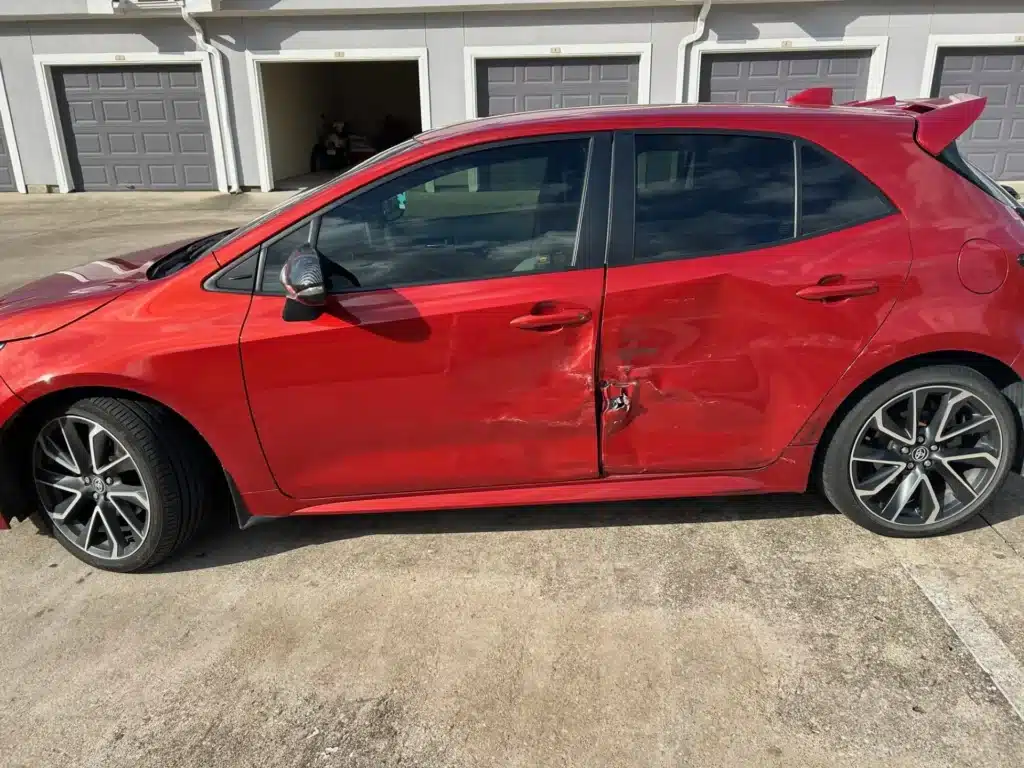
Jersey Village, US 290 service road
Minivan in a U Turn Lane
In 2023, our client made a left turn from Jones Road and entered the US 290 service road, traveling west in Jersey Village.
The road carried traffic in one direction, and its posted speed limit was 45 mph.
A minivan coming from the eastbound side took the marked U turn lane and struck her car on the driver side without yielding.
On the report, the officer entered the minivan driver's failure to yield while making the left turn as a contributing factor, with driver inattention entered as a possible one.
We brought a lawsuit, which ended in a settlement before trial.
A driver hit you coming out of a turnaround? Let's review the officer's account together when you bring your crash report.
Call 469-807-7480Who is at fault in a right turn on red accident in Texas?
Turning right on red without stopping or yielding often puts the turning driver at fault. The driver must first stop, then yield to pedestrians and sidewalk users lawfully in the adjacent crosswalk and to traffic lawfully using the intersection.
Can a driver turn left on red?
A frontage road signal may stand at a cross street above or below the highway. A driver making a permitted left turn on red between one way streets must also stop and yield. To find the rule that applies, I first check the signals and any posted turn restrictions.
What does a flashing red light mean?
A flashing red light requires a full stop. The driver may then proceed under the rules for a stop sign. Traffic on the crossing road may not have to stop, so the signals facing both drivers matter.
Two caller accounts
A signal on US 75
One caller on a US 75 feeder said a vehicle crossing the overpass street struck the caller's car when the signal was green. Our team checks the signal facing each driver and looks for witness names because a witness or video may show who had the green.
A rear impact
Another caller said a vehicle struck the caller's car at a red light while the caller looked left for a gap. The rule asks a driver to wait for a safe opening before turning right, so the rear impact raises a separate fault question about the driver behind.
Who is at fault if a driver pulls out of a side street onto the frontage road?
Pulling out without yielding often puts that driver at fault. Texas Transportation Code section 545.153(b) says a driver facing a stop sign must stop, then let vehicles already in the intersection from another road go first. The driver must also yield to a vehicle approaching so close that entering or crossing the intersection would create an immediate hazard. An officer or traffic control device can direct them to proceed instead.
Where should a right turn end?
When turning right at an intersection, stay as close as practical to the right curb or edge of the road, both on approach and throughout the turn. That rule comes from section 545.101(a), and I compare the turning car's final position with your crash report. Our El Paso case below shows why the car's position matters.
What about other road layouts?
Driveways, parking lot exits, stop signs and left turns each have their own rule. If a road has three lanes and carries traffic both ways, section 545.060(b) limits the center lane to passing when the lane is clear for a safe distance, preparing to turn left, or traveling in a direction assigned to that lane by a traffic control device.
More yield rules
- For the other situations, see the Texas failure to yield rules for stop signs, left turns and driveways.
Stop Sign Right Turn onto I-10 Access Road
In our El Paso case, the crash report and vehicle damage helped address fault without a witness or video.
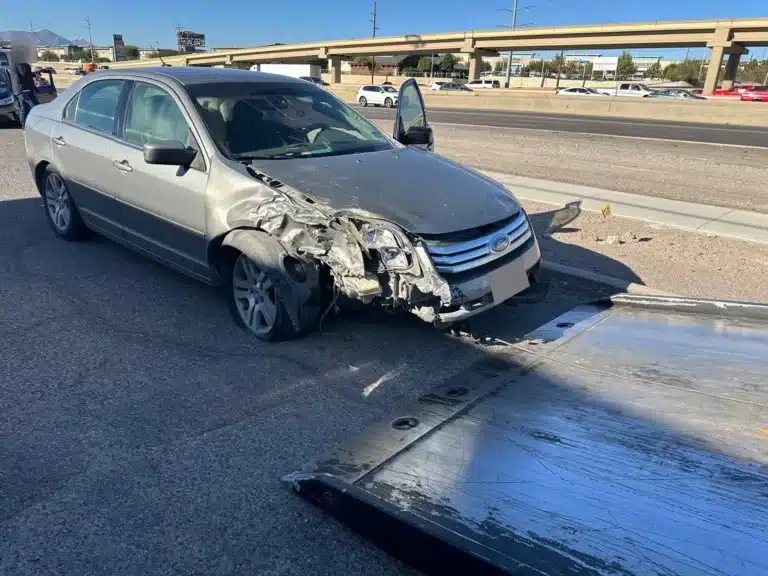
El Paso, Gateway East at Roswell
Right Turn at Roswell
Our client was heading east in lane 1 of Gateway East, a one way access road with three lanes beside I-10 in El Paso, posted at 45 mph.
Traveling north on Roswell, the other driver turned right at the stop sign onto Gateway East, leaving her car angled across his lane. No witness or camera recorded the crash.
The officer assigned the stop sign failure to yield code only to her car and issued her a citation.
Her insurer paid the policy's full limit, so there was no need to file a lawsuit.
The officer's diagram placed the turning car angled into the lane farthest from Roswell, and damage to both cars fit that drawing.
How do insurers decide who is at fault in a frontage road crash?
An adjuster reviews the report, signs, lane markings, damage, and any video and witness accounts before assigning fault shares. That assignment is the insurer's position. It is not a court decision.
One caller asked how a failure to yield entry affected a claim. Another had been told the crash could look like the caller failed to yield. Matthew Graham argued claims involving ramps and frontage roads on behalf of insurers.
He first asked whether the injured driver had drifted or switched lanes. Insurers ask that first, so our team uses the evidence below to place both cars. I answer that question first, too.
An injury claim follows a different path from a traffic fine. On the fine side, if a trial for a failure to yield offense establishes that the failure caused a crash that injured someone other than the driver, section 542.4045 sets the fine between $500 and $2,000, or between $1,000 and $4,000 when the injury is serious bodily injury. After a crash with no injuries, a driver convicted of failing to yield on a frontage road can face a traffic fine if no other penalty applies. A fine does not pay your medical bills, which is why your claim against the driver's insurer follows its own track.
The other driver's insurer may question your speed or lane and dispute fault, even when you had the right of way. Send me your report and photos of the ramp, turnaround or signal so we can determine who was required to wait before the insurer takes your account of the crash.
A claim may cover care bills, missed income, pain from injuries and mental anguish, along with other types of crash damages. For most Texas crash lawsuits, the filing window is two years, though exceptions apply, so we can go over your deadline along with the evidence.
24/7 | Free consultation | No fee unless we win
Tell me where the cars met. We can check who had to yield.
J. Alexander Law serves injured clients throughout Texas: Dallas | Houston | San Antonio | Fort Worth | Arlington | Canton. Se habla español.