$105,000 SettlementAfter a Towing Vehicle Made an Unsafe Lane Change on a Texas Highway
A vehicle towing another vehicle moved into our client’s lane on a Texas highway. The impact caused her to lose control, and her vehicle struck two highway signs.
She sought emergency care the next day and later underwent orthopedic treatment, MRI studies, chiropractic care, and a cervical epidural steroid injection. The claim resolved before a lawsuit was filed for $105,000.
Result
$105,000 pre-litigation settlement
Crash type
Unsafe lane-change collision involving a vehicle towing another vehicle
Collision sequence
Lane-change impact, loss of control, and collision with two highway signs
Vehicle damage
Client’s vehicle was later described as a total loss
Case Evidence
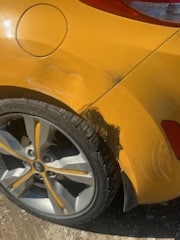
Rear passenger-side quarter panel and wheel area after the lane-change impactThe client’s car after the crash, later described as a total loss
01Case Summary
Case at a Glance
Case detail
Information
Result
$105,000 pre-litigation settlement
Crash type
Unsafe lane-change collision involving a vehicle towing another vehicle
Roadway
Texas highway with a posted 65 mph speed limit
Collision sequence
Lane-change impact, loss of control, and collision with two highway signs
Vehicle damage
The records later described the client’s vehicle as a total loss
Initial complaints
Headache, neck pain, left-shoulder pain, and left-elbow pain
Follow-up care
Pain-management and orthopedic care, MRI studies, chiropractic treatment, and a cervical epidural injection
Key findings
Partial left rotator-cuff tear and cervical disc findings
02Crash Sequence
Towing Vehicle Moved Into Client’s Lane
Our client was driving on a Texas highway with a posted 65 mph speed limit. She was wearing her seat belt.
According to the crash report, a vehicle towing another vehicle made an unsafe lane change into the client’s lane and struck her car.
After the impact, the client lost control of her vehicle and struck two highway signs.
The airbags did not deploy, and the client did not report a loss of consciousness. The records later described her vehicle as a total loss.
03Liability Evidence
Why the Unsafe Lane Change Mattered
Before changing lanes, a driver must first make sure the adjacent lane is clear. That obligation remains critical when the vehicle is towing another vehicle.
Here, the crash report describes the other vehicle as making an unsafe lane change into the client’s lane. That lane-change impact began the sequence that caused the client to lose control and strike two highway signs.
This was not simply a minor sideswipe claim. The initial collision was followed by a loss-of-control event and secondary impacts with roadside signs.
Same-direction sideswipes had one of the lowest serious crash rates of the ten crash groups compared in the Texas Crash Severity Index, 11.0 per 1,000 crashes coded serious in 2025 against a statewide figure of 33.2. A lane-change impact that ends in a loss of control and two sign strikes is a different claim from the average sideswipe, and the file had to show that difference.
04Property Damage
Vehicle Damage and Total-Loss Evidence
Available photographs show damage along the rear passenger-side quarter panel, rear wheel area, and bumper of the client’s vehicle.
The photographs preserve visible scraping, dents, panel deformation, and damage around the rear wheel area after the collision.
The medical-record summary later described the client’s vehicle as a total loss.
When a vehicle may be declared a total loss, evidence should be preserved early. Before the vehicle is moved, repaired, sold, dismantled, or destroyed, important evidence may include photographs, repair estimates, total-loss documents, tow and storage records, insurance communications, and any available inspection evidence.
05Hospital Evaluation
Emergency Treatment
The client sought emergency care on the evening after the collision.
She reported headache, neck pain, left-shoulder pain, and left-elbow pain. She had used ice but had not taken pain medication before arriving at the emergency department.
The examination documented lower-neck tenderness and muscle knots, diffuse tenderness in the left upper arm, reduced left-shoulder range of motion due to arm-muscle pain, and left-elbow tenderness.
Her neck range of motion, strength, and neurological findings were normal. CT studies of the head and cervical spine and X-rays of the left shoulder and elbow did not identify a fracture.
The emergency diagnoses included:
Neck muscle strain
Left-shoulder strain
Left-elbow contusion
Acute headache
She was discharged with ibuprofen and methocarbamol, a muscle relaxant, and was instructed to follow up for additional care.
06Follow-Up Care
Pain Management and Orthopedic Care
Four days after the collision, the client began treatment at a pain-management and orthopedic clinic.
She reported moderate neck, left-shoulder, and left-elbow pain. Her neck pain radiated toward the left shoulder, and she described intermittent tingling in her left arm.
The examination documented cervical facet tenderness, positive facet-loading tests, limited range of motion, and 4/5 left-shoulder strength.
The provider ordered MRI studies and recommended chiropractic or physical-therapy treatment. The care plan included ibuprofen, cyclobenzaprine, a topical medication, imaging, and conservative treatment.
07Shoulder Imaging
Shoulder MRI Findings
The left-shoulder MRI identified a low- to intermediate-grade partial tear of the supraspinatus tendon, one of the rotator-cuff tendons.
The MRI also described a mild or resolving bone bruise involving the humeral head.
At a later visit, the client was diagnosed with a traumatic partial rotator-cuff tear. A left-shoulder injection was considered, but she elected to defer that procedure.
By the final documented follow-up, shoulder pain remained mild to moderate with overhead reaching.
08Spine Imaging
Cervical MRI and Left-Arm Symptoms
A cervical MRI identified an annular tear with a 1 mm disc herniation at C3-4 and a 1.2 mm disc herniation at C5-6.
The MRI did not identify stenosis, fracture, slippage, or nerve-root or canal compression.
The client continued to report neck pain, numbness, and tingling in the left arm. Based on her symptoms and clinical examination, the provider diagnosed cervical radiculopathy.
During orthopedic follow-up, the client’s elbow symptoms were improving, but her neck pain and left-arm symptoms persisted.
09Injection Treatment
Cervical Epidural Injection
Because the client continued to experience neck pain and left-arm numbness and tingling, the orthopedic provider recommended a cervical epidural steroid injection.
The client expressed anxiety about the procedure and asked to discuss sedation. She later underwent a cervical epidural steroid injection at C7-T1 under local anesthesia and fluoroscopy.
The procedure was completed without complications.
At a later telephone follow-up, the client reported more than 70 percent improvement in neck pain and function. She also reported improvement in left-arm numbness and tingling.
The provider recommended a repeat injection if symptoms persisted and noted that future care could be needed.
10Conservative Care
Chiropractic Treatment
The client attended chiropractic treatment between approximately day 29 and day 50 after the collision.
At the initial chiropractic evaluation, she reported frequent neck, left-shoulder, and left-elbow pain, along with pain and numbness traveling down the left arm. She also reported trouble sleeping, stress, and anxiety about driving.
The examination documented bruising on the left shoulder, muscle spasm, 4/5 left-arm strength, and severely restricted left-shoulder and elbow range of motion. She reported missing five to six days of work.
Treatment included:
Electrical stimulation
Massage
Therapeutic exercise
At discharge, the provider documented improvement with conservative care and improved range of motion. The client was released to a home-exercise program.
The final report stated that she could be more susceptible to future flare-ups and estimated future therapy needs.
11Care Timeline
Treatment Timeline
Time after crash
Care and findings
Day 1
Emergency evaluation for headache, neck pain, left-shoulder pain, and left-elbow pain; CT and X-ray studies did not show a fracture
Day 4
Pain-management evaluation; neck pain radiating to the left shoulder and intermittent left-arm tingling; conservative treatment and MRI studies ordered
Day 13
Left-shoulder MRI identified a partial supraspinatus tendon tear and mild or resolving bone bruise
Day 19
Traumatic partial rotator-cuff tear diagnosis; shoulder injection considered
Days 30-44
Orthopedic evaluation; persistent neck pain and left-arm numbness and tingling; cervical epidural injection recommended
Day 37
Cervical MRI identified annular tear and small disc herniations
Day 53
Cervical epidural steroid injection at C7-T1
Day 63
Chiropractic discharge to home exercise after improvement with conservative treatment
Day 67
More than 70 percent improvement in neck pain and function reported
12Record Review
Medical Record Review
The records document prompt emergency treatment followed by continuing care for neck, left-shoulder, and left-elbow symptoms.
Later testing identified a partial left rotator-cuff tear and cervical disc findings. The client received pain-management and orthopedic care, medication, MRI studies, chiropractic treatment, and a cervical epidural steroid injection.
The records use different shorthand descriptions of the crash. Emergency records refer to the rear of the vehicle being clipped, clinic notes refer to a rear-end collision, and the crash report describes an unsafe lane-change collision.
The crash report’s unsafe lane-change description provides the clearest account of the mechanism in the available records: the towing vehicle moved into the client’s lane, made contact with her car, and the client then lost control and struck two highway signs.
13Case Result
$105,000 Settlement Before Lawsuit
$105,000
Pre-Litigation Settlement
The claim resolved before a lawsuit was filed for $105,000.
The resolution reflected the crash-report evidence of an unsafe lane change, the towing-vehicle involvement, the loss-of-control sequence, collision with highway signs, property-damage evidence, emergency treatment, MRI findings, orthopedic care, chiropractic treatment, and cervical epidural injection.
14Key Takeaway
What This Case Shows
A highway lane-change collision can become a multi-impact crash. The initial contact may force a driver to react quickly, lose control, or collide with roadside objects.
In this case, the crash report described an unsafe lane change by a vehicle towing another vehicle. The client then lost control and struck two highway signs.
Early evidence preservation matters, particularly when a vehicle may be totaled. Important evidence can include:
Photographs of all vehicle damage before repairs or disposal
Images of the tow arrangement, trailer, or vehicle being towed
License plates, company markings, unit numbers, and identifying information
Highway location, lane layout, roadway signs, debris, and skid marks
Crash-report information, officer findings, and citation records
Tow-yard access and inspection opportunities before a total-loss vehicle is disposed of
Medical records documenting symptoms, treatment, imaging, recovery, and future-care recommendations
15Attorney Analysis
Attorney Case Review
The liability evidence centered on the crash report’s description of an unsafe lane change. A vehicle towing another vehicle moved into the client’s lane on a Texas highway, struck her car, and began a sequence that ended when she lost control and collided with two highway signs.
The property-damage evidence helped preserve the post-crash condition of the vehicle. Available photographs show damage concentrated around the rear passenger-side quarter panel, rear wheel area, and bumper, and the records later described the vehicle as a total loss.
The medical record documented emergency treatment, continuing neck and left-arm symptoms, a partial left rotator-cuff tear, cervical disc findings, pain-management and orthopedic care, chiropractic treatment, and a cervical epidural steroid injection.
The records also documented recovery. After the cervical injection, the client reported more than 70 percent improvement in neck pain and function. A complete claim presentation should accurately address both the treatment received and the improvement documented in the medical record.
The claim resolved before litigation for $105,000.
Identifying information has been withheld to protect client privacy. Past results do not guarantee a similar outcome. Every case depends on its own facts, injuries, evidence, insurance coverage, and applicable law.
Reviewed by: Josh Alexander, Founder and Managing Attorney
If another vehicle moved into your lane on a Texas highway and caused a crash, J. Alexander Law can review the crash report, the property damage evidence and the medical records behind your claim.