


The short answer
No. Using hazard lights while moving is not a separate Texas offense, even in rain. Section 547.331 permits hazard lamps, and the rules for signaling a turn still apply. A driver convicted of breaking a signal rule may face a fine when the law sets no other penalty for that offense.
In their words
"So he was trying to make it seem like it was my fault, but how if I have my hazard light on to turn right into the alleyway, you're supposed to see that."
Caller, September 2026
Key points
Hazard lamps warn other drivers to take extra care around a vehicle.
Section 545.104 requires a continuous signal throughout the final 100 feet of movement before a turn.
A signal is also required before changing lanes or starting from a parked position.
The gap a following driver needs for a safe stop changes with how fast the vehicles are moving, how crowded the road is and the condition of the road.
Can driving with hazards on make you at fault in a Texas crash?
A signal dispute
A call about a turn
A missing turn signal can become a fault dispute even when hazard lights were flashing. On the September 2026 call quoted here, our intake team requested the caller's photos, confirmed she turned right from the middle lane and sent the information to an attorney for review.
Our answer about another driver blaming you addresses that accusation. No outcome is known from the call.
Hazard lamps flash together to warn approaching and passing drivers, but they do not show which way a driver plans to turn. Texas DPS says that if a police stop feels unsafe or you doubt the vehicle belongs to police, you can use hazards and drive slowly below the speed limit to a nearby well lit, populated place, but delaying a stop risks arrest.
Section 547.331 requires them to be visible at a distance of 500 feet or more in normal sunlight. Front lamps may be white, amber or a color between those two.
Rear lamps may be red, amber or an intermediate shade. Section 547.305(c) restricts red, white and blue flashing lights to authorized uses.
Our answer on driving with one headlight covers headlight timing.
A required turn signal may be given by hand and arm or by approved lamps, although certain larger vehicles must use lamps under section 545.106. Section 545.104 also bars using a turn signal to invite a following driver to pass.
A parked or disabled vehicle cannot have signals lit on only one side. Texas DPS says to move a broken down car off the pavement if you can, turn on the hazard lights and, at night, turn on the lights inside the car too.
Recorded signal factors
689
Reported crashes
Our review counts reportable crashes where an officer recorded a missing or wrong signal for at least one vehicle. The figures do not identify which crashes involved hazard lights.
TxDOT recorded 689 such crashes in 2026 as of November 9. The year's total is incomplete as more reports arrive, and the recorded factor does not settle fault.
167
Left turns
Of those, 167 paired a left turn with a vehicle continuing straight.
113
Right turns
Another 113 involved a right turn alongside a vehicle continuing forward. Each pair was headed the same way.
The Texas crash report has no dedicated hazard light code. In field 38, code 28 covers a missing signal or a wrong signal.
In field 39, code 8 covers turn signal lamps that are broken or missing. The narrative may contain further details.
According to Matthew Graham, officers learn at the academy to list the driver they believe caused a crash as unit one. He is the firm's Managing Litigation Attorney.
Of that position, he says, "It doesn't say that anywhere on the report".
Flashing hazards alone do not make a driver liable under Texas negligence per se rules. A missing signal can affect fault when it contributes to a crash.
The following driver's attention and distance can matter too. Our explanation of comparative fault in Texas addresses shared blame.
Talk with us before responding to the adjuster's questions or signing a document that gives up a claim. You may include medical bills and other losses from the crash in your injury claim.
Section 16.003 generally sets the deadline at two years after a claim accrues, with exceptions. Our Texas filing deadlines answer has more detail.
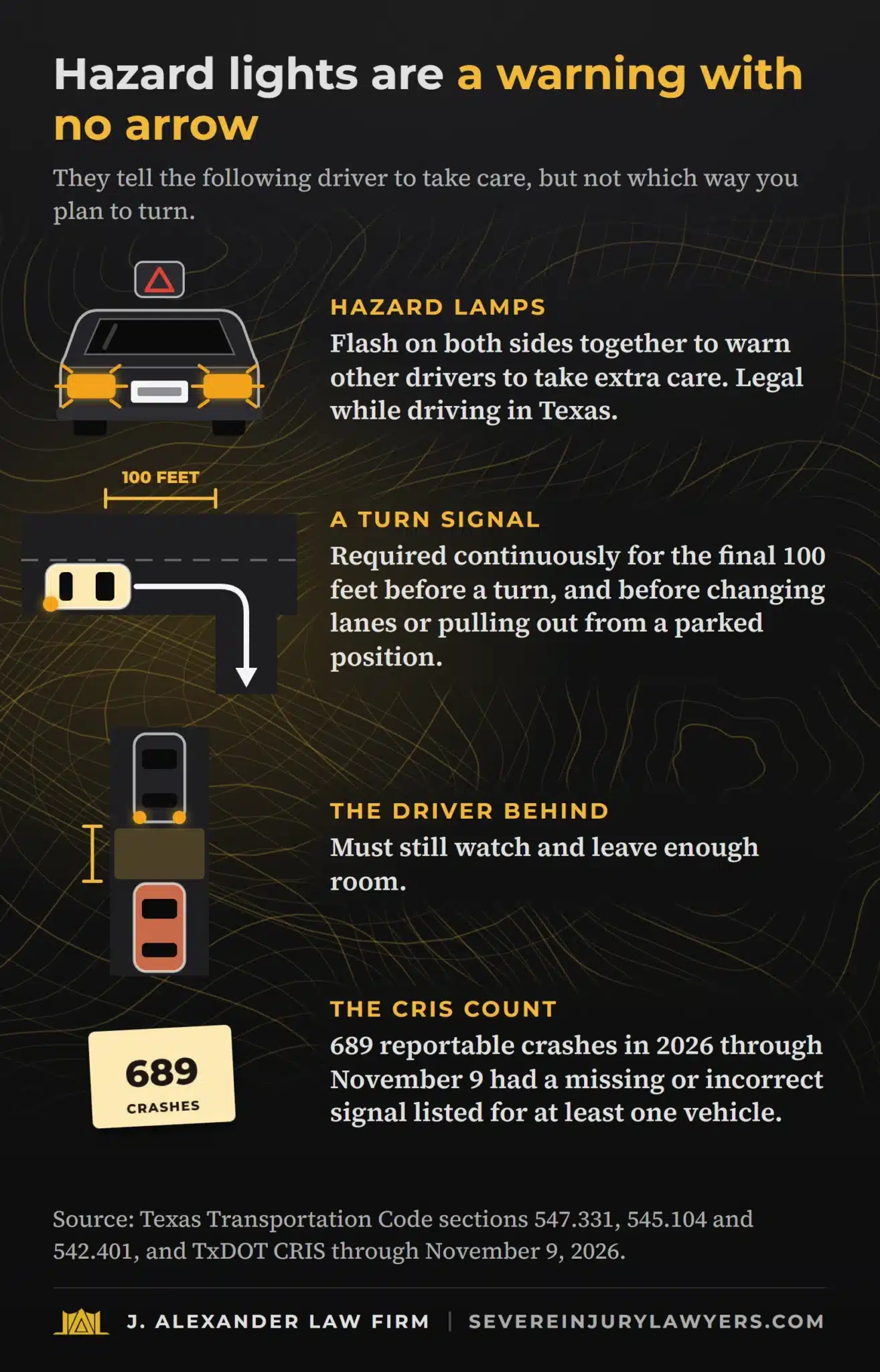
Read it as text
They tell the following driver to take care, but not which way you plan to turn.
- Hazard lamps: Flash on both sides together to warn other drivers to take extra care. Legal while driving in Texas.
- A turn signal: Required continuously for the final 100 feet before a turn, and before changing lanes or pulling out from a parked position.
- The driver behind: Must still watch and leave enough room.
- The CRIS count: 689 reportable crashes in 2026 through November 9 had a missing or incorrect signal listed for at least one vehicle.
Texas Transportation Code sections 547.331, 545.104 and 542.401, and TxDOT CRIS through November 9, 2026.
Example
Hazard lights before a Texas turn
Picture a wet Texas road. Your hazard lights are flashing as you slow for a right turn.
Another vehicle strikes yours from behind. Driving with hazards on is not a separate Texas offense, even in rain.
The officer might mark code 28 in field 38 when a missing or wrong signal appears to have contributed to the wreck. The report can matter, but that entry does not resolve every question about responsibility. The narrative may contain more details.
The other driver's adjuster may blame the turn signal rather than the hazards. Texas Transportation Code section 545.104 requires a continuous signal during the final 100 feet you travel before turning.
Flashing hazards warn drivers to use care, but they do not show your intended direction. Think of them as a warning bell, not a sign pointing right.
My first concern is what signal you gave and how far you traveled while giving it. Write down when each light was on. Save any dash camera footage that shows the vehicles or lights before impact, and check the report's signal fields and narrative.
A missing signal could matter if it played a part in the collision. The following driver's attention and distance can matter as well.
Responsibility could rest with one driver or be shared. A denial or a report entry can feel frightening, but neither tells the whole story of what happened on that road.
Read next on our site
I discuss how pleading to a traffic ticket could affect your injury suit under Texas car accident laws.