


The short answer
High beams are allowed on open Texas roads, but restrictions apply near other vehicles. Within 500 feet of an oncoming vehicle, use low beams or aim the brightest part away from the approaching driver's eyes. When approaching another vehicle from behind within 300 feet, do not use high beams.
Key points
Section 547.333 applies on curves and regardless of the vehicle's load.
Flashing headlights to signal does not set aside the distance and aiming rules.
Many cars must have an indicator showing when high beams are on.
Who is at fault if high beams blind a driver in Texas?
What I would check
Distance and direction matter when high beam glare contributes to a crash.
- I would look at the positions of both vehicles at the moment the driver saw the light.
- I would check what the officer wrote about the glare and which lights were involved.
That position can matter to a head on collision claim.
A mile has 5,280 feet, so 500 feet is just under a tenth of a mile. The 300 foot distance is about the space between football goal lines. When no separate penalty applies, breaking the dimming rule can bring a fine upon conviction. Texas Transportation Code section 542.401 sets that fine at $1 to $200.
Beam reach and dimming distance are different measurements. You do not always have to use your brights on a dark road.
Texas Transportation Code section 547.333(c) requires a beam that reveals a person or vehicle at a safe distance ahead, subject to the dimming rules. For covered cars, high beams must reveal a person or vehicle at least 450 feet ahead, and low beams must do so at least 150 feet ahead.
On a straight, level road, the bright portion of a low beam must be aimed away from an oncoming driver's eyes. Cars from model year 1948 onward with multiple beam lighting must have an indicator that lights only when high beams are in use.
Motorcycles and mopeds are excluded from those equipment requirements. Unless chapter 547 prohibits it, aftermarket LED lighting must meet current federal standards or those applicable at manufacture under Texas Transportation Code section 547.3215.
Texas DPS recommends DOT or appropriate SAE markings and says never to use equipment marked for off road or show use. For lighting hours and a burned out light, see driving with one headlight.
Texas assigns no separate crash report code to improper high beam use. An officer can record impaired visibility as 48 under Factors and Conditions in field 38, or enter 98 for other.
Either choice requires the officer to explain the reason in the narrative. For a defect marked other in field 39, Vehicle Defects, the officer must use 98 and describe the defect in the report narrative.
985
Reported glare crashes in 2026
TxDOT uses CRIS to count reportable crashes where a report lists glare from headlights or the sun as blocking someone's view. It cannot identify which vehicle caused the glare or whether high beams were on.
Between January 1 and November 9 of 2026, Texas counted 985 crashes in that category. Of those crashes, 780 occurred in daylight, 51 at dawn, 61 at dusk and 89 in darkness, when sunlight could not have caused the glare.
Not all reports for 2026 have arrived, and the recorded factor alone cannot determine fault.
A violation of the 500 foot or 300 foot rule may support a negligence per se claim if glare contributed to the wreck. The driver facing glare also has to keep control, and some blame can fall on that driver. How blame affects a claim is explained under our Texas rules for dividing fault.
A claim for medical bills and missed pay may be possible when another driver's high beam glare contributed to a crash. Most personal injury lawsuits face a deadline of two years under section 16.003, although exceptions may apply. The details are in our explanation of when to file after a wreck.
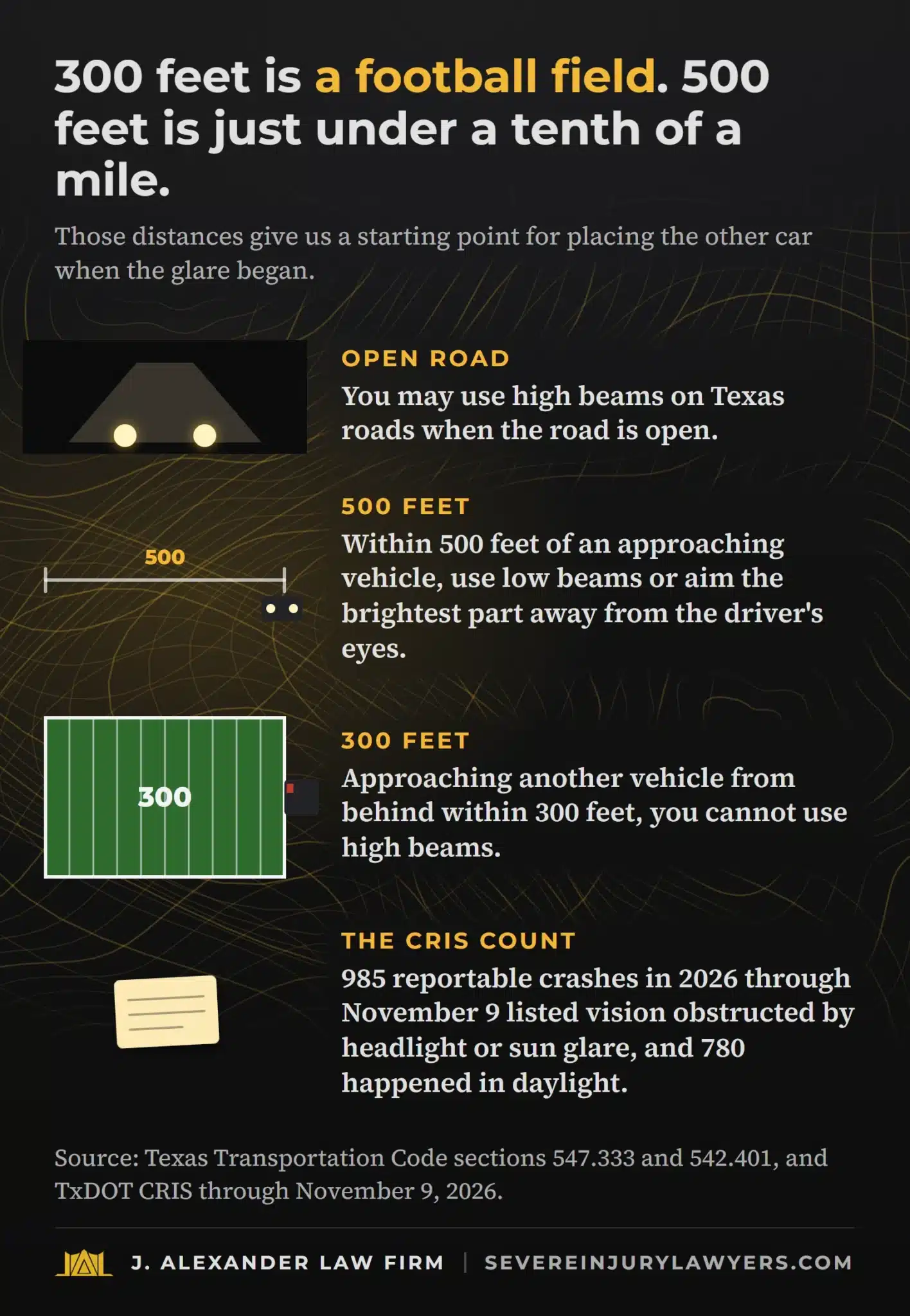
Read it as text
Those distances give us a starting point for placing the other car when the glare began.
- Open road: You may use high beams on Texas roads when the road is open.
- 500 feet: Within 500 feet of an approaching vehicle, use low beams or aim the brightest part away from the driver's eyes.
- 300 feet: Approaching another vehicle from behind within 300 feet, you cannot use high beams.
- The CRIS count: The 2026 count through November 9 included 985 reportable crashes with vision blocked by sun or headlight glare, including 780 in daylight.
Texas Transportation Code sections 547.333 and 542.401, and TxDOT CRIS through November 9, 2026.
Example
High beams before a Texas crash
Say you have just stepped out of your car after a collision on a dark Texas road. You remember a bright beam from an approaching vehicle, then impact. Now an adjuster wants to know whether you kept control.
The officer may use code 48 in field 38 to record a visibility problem and must explain the reason in the narrative. I would check that explanation for details about the lights. The report records an assessment, not a final decision about fault.
The insurer may argue that you should have controlled your car despite the glare. Texas permits responsibility to be shared, so the adjuster may ask that some of the blame fall on you. That position still leaves the lighting and your response to be examined.
I want to know the distance between the approaching vehicles when the glare reached your eyes. Section 547.333 makes 500 feet a threshold: within that distance, the approaching driver must use low beams or aim the brightest portion away from your eyes.
Think of the distance as a doorway into a different lighting rule. Even then, we would examine whether glare contributed to the crash.
Write down your estimate, the vehicle positions and whether the road curved. Keep any dash camera recording.
The approaching driver's lights and your response can both matter. If your actions contributed, an assigned share of fault could mean a smaller recovery. An adjuster's question can be unsettling, but your account of the glare and the moments before impact still matters.
Read next on our site
Read about reckless driving in the Texas crash laws and codes.