


The short answer
Sleeping in your car is not banned outright by Texas state law. At a TxDOT rest area, you can stay up to 24 hours. A longer stay can lead to a fine if the law's notice requirements are met. If another driver hits your parked car, I would also look at where you parked and whether your lights were on.
Key points
A posted sign or an officer's warning can matter when a rest area stay exceeds 24 hours.
Knowingly or intentionally camping in public without the required permission is a Class C misdemeanor.
Where you parked can matter to a crash claim if the other side questions who caused the collision.
Who is at fault if a parked car is hit while someone sleeps inside?
What rules apply at a rest area?
A Texas rest area can include a picnic area, roadside park, comfort station or scenic overlook. TxDOT's 76 safety rest areas have restrooms open 24 hours a day.
Under Transportation Code section 545.411, staying beyond 24 hours can be an offense when a posted sign states both the prohibition and the penalty. If you sleep in your car and wonder whether to crack a window, federal health officials warn that a small exhaust leak can let carbon monoxide build up inside.
A sleeping person can die from carbon monoxide poisoning before symptoms appear. The same notice requirement applies to putting up a tent, shelter or structure.
You may instead hear from an officer what is prohibited and what the penalty is. After that verbal notice, you have eight hours to leave or remove the structure.
A conviction can bring a fine.
Can sleeping count as camping?
Public camping and private property rules can affect where you rest. Penal Code section 48.05 defines camping as temporarily living somewhere with shelter.
Sleeping can be evidence of camping, though the statute does not mention vehicles. Local camping rules may also apply.
What about private property?
On private property, ask the owner or someone acting for the owner for permission. At a truck stop or store lot, check the signs or ask staff whether you can stay overnight. Remaining without consent after a warning to leave can be criminal trespass under section 30.05.
What does the DWI statute say?
DWI under section 49.04 requires intoxication while operating a vehicle in a public place. In Denton v. State in 1995, Texas' highest criminal court held that operation depends on all the circumstances and does not require driving.
The statute does not say whether sleeping in a parked car counts as operating it. In Dornbusch v. State in 2008, a Texas appeals court found sufficient evidence of operation where the driver was asleep or passed out, the engine was running and a curb held the car in place.
Parking and visibility
Where you park
- Your parking spot and lights can matter if a moving car hits you. In October, a caller said, "I was parked at a school campus waiting to pick my niece up from school." Another car hit hers. Our intake team suggested requesting camera footage and a signed statement from the director, who spoke with the driver afterward.
- Outside a business or residential district, section 545.301 generally permits parking on the main traveled part of a highway only when parking off it is impracticable, space remains for passing traffic and the car is clearly visible for 200 feet in each direction.
- Section 545.302 generally prohibits parking in intersections, on crosswalks, on highway bridges and on railroad tracks.
Lights on the car
- When lights are required, section 547.383 calls for a lamp on a car stopped or parked on a roadway or shoulder.
- The light must be visible from 1,000 feet, white or amber toward the front and red toward the rear.
- A lawfully parked car on a highway is excepted at night if a person or vehicle can be seen from 1,000 feet away.
Does parking decide fault?
A parking question does not decide every parked car claim. In our client's story about being hit while parked, another driver struck our client's parked car, and fault was never disputed.
What can the crash report show?
Field 38 of the Texas report, labeled Factors and Conditions, can include code 55 when a car sits in a traffic lane, code 56 when it is parked without lights, and code 54 when a parked car's brakes are not set. Those three entries describe parking conditions, not whether an occupant was asleep. The officer's entry is a reported factor, not a final decision on responsibility.
Where can I read about hazard lights?
Our answer on driving with hazard lights on explains what those lamps are for.
What did the crash records show?
We counted reportable crashes in the TxDOT CRIS records we reviewed when a vehicle was marked as wrecked already, parked legally or parked illegally. Its fields cannot tell us whether occupants were asleep.
Data through November 9, 2026 lists 3,020 people in 2,259 such crashes across Texas. Officers recorded parked in traffic lane in 849 crashes and parked without lights in 118.
For the same months of 2025, the counts were 820 and 105. Because reports from the latest weeks of 2026 are still coming in, comparing the two periods fairly is not yet possible.
Does sleeping establish negligence?
Sleeping alone does not establish negligence. If parking in a forbidden spot contributed to a crash, the questions can include negligence per se and the rules on shared responsibility.
What may a claim include?
After a moving car strikes your parked car, a claim may include Medical bills, missed pay and the disruption to your days.
When must an injury suit be filed?
Under section 16.003, most injury suits must be filed within a two year filing period.
What if an adjuster asks about parking?
If the moving driver's adjuster asks where you parked, you can contact us before answering.
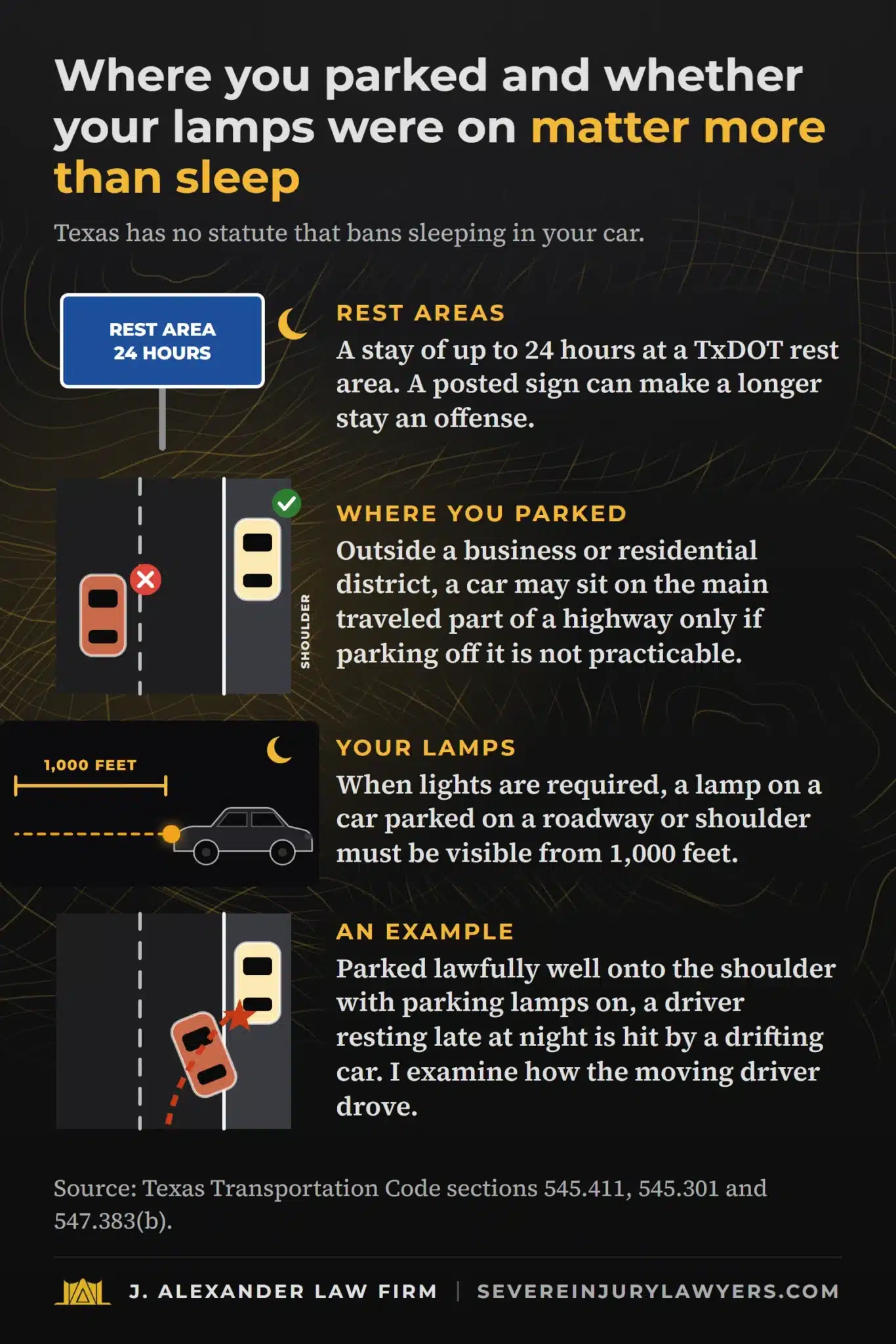
Read it as text
Texas has no statute that bans sleeping in your car.
- Rest areas: A stay of up to 24 hours at a TxDOT rest area. A posted sign can make a longer stay an offense.
- Where you parked: Outside a business or residential district, a car may sit on the main traveled part of a highway only if parking off it is not practicable.
- Your lamps: When lights are required, a lamp on a car parked on a roadway or shoulder must be visible from 1,000 feet.
- An example: Parked lawfully well onto the shoulder with parking lamps on, a driver resting late at night is hit by a drifting car. I examine how the moving driver drove.
Texas Transportation Code sections 545.411, 545.301 and 547.383(b).
Example
Hit while sleeping in a parked car
Picture pulling onto a Texas highway shoulder at night. The dash glows as you fall asleep.
Another car hits yours, and later you wonder whether resting there will be held against you. Texas has no outright state ban on sleeping in a car.
Being asleep, by itself, does not establish negligence.
An officer might enter code 56 in field 38 of the crash report to identify a car parked without lights. That entry points to a possible contributing condition. Think of it as a note on a file, not the final word on responsibility.
The other driver's adjuster may point to the lighting rule and argue that your parking contributed to the wreck. The question is whether the rule applied to your car and whether the lighting made a difference in the collision.
I would look first at the parking spot and the light available there. Section 547.383 requires a qualifying lamp on a car stopped on a shoulder when lights are required.
A lawfully parked car on a highway has a nighttime exception if there is enough light to see a person or vehicle from 1,000 feet away. If safe, photograph the car beside the lane lines and signs before it moves.
Note whether its parking lights were on.
A parking problem that contributed to the crash could put some responsibility on you. The moving driver's conduct matters too, and shared responsibility can affect a claim. If you woke up to a collision, the fact that you were sleeping is not the answer to who caused it.
Read next on our site
For more about reporting a crash and other claim rules, read Texas crash claim laws.