



Short answer
Is hostile driving considered road rage?
Yes. You can sue a driver who hurt you during a road rage crash in Texas. Road rage involves violence, not just anger behind the wheel. Forcing a car off the road on purpose is one example. Whether you can collect money on a claim may depend on what the driver intended, what the policy says and what the driver owns.
After a Texas crash involving road rage, you may wonder if any insurance will pay before you even ask who caused it. A liability policy may leave out harm deliberately caused by a driver, so the driver's anger can affect whether coverage applies. When the motorist is uninsured or their insurer refuses coverage, your UM coverage might help pay medical bills and repair costs. Check your personal injury protection if the collision was the other driver's deliberate act. In some cases, a state fund for crime victims may help too.
What the driver did matters more than how angry they looked. There is no single Texas charge named road rage. Following too close and misjudging a stop may be a driver's careless mistake. Pulling alongside you and steering into your door looks like a deliberate act.
The first thing I try to pin down is that difference, because it can affect insurance payment for your crash and which criminal charges may follow.
Does the other driver's insurance pay for a road rage crash?
Possibly. An insurer may refuse payment if the driver intended the injury, but anger alone may not establish that intent. Reckless driving alone does not prove it either.
What the policy says
The exclusion
The wording of the other driver's policy determines what it covers, so I read that policy first. A liability policy can be like a safety net with one panel cut out: harm caused on purpose can fall through.
For example, State Farm's Texas Personal Auto Policy excludes liability coverage for a person who deliberately injures someone or damages property. If an exclusion like that applies, the insurer may deny your road rage claim.
Recklessness and intent
Being reckless, or making an injury likely, is not the same as meaning to hurt someone. Some policies require more proof before the company can deny coverage based on an intentional injury.
In Tanner v. Nationwide Mutual Fire Insurance Co. (2009), a driver hit another car while fleeing police at high speed. His policy excluded coverage if he knew or should have known an injury would follow.
The court said an injury's likelihood was not enough to trigger that exclusion, and his reckless driving alone did not establish an intent to injure. In your road rage claim, anger and dangerous driving alone do not necessarily show that the driver meant to cause harm.
Checking the coverage
The payment question
Matthew Graham saw the insurer question coverage for crashes that looked deliberate while he worked on road rage claims for an insurance company. An act done on purpose could fall outside the policy.
I expect the question of insurance payment to spark a disagreement before anyone argues about fault. My preparation starts with coverage.
When payment is denied
When an insurer cites a deliberate crash to deny payment, we examine whether the driver intended or expected to cause injury, or drove recklessly instead. The driver's words and actions before the collision, video and any criminal charge may help us assess that.
Even if the crash was deliberate, the driver could have too little insurance to cover the harm. Please send me both the denial letter and your policy so I can read them before anyone decides who pays.
Did the insurer say the crash was deliberate and deny your claim? I can review your policy and the denial letter if you send them to me.
Call 469-807-7480Does uninsured motorist coverage pay after a road rage crash?
It may help if you have UM coverage and the other driver's insurer denies coverage. Your policy terms matter.
Coverage to look for
A denial by the other insurer
Even if that driver's insurer denies your claim, we keep looking for coverage. The State Farm sample allows a vehicle to be treated as uninsured when its liability insurer denies coverage.
That includes a denial based on an intentional act. Learn who may pay after an uninsured driver crash.
A family calling for help
A parent called us after a driver fleeing police hit their daughter's car. The parent did not know who owned the car or whether the driver had insurance.
The crash report's financial responsibility field may name an insurer, so our intake team points callers to it. That insurer may raise an exclusion for criminal conduct, but the chase alone does not decide coverage.
The family's own UM coverage may help if they carry it and the insurer denies coverage.
Your UM coverage
UM means uninsured motorist coverage. In the State Farm example, UM does not pay for harm you cause through your own intentional acts.
Even when another motorist deliberately hits you, that fact alone does not end your UM coverage. Your insurer may still ask whether your actions caused the harm.
The example does not say that a rude gesture or swear word by itself takes away coverage.
Your PIP coverage
Another part of your own policy to look at is PIP. The State Farm sample also bars PIP for injuries to someone who deliberately caused the crash.
UM and PIP
Check your policy
Picture a car trailing you closely for a mile, then pulling alongside and swerving into your door. The insurer might refuse coverage if it considers the impact intentional, so we check your UM and PIP early.
Your policy may differ from the State Farm example, and its terms control your coverage. Please send me your policy booklet and declarations page, which lists your coverages toward the beginning of the policy.
Our Client's Uninsured Motorist Coverage
A driver without insurance struck our client in a crash unrelated to road rage, and she used her own coverage.
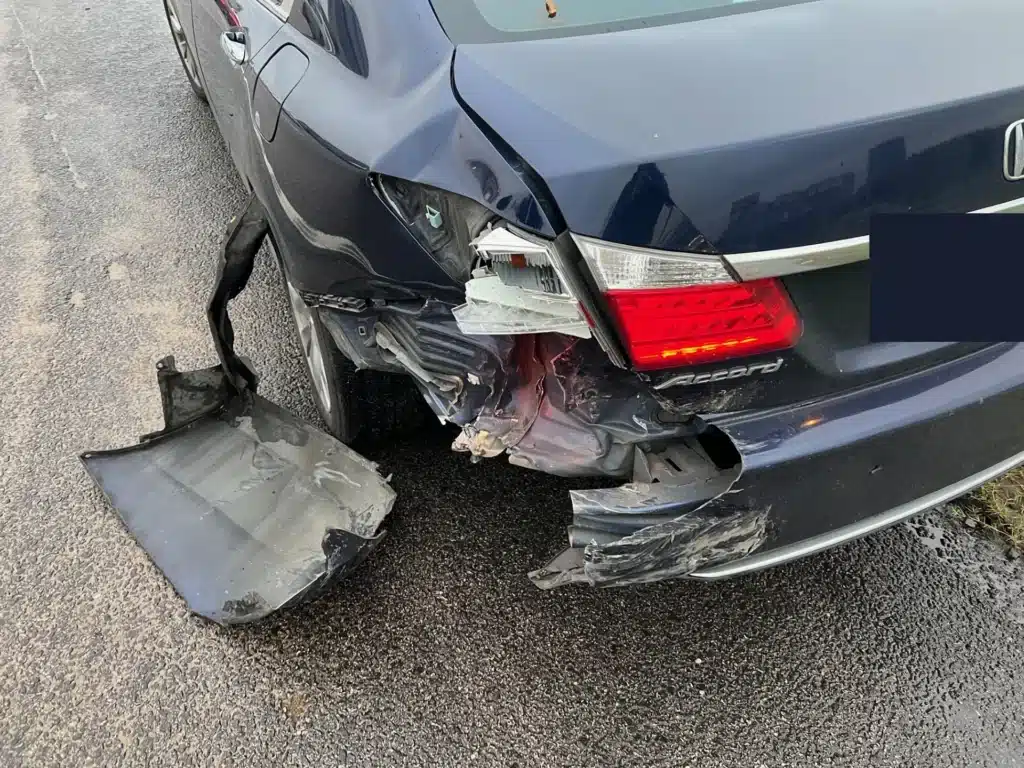
Dallas County, the Stemmons Freeway, I-35E northbound
Her Own Coverage After a Rear Impact
In 2023, a car hit the rear of our client's sedan in rainy weather while she was traveling north on the Stemmons Freeway.
The report showed no proof of insurance for the other car and listed a no insurance charge against its driver. We checked her policy and declarations page.
Her UM coverage paid up to its limit, and PIP also paid. The matter ended without a lawsuit.
Call us about your own road rage crash. Call 469-807-7480
Can punitive damages apply after a road rage crash in Texas?
Yes. Punitive damages may be available against a driver who meant to cause serious injury. A careless mistake alone is not enough.
Collecting payment
Suing the driver
With no insurance payment, you may take the driver to court and seek money for your care, missed earnings, physical hurt and mental distress. There is a limit to keep in mind.
Collecting money depends on what the driver owns. So before I recommend suing a driver without coverage, I look at what that driver owns.
Awards and deadlines
Punitive awards
A punitive award is meant to punish the driver. It is added to the money awarded for your losses. Texas calls it exemplary damages.
Time to sue
The deadline to sue depends on whom you sue. For the driver's deadline, see Texas car crash filing deadlines.
You have four years to bring a contract lawsuit against your UM insurer after a road rage crash. That period usually starts when your insurer rejects your claim.
Is road rage a criminal offense in Texas?
Road rage is not the name of a Texas crime, but a driver's actions can lead to an assault or reckless driving charge.
The driver's conduct determines the charge, so I ask for a detailed account of how the driver approached you. Possible charges include:
- Reckless driving, Transportation Code 545.401. A driver shows willful or wanton disregard of safety by knowingly ignoring a serious safety risk.
- Assault, Penal Code 22.01. A person intentionally, knowingly or recklessly causes bodily injury, or intentionally or knowingly threatens imminent bodily injury.
- Aggravated assault, Penal Code 22.02. An assault may be aggravated if it causes serious bodily injury or involves the use of a deadly weapon. Section 1.07 describes a deadly weapon as an object capable of causing death or serious injury through its use. A car can qualify, depending on how it was driven at you. Please describe exactly how that driver approached you.
- Deadly conduct, Penal Code 22.05. This includes recklessly putting someone in immediate danger of serious bodily injury. It also includes knowingly firing a gun at or toward a person. Firing at or toward a vehicle can qualify too, if the person firing acts recklessly about whether someone is inside.
You report, they charge
The police and prosecutor decide on charges, not you.
Can the Texas crime victims' compensation program help after a road rage crash?
Yes, if a qualifying crime caused the crash and you meet the program's requirements.
If your road rage crash involved a crime, a state program may help with costs, though an ordinary accident is not covered. The Texas Attorney General runs the program, called Crime Victims' Compensation, or CVC.
The crimes it covers include assault, hit and run, terroristic threat, and crashes involving DWI, or driving while intoxicated. A reported road rage assault or threat may qualify, depending on the circumstances and the program's rules.
$50,000
Possible program limit
In most cases, CVC may pay up to $50,000 toward costs.
The program, rather than our firm, decides the claim.
We check the program's requirements because they can affect another claim you make over the crash:
- Report the crime promptly. CVC requires a reasonable reporting time and cooperation with the investigation and any prosecution.
- You must not have participated in the crime. The program may pay less if your conduct contributed to it.
- Before suing over a crime for which you have claimed or received CVC, give the attorney general written notice. Before settling the lawsuit, ask the CVC program in writing for written permission. Let me know about the application so we can coordinate the claim with the program.
Ask the program
On weekdays, call (800) 983-9933 to ask the program about eligibility and applying. Tell me too, so we can coordinate any claim with CVC.
Could crime victims' compensation help with your road rage crash? I can review the form with your claim if you send it to me.
Call 469-807-7480Is it worth reporting road rage to the police?
Yes, it is worth reporting road rage to the police. A police report puts an officer's account on record, and CVC requires a report within a reasonable time, subject to its rules.
Who to call
When safety is at risk
Call 911 and give your location if someone is injured, a driver shows a weapon, follows you or makes you fear for your safety.
When the driver has left
Call the local police or sheriff on a non emergency number when the driver has left and no one is hurt. For a state highway, contact Highway Patrol.
If you did not report the crash at the scene, contact that office now and describe what happened. A report made later can still matter because the insurer and the crime victims' program may look for it.
Arlington has a road rage hotline, (817) 459-5389, and an online form for non emergencies. Ask local police what is available in your city.
Making the report
What the officer needs from you
Tell the officer if you were hurt, describe the vehicle and give its plate number, the crash location and your account of what you saw.
Send me the report number
Get the report number to me so I can read the officer's account of the other driver's actions.
A delayed statement
"I was in an ambulance, so I was unable to give a statement at the time."
Caller, 2026
How do you prove road rage after a car accident?
We can use video, the report and witness statements to trace the events leading up to impact. Save any video promptly and write down the sequence of events.
What callers tell us
After a vehicle from a company forced their car off a connector on the highway, a caller said it overturned, the report raised possible road rage by each driver, and the other motorist's insurer was refusing payment.
A witness in the next car saw the other driver block the merge, then push the car into a rollover with a PIT maneuver. The officer later said state traffic camera footage confirmed it.
We tell callers to get the report and point out errors to the officer, using the witness and footage, and we ask that the footage be saved.
A Texas crash report has separate fields for each vehicle. An officer can record factors believed to have contributed to the crash, with a separate place for factors that might have contributed.
In TxDOT's records, we counted 1,019 reportable crashes across Texas that listed road rage as a contributing factor, from the first day of 2026 through November 9. Road rage appeared as a possible factor, but not a contributing factor, in 439 more crashes.
Neither entry determines fault, and the counts will increase as more reports reach TxDOT.
Texas crashes with road rage on the report, by the field the officer used, 2026 through November 9 | TxDOT CRIS public query, January 1 to November 9, 2026, pulled November 12, 2026
| Where the officer listed road rage | Crashes | Fatal crashes | Suspected serious injury crashes |
|---|---|---|---|
| A contributing factor field (Contributing Factor 1, 2 or 3) | 1,019 | 0 | 31 |
| Only a possible contributing factor field (Possible Contributing Factor 1 or 2) | 439 | 1 | 8 |
Each crash appears once, in the row for the officer's chosen field, with crashes listing road rage in both kinds of field placed in the first row. Its severity is the gravest injury coded for any person in it.
I expect the insurance company to say both drivers played a role in the confrontation. An independent witness can help us answer that argument, along with the actions of each driver before impact. Close following, trapping a car or sudden braking may show who started the confrontation.
For a confrontation involving close following or sudden braking, see the Texas comparative fault rules.
Save evidence for both your claim against the driver and your claim with your own insurer. Each piece can help us examine who caused the crash:
Keep it quiet
Notify your insurer about the crash. Before you have advice, do not post about it or respond to the other driver or that driver's insurer.
Does the report suggest both drivers were involved in road rage? I can discuss what the witness saw after you send me the footage.
Call 469-807-7480What are two things you can do to avoid road rage?
Two things can help you avoid road rage: leave an angry driver plenty of space, and keep your eyes on the road instead of responding with gestures or insults.
Staying safe on the road
Avoid a confrontation
I want you to stay calm and avoid fighting back, even if the other driver confronts you. Do not pull over where that driver can reach you.
Your safety comes first. We can look for video and witnesses later.
If a driver follows you
A driver following you is a reason to lock your doors and go to a busy, well lit public place, such as a police station or store lot. Stay inside your car. Do not lead the driver to your home.
Wait for help
An angry or armed motorist
After the crash, stay inside your vehicle with the doors locked if the driver is angry or armed. Wait for police and medical help. Exchange insurance details when an officer is there.
Call us once you are safe
Give me the date and location, along with the driver's actions. We'll review your policy and request that the footage be preserved.
24/7 | Free consultation | No fee unless we win
Tell me what happened. We will check your policy.
J. Alexander Law serves injured clients throughout Texas: Dallas | Houston | San Antonio | Fort Worth | Arlington | Canton. Se habla español.