



Short answer
Can you sue for pain and suffering in Texas?
Yes. A Texas statute, Section 41.001(12), calls physical pain and suffering, emotional distress, disfigurement and physical impairment noneconomic damages. Jurors are asked separate questions about harm you have lived through and harm still ahead. They are told not to pay twice for the same loss, so we prepare evidence for both. They can consider activities an injury took away when deciding on physical impairment. For that impairment to be paid separately, its effect must be substantial and go beyond pain, suffering, mental anguish, lost pay or reduced earning capacity. The Texas Supreme Court clarified that in Golden Eagle Archery v. Jackson (2003). So my questions cover what you have stopped doing as well as what hurts, because proof of those lost activities can help support the value of your claim.
Texas law gives no formula for what pain is worth after a wreck. Most crash claims settle, but I prepare each one for a jury, because an offer reflects what the adjuster thinks jurors would award. Some adjusters start working out an offer from the medical bills, but a bill shows what care cost, not what pain kept you from doing each day.
What callers tell us
In October, a caller told us that washing her hair hurt, lifting even a cup of water was very painful, and brain fog kept her from driving.
Small daily details like these help jurors see what pain looks like in someone’s life. Once a doctor puts them in her medical chart, jurors can see what she reported at the time, not just hear about it from her later.
Saying you were upset is not enough to show mental anguish. Jurors need to hear what the distress was like, how long it lasted, how bad it got and how much it disrupted your routine.
The Texas Supreme Court said direct evidence of those things can support an award when it shows a substantial disruption to daily life. In Parkway Co. v.
Woodruff (1995), the people who sued lost on that point because their testimony showed anger and frustration, which the court said was not enough.
A jury may later hear about symptoms you describe to a doctor while seeking diagnosis or treatment, if what you said was reasonably related to that care. Texas evidence Rule 803(4) allows that. Tell every doctor, in plain words, what pain stops you from doing.
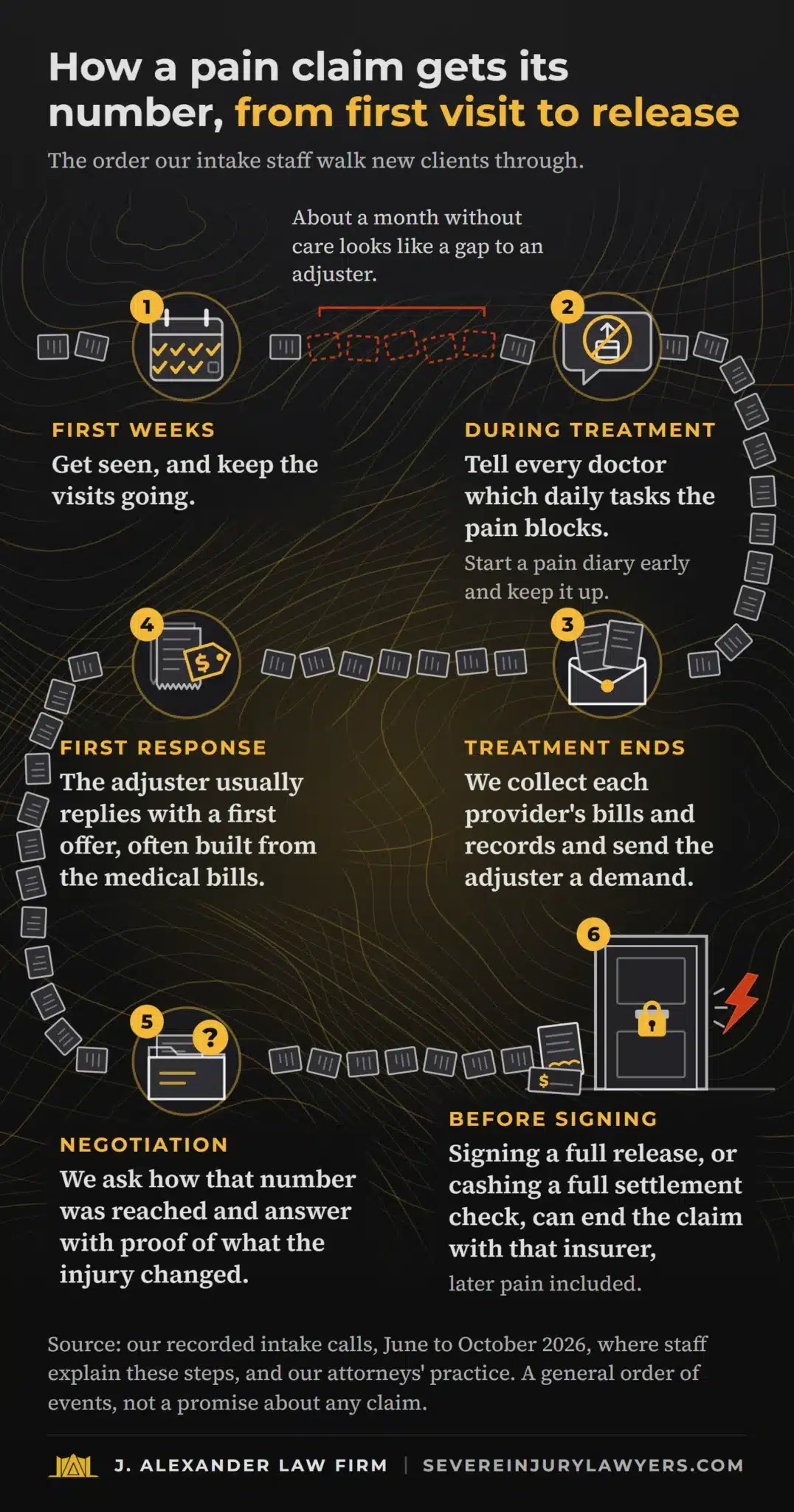
Our intake team explains why treatment matters when you first call. Your treatment records help us show an insurer what pain is doing to you:
A staff member on showing an insurer how you were hurt
"But again, you have to be hurt in order for us because we have to prove to the insurance company pain and suffering."
A staff member, 2026
What is the pain and suffering multiplier in Texas?
Some insurers value pain by multiplying medical bills by a chosen number, but Texas does not require that calculation.
An online calculator answers in seconds, whether it multiplies your bills or uses a flat amount for each day you hurt, called a per diem rate. That speed is misleading because the calculator has not seen your medical records or learned how your life changed. It is like guessing what a meal tastes like from the grocery bill.
An insurer evaluating your pain starts with your medical chart. It looks at your diagnosis, the length of your care and your doctors’ notes about activities you could no longer do. We know this because Matthew Graham saw how insurers evaluated claims when he worked for them earlier in his career.
When a first offer looks like your bills multiplied by a number, Matthew and I ask the adjuster how they got it.
A jury cannot pull a number for pain out of thin air. The person asking for the money must be able to explain the number. In 2023, the Texas Supreme Court ordered a new trial in a death case, Gregory v. Chohan.
The court’s main opinion said an award for grief or pain needs an explainable link to the evidence. It also said jurors do not have to base that amount on the family’s financial loss.
Another justice wrote that injury cases also need proof of pain and an amount based on that proof. A lawyer cannot ask jurors to base a number on things unrelated to the pain.
Jurors need to consider what the pain felt like, how long it went on and how bad it was. I base every dollar I request on your records and what you tell me.
Several factors affect what a pain and suffering claim is worth, and I can point to each one in your file.
Your diagnosis and treatment help us understand how serious your pain was: pain that needed therapy is one thing, while pain that needed injections or surgery is another. Treatment dates help us show how long the pain lasted.
If we ask for payment for future pain, jurors need a doctor’s opinion about what lies ahead or other evidence that lets them reasonably find your pain is likely to last. We also consider lost activities, which can count as physical impairment.
Family, coworkers and friends can describe changes they saw. These answers give jurors reasons for the amount I ask for, which multiplying your bills by a number cannot do.
Send me the offer before you answer it.
Call 469-807-7480How do you prove pain and suffering after a car accident?
Your treatment records are the main evidence of your pain. Photos, a journal and people who know you can help fill in what your days were like between appointments.
The other driver’s insurer and its lawyers, called the defense, may question whether the wreck caused your injury and how serious it is. Your chart notes are where both answers begin.
Some injuries are plainly connected to a wreck, and the words of people without medical training can be enough to show what caused them. Other conditions take more than jurors can judge from everyday experience, so showing a wreck caused one generally takes a doctor’s opinion.
The Texas Supreme Court drew that line in Guevara v. Ferrer (2007). When your condition calls for that opinion, I ask a doctor for it.
Your chart can show your symptoms and pain levels, limits your doctor puts on work and lifting, referrals, and what your doctor expects from your recovery. About a month without care can give the defense room to blame your pain on something else.
Work, cost or no transportation can cause a gap, and our team writes down the reason. A visit note that leaves out pain may look like a sign you improved, so follow your treatment plan and be honest about your pain at every visit.
Medical bills need proof too, so our case managers gather them and request a sworn written statement, called an affidavit, from each provider’s office. The person who treated you or the person who keeps the office’s records signs it.
Jurors may use it to decide whether the charge was reasonable and the care was needed under a Texas statute, Section 18.001. That applies unless the other side properly serves a sworn statement disputing it, called a counteraffidavit. The affidavit cannot prove your injury came from the crash.
If an ER visit is your only care on record, the offer will likely be lower than it would be with therapy records, because one visit tells the adjuster little about how long you hurt.
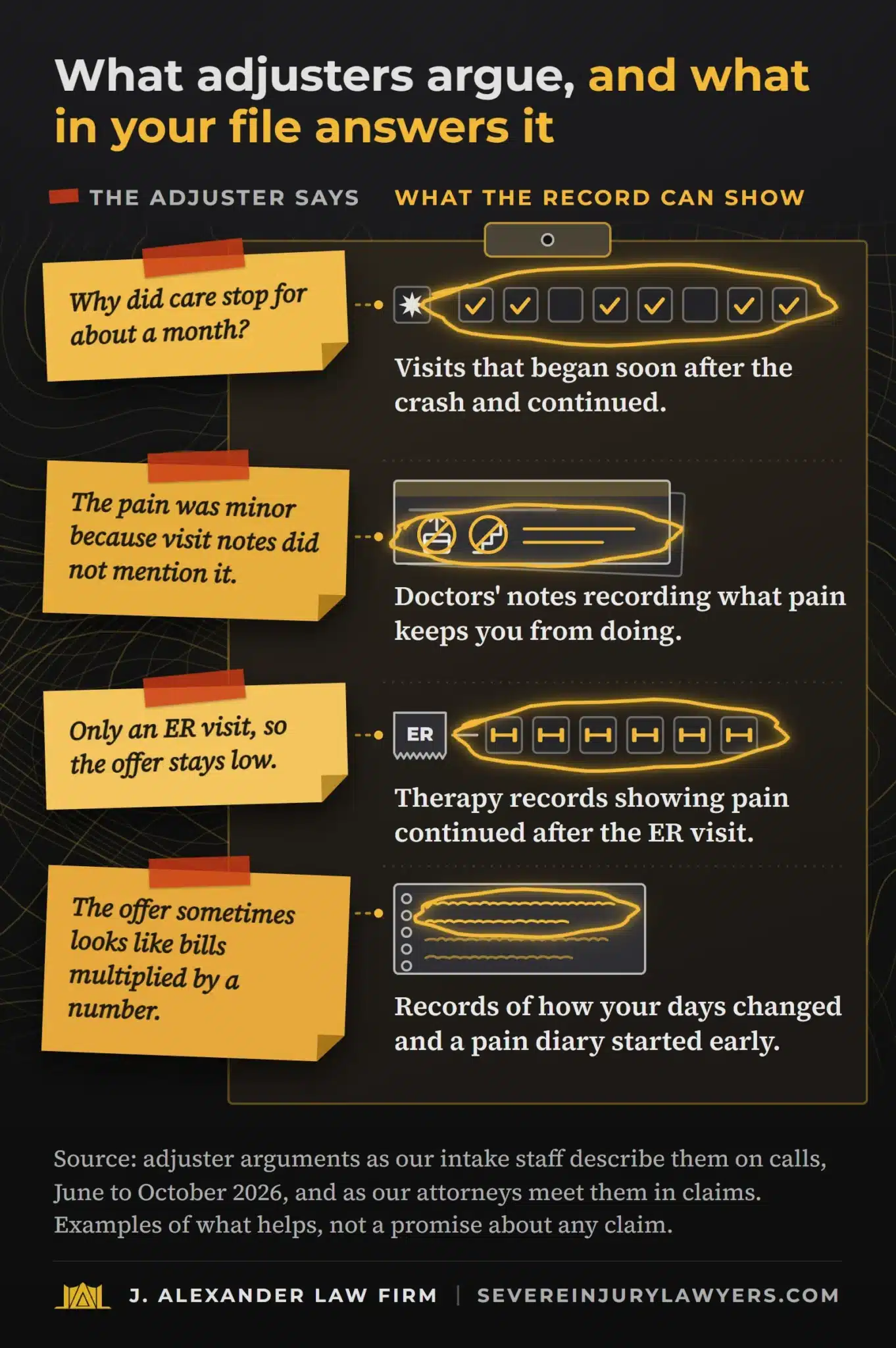
Here is what to keep and pass along to our case managers as you go:

"So, being a mom, I'm having to take kids to school, uh play with them, do everything, and I also take care of my disabled mother. So, um I wasn't able to like load up uh the wheelchair or anything like that."
Jasmine, a client of J. Alexander Law Firm. Watch Jasmine tell it
Pain Evidence in One of Our Cases
After a pickup crash, our client’s recovery records showed how pain affected him.
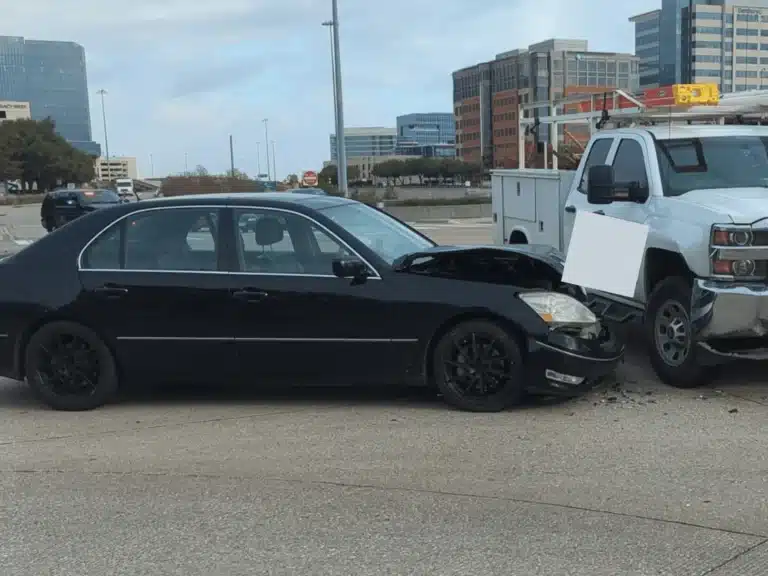
The intersection of Dallas Parkway and Legacy Drive in Plano
Headaches and Recovery After a Pickup Crash
A company pickup struck our client’s Lexus in 2024. The police report said the truck driver did not give way.
He had headaches, nausea and pain, followed by dizziness, sleep problems and memory trouble.
His records showed improvement and a return to work duties and hobbies, though some stiffness and irritability remained. After the insurer questioned his history and care, we presented the timeline.
The case resolved in 2026 while the lawsuit was ongoing.
Tell me what still hurts today. Call 469-807-7480
Is there a cap on pain and suffering after a car accident in Texas?
No. For an ordinary claim against a driver, Texas law does not cap payment for pain and suffering. The other driver’s policy limit is still the most that insurer will pay under that coverage.
You may have heard of a cap, but it applies to a different payment. Exemplary damages punish serious misconduct rather than pay for pain. A Texas statute, Section 41.008, generally limits those awards, which are rare in ordinary crash claims.
If what you went through is worth more than the other driver’s insurance limit, my next step is to look for other coverage that may pay.
Pain is one part of your claim, alongside medical bills and lost pay. I watch the lawsuit deadline on every file. Most cases have two years, though some exceptions change that.
In my cases, a dispute over fault can take more from a pain award than an argument about a multiplier. So I ask early who was at fault and whether the other driver’s insurer admits it.
A Texas statute, Chapter 33, reduces every part of your award, including payment for pain, by your share of fault. For example, if jurors assign you 20 percent of the blame, each part of your award falls by 20 percent.
If they put more than 50 percent on you, you cannot recover anything.
To pay a settlement, an insurer wants your signature on a release. A full release can close your injury claim with that insurer for good, even if more pain appears later. Cashing a check offered as full settlement can do the same.
Texas courts treat releases as contracts and look to their terms. Future pain may not be clear until treatment ends or your doctor explains what lies ahead. So let me learn what future care may cost and go over the release before you sign anything.
See what to expect when an insurer contacts you following a wreck.
24/7 | Free consultation | No fee unless we win
Call or write me about your pain and your claim.
J. Alexander Law serves injured clients throughout Texas: Dallas | Houston | San Antonio | Fort Worth | Arlington | Canton. Se habla español.