


San Antonio Chain Reaction Rear End Settlements
$89,000 for Two Clients After a Three Car Chain Reaction on I-35 in San Antonio
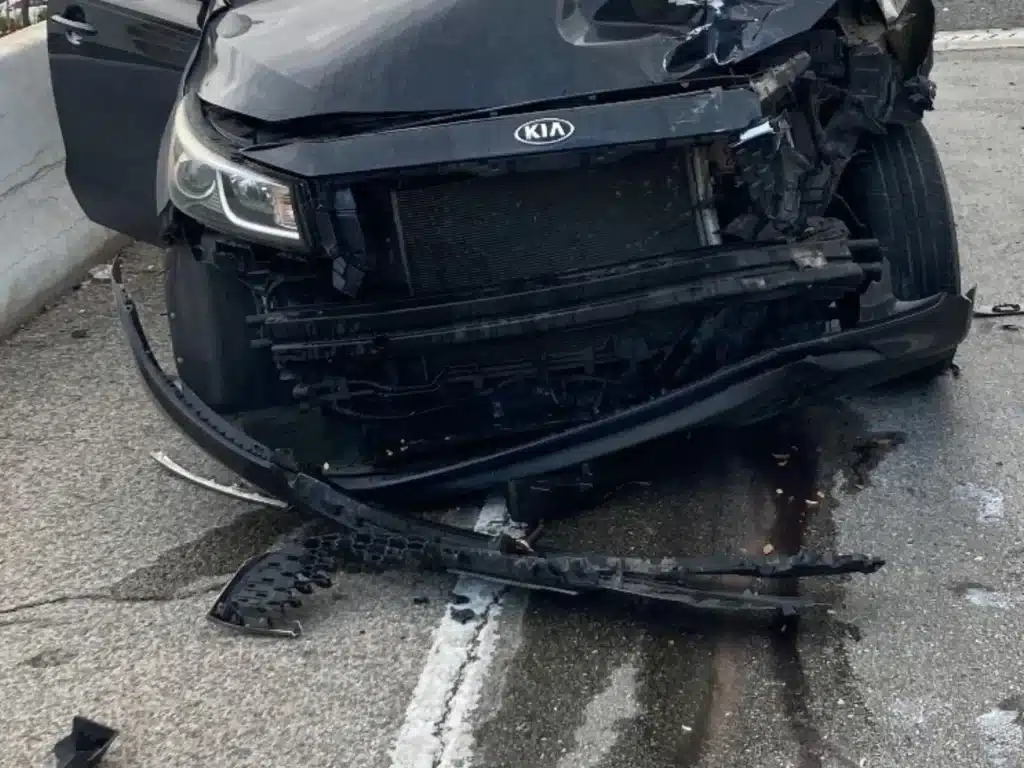
A Kia minivan hit our clients’ stopped Toyota RAV4 from behind on the I-35 southbound exit to Laredo Street and shoved it into a pickup truck.
The RAV4’s driver and her rear seat passenger each had an injury claim. We settled both without a lawsuit, the driver’s at the $50,000 policy limit and the passenger’s for $39,000.
On This Page
Case at a Glance
| Case detail | Information |
|---|---|
| Result | $89,000 across two claims: $50,000 for the driver, the policy limit, and $39,000 for the passenger, with no lawsuit filed |
| Date and time | |
| Location | I-35 southbound exit ramp to Laredo Street, San Antonio, Bexar County |
| Vehicles | 2015 Kia Sedona minivan; 2014 Toyota RAV4, our clients’ SUV; 2016 Chevrolet pickup |
| People | Six across the three vehicles; our clients rode in the RAV4, one at the wheel and one in the right rear seat |
| Crash report | San Antonio Police Department CR-3, dated the day of the crash |
| Medical care | Emergency room visits that morning for both clients, then chiropractic care, MRI studies and specialist referrals |
How the Chain Reaction Unfolded
A little before 8 a.m. on a Monday, traffic had backed up on the southbound I-35 exit to Laredo Street, a ramp posted at 25 mph. Our clients sat stopped in their RAV4 behind a white Chevrolet pickup. A black Kia Sedona minivan heading down the ramp hit the RAV4 from behind, and the force drove the RAV4 into the pickup’s rear.
- 7:58 a.m.Crash time; officer dispatched
- 8:23 a.m.Officer arrives on the ramp
- 9:30 a.m.Ramp and scene cleared
- That morningBoth clients at an emergency room
- Same dayFirst chiropractic exams
The officer’s narrative on page 2 of the report records our client’s account. Here it is exactly as written:
D2 stated they were on the off ramp of IH35 S and Laredo stopped due to traffic being heavy. D2 stated she felt the impact of U1 who rear-ended her which then caused her to rear-end U3. BWC/COBAN
D2 is the driver of Unit 2, our client in the RAV4. U1 is the Kia and U3 is the pickup. The closing entry, BWC/COBAN, flags police video from the scene: BWC means body worn camera, and COBAN is a brand of in car police video.
The narrative compresses our client’s account to two sentences: stopped in heavy traffic, then the impact. A caller who was the middle vehicle in a three car crash on a DeSoto freeway in August 2026 described those seconds from the driver’s seat, watching a car come up fast in the mirror: “So I was conscious in those few seconds that I was going to get hit and there was no way out. And of course I was hit.” Her car, she said, was pushed toward the one in front.
- Kia Sedona minivan. Traveling south on the ramp, it struck the stopped RAV4 from behind.
- Toyota RAV4, our clients. Stopped in line when the Kia hit it, then shoved forward into the pickup.
- Chevrolet pickup. First in the line of stopped traffic; the RAV4 struck its rear.
Getting hit while stopped is common in San Antonio. Of the city’s 40,345 reportable crashes in 2023, 10,947, about 27%, were rear end collisions, and in 5,302 of those one vehicle was stopped when it was struck, the setup on this ramp. Those counts come from our Texas Rear End Crash Index, which draws on TxDOT’s CRIS records.
Damage at Both Ends of the RAV4
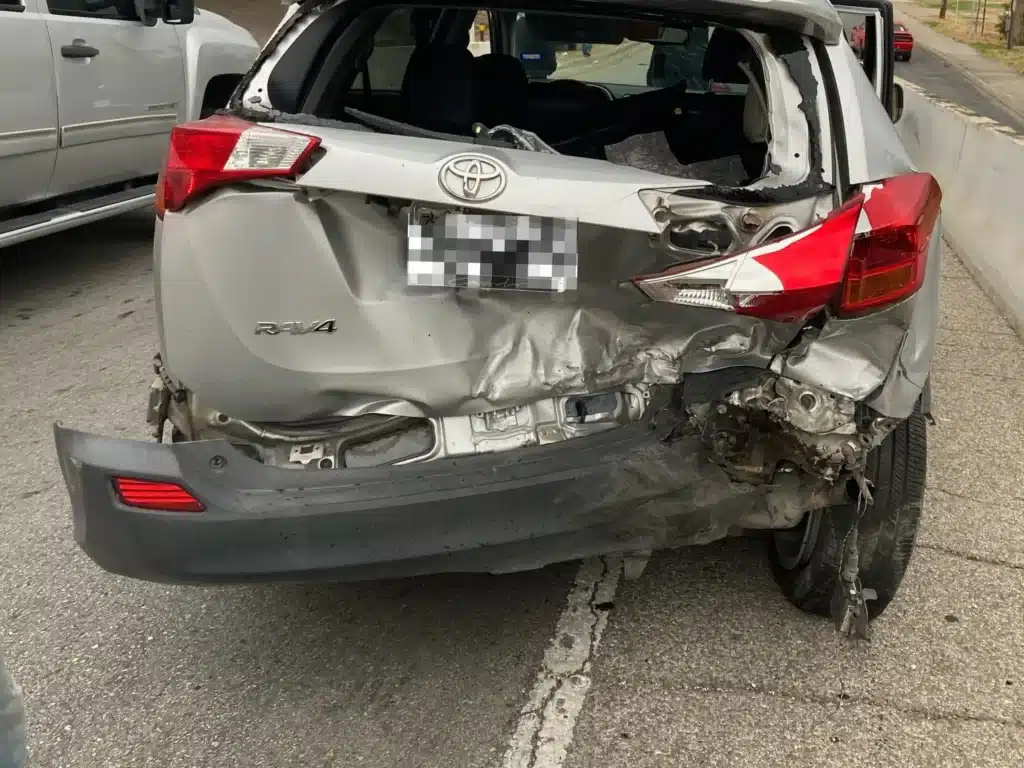
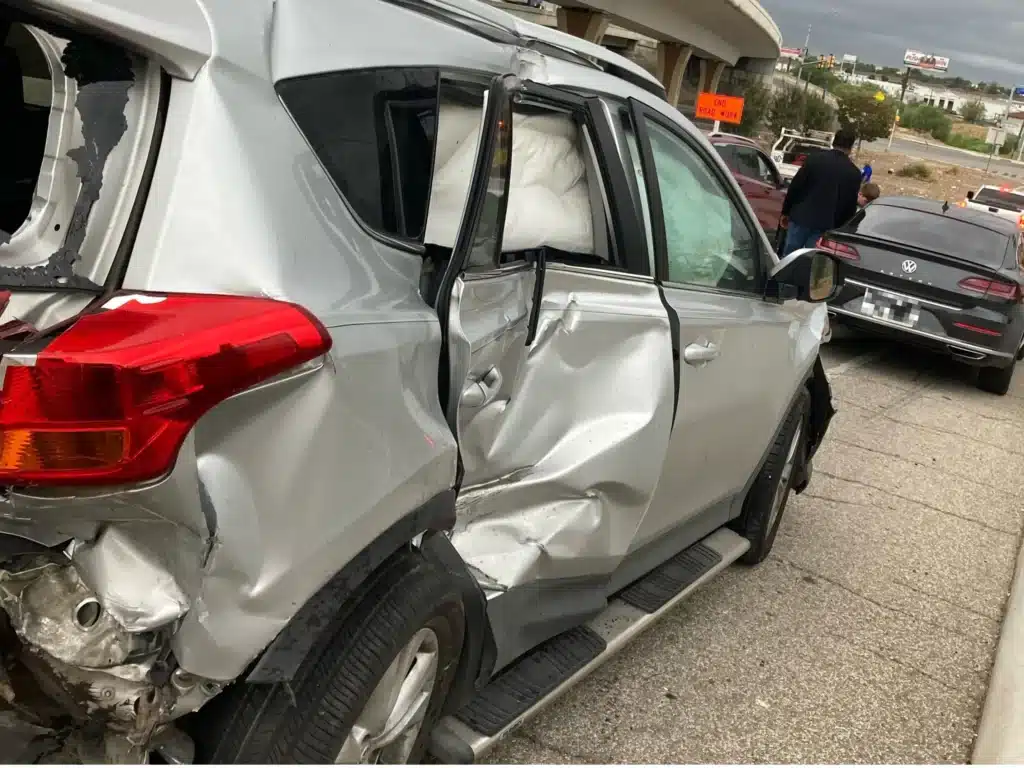
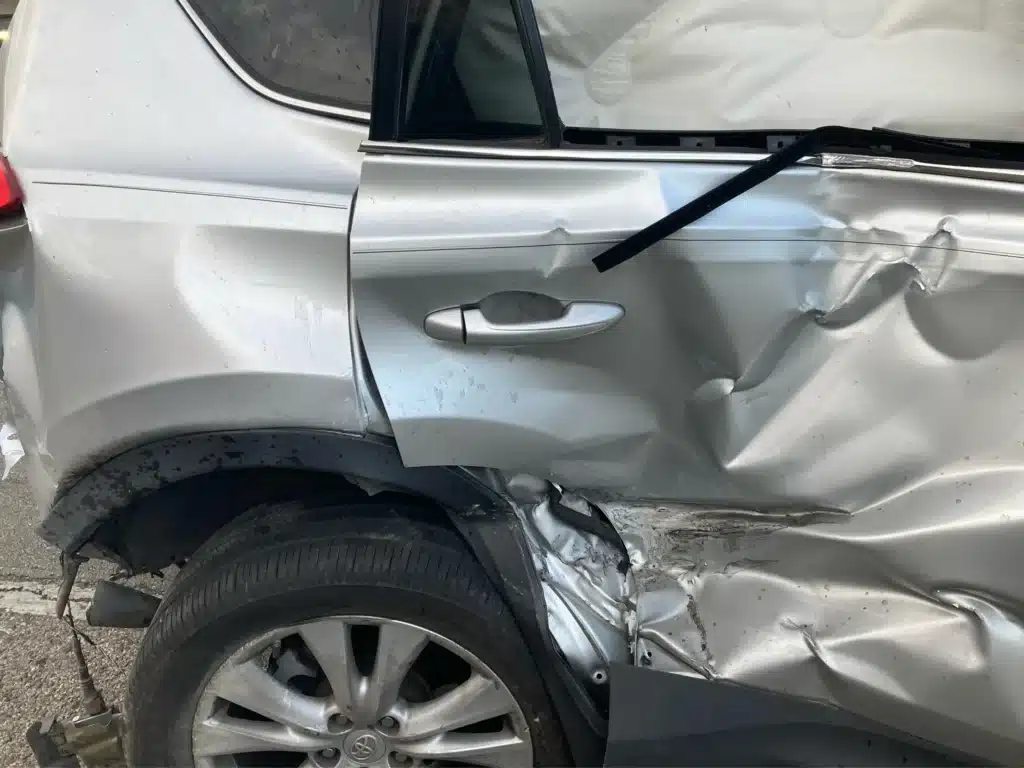
Photos from the ramp match the report. The Kia’s front end was torn open. The RAV4 took the first hit in its rear and the second in its front, the only vehicle of the three damaged at both ends.
Officers rate each vehicle’s damage on the CR-3 with a three part code: the clock direction the force came from, the area hit, and a severity number that tops out at 7. These are the ratings on this report:
| Vehicle | Rating, read plainly |
|---|---|
| Kia Sedona, Unit 1 | 12-FD-6Force from straight ahead, damage spread across the front, severity 6 |
| Toyota RAV4, Unit 2 (our clients) | 6-BD-6 and 12-FD-6Struck from directly behind, then driven forward: rear and front each rated 6 |
| Chevrolet pickup, Unit 3 | 6-BD-2Force from behind, damage across the rear, severity 2 |
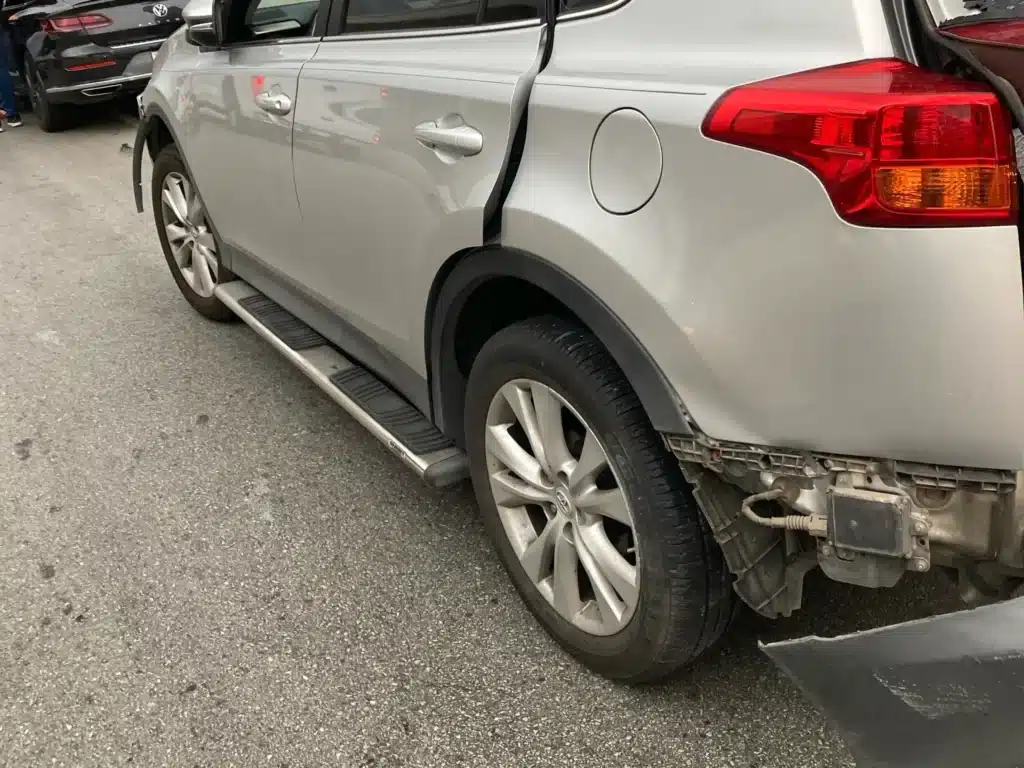
The airbag codes point the same way. The report lists the RAV4’s airbags as deployed, multiple, for both of our clients, and the side curtain airbag is visible in the photos. The Kia’s airbags deployed as well; the pickup’s did not. Both the Kia and the RAV4 were towed from the ramp, while the pickup was marked not towed.
Reading the SAPD Report
The CR-3 runs four pages, most of it in numbered codes. These are the entries that carried the most weight in this file. Our Texas Crash Report Decoder explains the rest.
| Field | Entry on the report, then its meaning |
|---|---|
| Road | IH 35, roadway part 4Interstate 35, exit or off ramp |
| Direction and limit | S, speed limit 25Southbound, posted 25 mph |
| Reference point | 200 FT N of 1400 S Pecos La TrinidadNot at an intersection; about 200 feet north of South Pecos La Trinidad |
| Factors, Kia | 44; 29 as may have contributedFollowed too closely; did not stop at the required point |
| Factor, RAV4 | 44Followed too closely |
| Factor, pickup | NoneNo contributing factor listed |
| Conditions | Weather 2, light 1, surface 1Cloudy, daylight, dry |
| Traffic control | 17Marked lanes |
| Restraints | 1 for all six peopleShoulder and lap belt |
| Passenger seat | 6Second seat, right side |
| Injury severity | N for all six peopleNot injured, in the officer’s judgment at the scene |
| Airbags | 5 in the Kia and RAV4; 1 in the pickupDeployed, multiple; not deployed |
Both the Kia and our clients’ RAV4 carry factor 44. The form heads that block “Contributing Factors (Investigator’s Opinion),” and the heading means what it says. Our intake manager explained it to a Garland caller in August 2026 who was still waiting on the officer’s report: “Officers don’t normally put down who’s at fault for the accident, but they will kind of indicate we need to see if there’s any contributing factors, things of that nature, which kind of tell the story.” Factor 44 refers to Texas Transportation Code § 545.062, the statute that tells anyone driving behind another car to keep an assured clear distance, room enough to stop without hitting it.
The narrative on the same page says the RAV4 was stopped in heavy traffic when the Kia hit it, and that the impact sent it into the pickup. The damage codes fit that order. Texas splits fault by percentage under its 51 percent rule, and our guide to multi car accidents in Texas covers how blame is weighed along a chain.
Read the redacted SAPD crash report (PDF)Coded Not Injured, Treated the Same Morning
The officer marked all six people N, not injured. That letter is a roadside judgment made minutes after a crash, not a medical exam. Nobody left in an ambulance, either; the Taken To and Taken By boxes on page 2 are empty. A caller who had been rear ended while stopped in slowed traffic near a highway exit in Arlington was asked by a staff member the next morning, in August 2026, whether she had gone to the ER: “I didn’t end up going to the ER yesterday just because, I mean, I guess the adrenaline was in, so I didn’t really feel anything much.” By the time she called, her back hurt. Both of our clients went to an emergency room that morning.
An N is the most common reading on a San Antonio rear end report. In 2023, 7,293 of the city’s 10,947 rear end crashes, about two in three, were coded N at the crash level, meaning the report listed no one as hurt. Doctors, not the report, decide what an injury is.
Both clients reported pain in the same four areas:
- Neck
- Lower back
- Shoulder
- Knee
The driver
She arrived at a hospital emergency room by private vehicle a few hours after the crash. She told the staff her stopped car had been struck from behind, that she was belted, and that she felt “slightly woozy.” Her complaints that morning were pain in her right lower leg and right shoulder and tightness in the muscles of her neck. Imaging that morning included a chest X ray and CT scans of her head, neck, right shoulder and right leg. Everything read clear except the right knee, where the scan showed soft tissue swelling over the kneecap and a small amount of fluid inside the joint, with no fracture. In the ER she was given cyclobenzaprine, a muscle relaxant, and acetaminophen, then discharged before noon with prescriptions for Flexeril and meloxicam, an anti inflammatory, and instructions to avoid strenuous activity.
Her first chiropractic exam came later that same day. At that exam she reported pain in her neck, low back, both shoulders and right knee. The chiropractor found swelling, spasm and a reduced range of motion, and the orthopedic tests he ran on her neck, low back and knee were positive; her neurological exam was normal. His diagnoses were sprains of the neck and low back, of both shoulders and of the right knee, plus an unspecified head injury. He set a course of care running through the end of October. Each visit combined therapeutic exercise, electrical stimulation and hot and cold packs, and his handwritten daily notes mostly recorded her right sided pain as “más o menos,” about the same.
MRIs on November 15 showed disc protrusions in her neck reaching the sac that surrounds the spinal cord, with the cord itself normal; disc protrusions in her lower back; and in the right knee a moderate amount of fluid and a partial tear of the ACL, the knee’s anterior cruciate ligament; the menisci were intact. On November 27 the chiropractor reviewed those studies, added disc displacement at the neck and the low back and a right ACL sprain to her diagnoses, and noted that her pain had eased and that she was walking normally. He recorded that she had reached maximum therapeutic benefit from his care, released her from active treatment, and referred her to neurology and to pain management to consider epidural steroid injections.
Three days later, on November 30, a nurse practitioner at a multidisciplinary clinic evaluated her. She reported daily headaches with nausea; pain running from her neck down to her low back; tingling and numbness in her right arm and right leg; and dizziness, ringing in her ears, blurred vision, memory problems, depression, anxiety and nightmares. The exam found tenderness and spasm along the spine and a positive neck compression test. The diagnoses were neck pain, low back pain, irritated nerve roots in the neck and lower back (cervical and lumbar radiculopathy), headache, dizziness, and pain in the right shoulder, knee, ankle and foot. The nurse practitioner concluded that her symptoms were consistent with post concussive syndrome, the lingering effects of a concussion, which the clinic recorded as a mild traumatic brain injury. The plan: tramadol for pain and methocarbamol, another muscle relaxant; testing for brain injury and cognition with a battery of questionnaires; vestibular therapy, which treats balance and dizziness; and continued therapy with a follow up visit. She filled those prescriptions on December 4.
That is where her records leave her: released from active chiropractic care, carrying referrals to neurology and pain management, with the clinic’s brain injury testing and vestibular therapy laid out ahead.
The rear seat passenger
She rode belted in the second row on the right, beside the rear door the photos show pushed in. She reached the emergency room about an hour after the crash and described a rear impact at moderate speed. The exam found scrapes on her arm and leg. CT scans of her head and neck were normal. She received a tetanus booster and a dose of methocarbamol, was released that morning with the same two prescriptions the driver received, Flexeril and meloxicam, and was told to expect soreness for a few days.
Her first chiropractic exam came the same day. She described pain in the neck, the low back, the shoulder and the knee, with pain radiating down toward her forearm, and said her shoulder and knee had hit the inside of the vehicle. The chiropractor recorded swelling, spasm, trigger points and reduced range of motion in all four areas, grinding in the knee and shoulder, and noticeable difficulty walking. The orthopedic tests were positive; the neurological findings were normal. The chiropractor diagnosed sprains of the neck, low back, shoulder and knee, set a schedule of care over the following weeks, and referred her to pain management. Her visits followed the same routine as the driver’s.
MRIs on November 17 showed disc protrusion in her neck and in her lower back, each reaching the sac around the spinal cord, and in the knee a moderate collection of fluid, a sprain of the anterior cruciate ligament and looseness of the posterior cruciate ligament, with the menisci intact. At a re exam on November 28 she was slightly better and walking normally, though swelling, spasm and limited motion remained. The chiropractor added disc displacement in the neck and low back to her diagnoses and kept her in care into the first week of December.
On January 12, 2024, a pain management physician saw her. Her pain in the neck, low back and knee had improved with therapy and medication. He found tenderness and guarding, with limited motion, in her neck and low back, tenderness along the inner side of the knee, and a normal neurological exam and gait. He assessed her with neck pain, low back pain accompanied by sciatica, and knee pain. He prescribed ibuprofen and cyclobenzaprine, told her to finish her therapy and return as needed, and recommended no injections or procedures. By January she was improving, and that is where her treatment records end.
From the Ramp to January 2024
One caller, whose vehicle was hit by a semi truck while waiting at a light, described the next morning this way in September 2026: “I woke up this morning feeling real tight, you know, just very sore.” For the two women in the RAV4, the pain led to weeks of chiropractic care before MRIs in the third week of November 2023 put a name to it.
- September 25, 2023: The crash at 7:58 a.m. Both clients are seen in a hospital emergency room that morning, sent home with a muscle relaxant and an anti inflammatory, and have their first chiropractic exams later in the day.
- Late September through November 2023: Chiropractic visits for both clients, each one built around exercise therapy, electrical stimulation and hot or cold packs.
- November 15 and 17, 2023: MRIs of the neck, lower back and knee, the driver’s first and the passenger’s two days later.
- November 27, 2023: The driver’s chiropractor reviews her MRIs, adds disc displacement and ACL sprain diagnoses, releases her from active care and refers her to neurology and pain management.
- November 28, 2023: The passenger’s re exam: slightly better and walking normally, disc displacement added to her diagnoses.
- November 30, 2023: A multidisciplinary clinic evaluates the driver, finds her symptoms consistent with post concussive syndrome, and orders medication, cognitive testing and vestibular therapy.
- Early December 2023: The driver fills her new prescriptions on December 4; the passenger’s chiropractic visits run through December 6.
- January 12, 2024: The passenger’s pain management consultation. Improved with therapy and medication, told to finish therapy, no injections or procedures recommended.
- Before any lawsuit: We settle both claims, for $50,000 and $39,000.
Two Claims, One Policy
Riding in the same car does not merge two people’s injuries into one claim. When an Irving father who had been rear ended on the highway with his young son in the back seat asked in August 2026 whether he and the boy counted separately, a staff member answered: “You and him have two separate claims. He has his bodily injury claim. You have your bodily injury claim.” It worked the same way on this ramp. The driver and the passenger each had her own claim, and both ran against the Kia driver’s liability insurance.
A Texas liability policy caps injury payments two ways: a limit for each person and a limit for the whole crash. The state minimum is $30,000 a person and $60,000 a crash, as our page on Texas minimum car insurance explains, and many drivers buy more. No matter how badly someone is hurt, the policy pays that one person no more than its per person cap.
Here the driver’s claim reached the $50,000 limit, the most the policy would pay for her injuries. The passenger’s claim was resolved separately, for $39,000.
A policy limit is a cap on one insurer’s payment, not a price tag on an injury. If the person who caused a wreck bought too little coverage, the underinsured motorist portion of the victim’s own auto policy can sometimes help close the gap; our page on drivers with no insurance or too little lays out who pays.
$89,000 Before a Lawsuit
$89,000
Two claims settled, no suit filed
We resolved both claims without filing suit. The driver received $50,000, the full policy limit on her claim, and the passenger received $39,000, for a combined $89,000.
What went into the file
The two claims rested on a documented record: a certified copy of the SAPD crash report, photos from the scene, and for each client her own records from the emergency room, the chiropractic clinic, the MRI facility and the specialist she saw, plus the driver’s pharmacy records. Those records were presented as two separate claims against the Kia driver’s liability coverage, one for the driver and one for the passenger, each resting on her own injuries and her own treatment. No lawsuit was filed, so neither client gave a deposition or went to court.
Names and identifying details are withheld for our clients’ privacy. Amounts shown are gross, before the firm’s fee, expenses and liens are paid. No two cases share the same facts, injuries, proof or coverage, so this outcome is not a promise for any other claim.
What This Chain Reaction Shows
- A factor 44 on the middle car did not keep either client in that car from recovering.
- Read the narrative as closely as the codes; page 2 of this report records that the RAV4 was stopped and pushed.
- An N for not injured is the officer’s roadside call. Both clients were in an emergency room within hours.
- Two people in one car means two claims, each judged on its own injuries and records.
- Scene photos of every vehicle, including the one that caused the crash, back up the damage ratings on the report.
- A BWC or COBAN note in a narrative means police video of the scene may exist.
Attorney Review

Reviewed by: Josh Alexander, Founder and Managing Attorney
Published:
Last reviewed:
More Texas Crash Case Results
- $850,000Pasadena red light crashSettled in litigation
- $600,000Rockwall County five vehicle crashSettled in litigation
- $600,000Mesquite 18 wheeler crashTruck accident settlement
- $325,000Hood County commercial truck crashSettled in litigation
- $175,000Round Rock construction vehicle crashSettled before suit
- $125,000Brownsville armored truck rear endSettled before suit
- $105,000Texas highway unsafe lane changeSettled before suit
- $105,000Three vehicle crash in DallasPolicy limits recovery
- $100,000Rear end, no police reportSettled before suit
- $95,000Midland company truck left turnSettled before suit
- $82,500Plano company truck left turnSettled in litigation
- $50,000Allen rear end crashPolicy limits settlement
- $30,000Houston hit and run recoveryUM policy limits
12Contact
Rear Ended
Rear Ended
and Pushed Into Another Car?
If a driver behind you set off a chain reaction in San Antonio, we can get the crash report, decode it line by line and build a claim for every injured person in your car.
No fee unless we recover · Se habla español · Proudly Serving All of Texas