


Case Result
$250,000 18 Wheeler Accident Settlement for a Forney Truck Driver Hit While She Slept in Her Parked Cab in Louisiana
On This Page
We represented a truck driver from Forney, Texas, who was asleep in her parked 18 wheeler at a Louisiana well site when the trailer of another rig struck her tractor. Three things stood in the way: fault at a work site, injuries the report did not record, and more than one owner behind the other rig. After a policy limits demand did not settle the claim, we filed suit, and the case settled for $250,000 while the lawsuit was pending, a gross amount.
This File in Brief
- How it ended
- Settled during the lawsuit
- Settlement
- $250,000, gross, before fees and costs
- Kind of case
- Parked 18 wheeler struck by another rig’s trailer
- Her injuries
- Neck, lower back, shoulder and right knee injuries
- Where
- A well site in Red River Parish, Louisiana, and our client lives in Forney, Texas
- Who we were for
- Our client, the truck driver who was hit
- What was in dispute
- Fault at a work site, injuries the report did not record, and more than one owner behind the other rig
- Where the facts come from
- The deputy’s report (redacted and linked below), our client’s photos, and our file
Asleep in Her Parked Truck, Struck at a Well Site in Louisiana
Our client drives a sand truck and lives in Forney, Texas. Late at night she was resting in the sleeper of her parked 18 wheeler at a well site in Red River Parish, Louisiana. The site was private gravel ground with no traffic control.
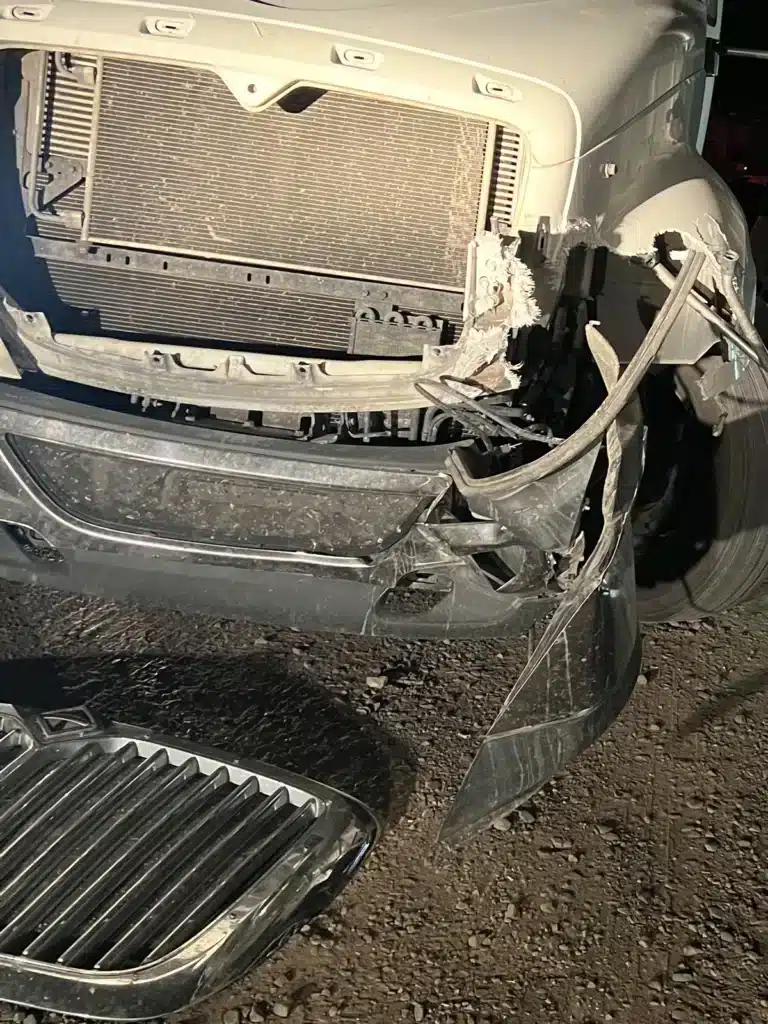
Another driver, also in a sand truck, tried to get his rig around hers. His trailer hit the front driver side of her tractor while she slept inside. The deputy who came out wrote down what each driver told him, and we have set his words out below.
[OUR CLIENT] INFORMED ME THAT SHE WAS TAKING A NAP IN HER TRUCK ON THE WELL SITE WHEN ANOTHER TRUCK THAT WAS ATTEMPTING TO GO AROUND HER STRUCK HER VEHICLE. […] [THE OTHER DRIVER] ADVISED ME THAT HE HAD STRUCK [OUR CLIENT’S] VEHICLE WHILE TRYING TO GET AROUND THE TRUCK. […] UPON MY INVESTIGATION, I OBSERVED HEAVY DAMAGE TO THE FRONT OF [OUR CLIENT’S] VEHICLE. I OBSERVED MINOR DAMAGE TO [THE OTHER DRIVER’S] TRAILER WHERE THE CONTACT HAD TAKEN PLACE, THERE WAS ALSO DEBRIS BELONGING TO [OUR CLIENT’S] TRUCK UNDERNEATH THE DAMAGED SECTION OF THE TRAILER. […] IN CONCLUSION, [THE OTHER DRIVER] ATTEMPTED TO GO AROUND [OUR CLIENT’S] STATIONARY VEHICLE WHEN THE TRAILER BEING PULLED BY [HIM] MADE CONTACT WITH THE FRONT DRIVER SIDE OF [OUR CLIENT’S] VEHICLE CAUSING MAJOR DAMAGE TO THE FRONT OF THE VEHICLE WHILE ALSO CAUSING MINOR DAMAGE TO THE TRAILER BEING PULLED BY [HIM].
The deputy saw heavy damage to the front of her tractor and minor damage to the other trailer, and neither truck was towed. The first three pages of the report are linked below, with names, plates, IDs, owners and insurers blacked out.
Read the deputy’s report, redacted (PDF)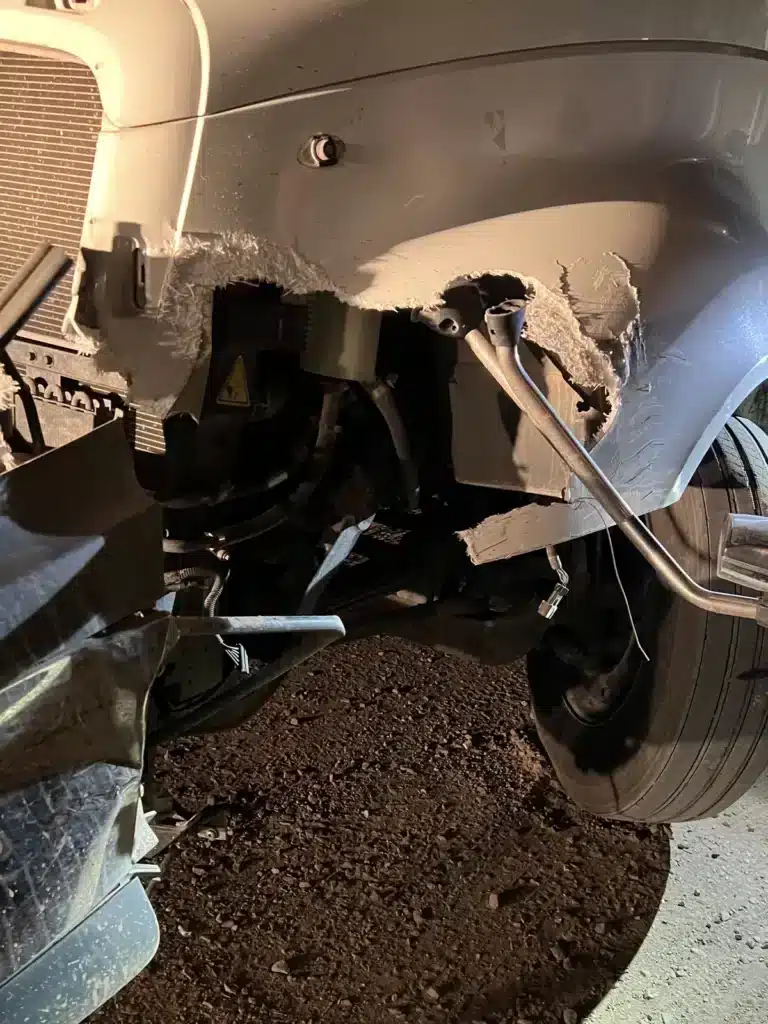
What the Report Left Us to Prove
The report coded both drivers as not injured, and our client had been lying down asleep. We knew that code would be the first thing anyone read about her injuries, and that a sleeping person has no chance to brace.
The crash happened on private property at a work site at night, with no traffic control, and in another state. Which state’s rules govern parts of a claim like this is a question that has to be answered early.
Several owners stood behind the other rig. The report lists his tractor as his own, the deputy photographed a motor carrier’s name and a USDOT number on its door, and a separate company owned the trailer, which the report marks as uninsured. Each of them could point at another.
Five Things the Record Gave Us
- The other driver’s own statement
- He told the deputy he had struck her vehicle while trying to get around the truck. That meant we did not have to rebuild how the crash happened from the damage alone.
- The deputy’s conclusion about her truck
- The deputy wrote that her vehicle was stationary and that the trailer made contact with it. We began our fault analysis there, because it put the movement on the other rig.
- Debris from her truck under the trailer
- The deputy found it under the damaged section of the trailer. It ties the two vehicles together at the spot of contact.
- Her photos of the tractor that night
- They show the corner torn open, the bumper bent down and the grille lying on the gravel. They show the force of the hit better than any description could.
- About seven months of care
- Her care began within days of the crash. A record that starts that early and runs that long gave us a way to connect her complaints to that night.
We have also handled a $600,000 result for an interstate truck crash in Mesquite. It is background on our truck work, and it is not evidence in this case.
How We Addressed Fault, Her Injuries and the Policy
I learned how to approach hard work in the Marine Corps, before law school. “It did give me a lasting framework for handling difficult work: prepare early, identify the facts, stay accountable, communicate clearly, and do not confuse motion with progress.” Those words are on my bio, and they fit this file. The three issues below follow the order in which we weighed them.
A parked truck, and a trailer that cut too close
The other driver handed us the first piece himself. He told the deputy he struck her vehicle while trying to get around the truck. The deputy then concluded that her vehicle was stationary and that the trailer made contact, and he found debris from her truck under the damaged part of that trailer.
We still expected the insurer to say she had parked where trucks needed to pass and should carry part of the blame, a comparative negligence argument built on where she stopped. So we looked past the admission to the path of the trailer. The Texas commercial driver license manual says, “When a vehicle goes around a corner, the rear wheels follow a different path than the front wheels. This is called off-tracking or ‘cheating.’” It goes on, “The rear wheels of the powered unit (truck or tractor) will off-track some, and the rear wheels of the trailer will off-track even more.” Section 2.7.6 adds, “Because of wide turning and off-tracking, large vehicles can hit other vehicles or objects during turns.”
The deputy never used that term. Reading his account of a trailer making contact while its driver tried to get around a stationary truck as the kind of contact the manual describes is our reading, and it answers what the admission leaves open, which is why a careful driver would have kept clear. As for her being asleep there, rest like hers is built into a trucker’s day. The federal rule at 49 CFR 395.3 says, “A driver may not drive without first taking 10 consecutive hours off duty”. Whether her rest that night was a required break is not something we claim.
Our demand laid out how the crash happened and her care, provider by provider. The insurer’s reply on fault stays in our file.
A not injured box, and seven months of care
The report coded her as not injured. We knew the insurer would treat that box as the answer and argue her complaints came from somewhere else. The box says nothing about the fact that she was asleep and lying down, with no chance to brace.
Her records filled in what the box left out. Care began within days and ran about seven months, with a pain management doctor, X rays and MRI studies, physical therapy, a series of injections and procedures for her neck and lower back, and consultations with spine surgeons. She did not have surgery. We were careful not to treat the length of her care as proof of what caused it.
A short summary would have left questions open that the records answer on paper. The records and bills from her providers went out with our policy limits demand, which stayed open for about two weeks, and our Stowers guide explains how a demand like that works. The records themselves stay confidential.
Three owners behind one rig, and a state line
The demand did not settle the claim, and we filed suit. By then the report had already shown how many parties stood behind the other rig.
The report lists the tractor as the driver’s own, the deputy’s photos show a motor carrier’s name and USDOT number on its door, and a separate company owned the trailer. We expected each of them to point at the others, and we expected an argument over where the claim belonged. Federal rules set a $750,000 minimum for for hire interstate carriers of ordinary freight, as our truck accident lawyers page explains.
Every driver and vehicle on the report was from Texas, a fact that weighs on where a claim belongs when the crash happened in another state. Talking longer and filing suit both cost time, and which one makes sense turns on how the insurer answers the demand. Where we filed, who paid and the terms stay private.
$250,000, Settled During the Lawsuit
$250,000
Settled while the lawsuit was pending
Her case settled for $250,000 while the lawsuit was pending. That figure is gross, so fees and case costs were paid out of it.
We won’t claim the lawsuit by itself produced that number, since a settlement has many moving parts. Who paid and the terms stay private.
Hurt while your truck sat parked, or in a state far from home? Give us the details, and we will walk you through them.
Tell Us What HappenedThe Limits of This Result
- The $250,000 is gross. Her own share was what remained after fees and costs.
- The narrative is the deputy’s account and his opinion. It is not a ruling on fault.
- The not injured code on the report is a box on a form. It is not a medical finding.
- Off tracking is our reading of the record. The deputy did not use the term.
- A different claim rises or falls on its own facts, since each crash and each person differs.
What We Relied On for This Page
- The Red River Parish Sheriff’s Office accident report, first three pages, redacted
- Our demand packet and her care records, which are not published
- The Texas DPS commercial driver license manual, sections 2.7.6 and 6.1.6
- 49 CFR 395.3, hours of service
- 49 CFR 387.9, federal minimum financial responsibility
Attorney Review

Reviewed by: Josh Alexander, Founder and Managing Attorney
Published and reviewed on
More Truck Cases We Have Handled for Texans
- $15,000,000I-45 truck crash wrongful deathSettled in litigation
- $5,000,000Northlake forklift wrongful deathSettled in litigation
- $850,000Pasadena red light crashSettled in litigation
- $600,000Rockwall County five vehicle crashSettled in litigation
- $600,000Mesquite 18 wheeler crashTruck accident settlement
- $325,000Hood County commercial truck crashSettled in litigation
- $195,000Rear ended by a business vehicle, no reportCommercial insurer
- $175,000Round Rock construction vehicle crashSettled before suit
- $150,000Odessa company pickup, two clientsCommercial policy, before suit
- $130,000Redwater head on, two limitsBoth limits, before suit
- $125,000Brownsville armored truck rear endSettled before suit
- $105,000Texas highway unsafe lane changeSettled before suit
- $105,000Three vehicle crash in DallasPolicy limits recovery
- $100,000Rear end, no police reportSettled before suit
- $95,000Midland company truck left turnSettled before suit
- $89,000San Antonio 3 car chain reactionSettled before suit
- $85,000Farmers Branch left turn, UIMSettled in litigation
- $82,500Plano company truck left turnSettled in litigation
- $80,000Jersey Village U turnSettled in litigation
- $60,000San Antonio rear end, UIMTwo policy limits, pre litigation
- $60,000Fort Worth trailer hitch rear endTwo limits, before suit
- $60,000DeSoto stop sign, broken wristTwo limits, before suit
- $60,000Hit walking her dog, UIM on footTwo limits, before suit
- $50,000Allen rear end crashPolicy limits settlement
- $50,000La Porte red light T boneFull policy limit, before suit
- $32,500Uninsured driver, UM and PIPUM limit plus PIP, before suit
- $30,000San Antonio rotator cuff tearPolicy limit, before suit
- $30,000Houston hit and run recoveryUM policy limits
- $30,000Richardson apartment exit crashPolicy limits, pre litigation
- $30,000Uvalde chain reaction, hit twicePolicy limit, before suit
- $30,000El Paso right turn, no UIMPolicy limit, before suit
- $30,000Grand Prairie red light, driver sideFull policy limit
11Contact
Hurt While Parked
Hurt While Parked
or Far From Home?
Send us the report if you have one, or just your account of that night. We will read what you have and tell you what we see.
No fee unless we recover · Se habla español · Proudly Serving All of Texas