


Case Result
$60,000 Settlement for a Woman Hit While Walking Her Dog From Two $30,000 Limits, the Driver’s and Her Own UIM
J. Alexander Law Firm represented a woman who was hit, and whose dog was killed, when a pickup turned left into a parking lot across her path on Coppertowne Lane in Dallas. The police report put the only fault code on the driver. With no lawsuit filed, a pair of policies paid $30,000 apiece, the most each allowed: the driver’s liability coverage and her own underinsured motorist (UIM) coverage, $60,000 in all, even though she was on foot.
Hit while walking? Your own auto policy may cover you too. Tell us what happened.
On This Page
A Walk With Her Dog Ends at a Parking Lot Entrance
The street is posted at 20 mph. It was evening, dark, and raining. Our client was walking her dog along the road and crossing the entrance to a parking lot when a pickup coming the other way turned left into that lot.
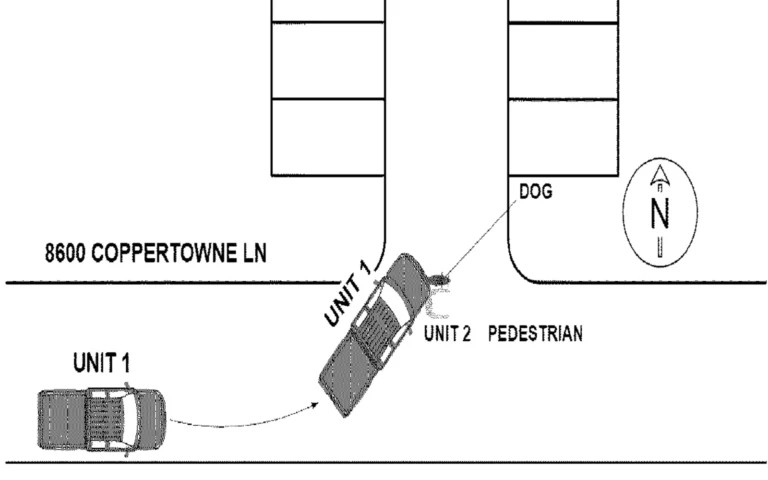
UNIT 1 WAS TRAVELING E/B 8600 COPPERTOWNE LN, IN THE RIGHT LANE. PEDESTRIAN 1 & DOG WERE WALKING E/B 8600 COPPERTOWN LN ON THE LEFT SIDE OF THE ROAD. PEDESTRIAN 1 & DOG WERE WALKING E/B 8600 COPPERTOWN LN CROSSING THE PARKING LOT WHEN UNIT 1 WHO WAS TURNING LEFT INTO THE PARKING LOT FAILED TO YIELD RIGHT OF WAY TO A PEDESTRIAN & COLLIDED FC WITH PEDESTRIAN 1 & THE DOG, THE DOG WAS FATALLY INJURED & PEDESTRIAN 1 SUFFERED MINOR INJURIES.
The officer was sent to the scene the next morning. The officer’s full report is linked below, with the names, the plate, the ID numbers and the insurer covered in black.
Open the redacted police report, with the officer’s diagram (PDF)Five Things That Made Her Claim Harder
No witness and no video were listed, and the officer was sent to the scene the next morning. That left the paper record to carry the facts, so the claim depended on how the report was written and read.
It was dark, it was raining, and the road was wet. An insurer can say a walker was hard to see, which goes to fault and to any share of it placed on her.
She was checked at the scene and not taken to a hospital. An insurer tends to read that as a minor injury, which goes to what her injury claim is worth.
The driver carried $30,000 of coverage for one injured person, the Texas minimum under § 601.072. Once that limit was paid, anything more had to come from another policy, and she had not been in her car.
Texas law values a dog as property, and that limits what a claim for her dog can recover. In Strickland v. Medlen (Tex. 2013) the Texas Supreme Court began with “Texans love their dogs.” It then held that “Pets are property in the eyes of the law” and that recovery in pet death cases is “limited to loss of value, not loss of relationship.” The court said any change to that rule is for the Texas Legislature.
Seven Records and Rules That Carried the Claim
- Code 36 on the pickup driver alone
- Only one contributing factor appears on the report, and it belongs to the pickup driver, so the record puts fault on the driver and lists nothing for her. The report lists no ticket and the charges section is empty, and our crash report decoder explains code 36 in plain words.
- Traffic control coded as a crosswalk
- The report lists the traffic control at that spot as a crosswalk. That matters to fault, because the driver had to look for people crossing before turning.
- The officer’s diagram
- The officer’s diagram shows the pickup swinging across the street to the lot entrance where she and her dog are marked. That matters to fault, because it shows the pickup crossing her path.
- Injury code B
- The officer coded her injury B, an evident injury such as a bruise or scrape that does not incapacitate. Dallas Fire Rescue evaluated her at the scene, and she was not taken to a hospital. That matters to her injury claim, because an evident injury was recorded even with no transport.
- Her dog on the damaged property row
- The report lists her dog under “Damaged Property Other Than Vehicles”. Texas law treats a dog the same way. That row is the basis of the separate dog claim, which matters to damages.
- Two Texas rules for a turn into a lot
- Two Texas rules fit a driver turning into a lot. Section 552.006 says a driver entering a private road or driveway “shall stop and yield the right-of-way to a pedestrian approaching on a sidewalk extending across the alley, building entrance or exit, road, or driveway.” The report does not say whether she was on a sidewalk, so we do not claim she was. Section 552.008 says a driver shall “exercise due care to avoid colliding with a pedestrian on a roadway”. These rules matter to fault, because they set the duty the driver owed.
- Her own auto policy’s UIM limit
- She carried $30,000 of underinsured motorist coverage. That mattered to the recovery, because the coverage protects the people it insures, not only the car, so it reached her as a pedestrian.
Context, not evidence: Our study of crashes in lots, driveways and backing shows how exposed walkers are off the main road. In private property crash reports, pedestrians made up 54.4% of everyone the officers coded as killed or seriously hurt, against 9.7% across all reportable Texas crashes. That figure covers crashes inside lots and on private property. This one was reported on the public street at the lot entrance. Our pedestrian accident lawyers page covers these claims, and we also handled the claim of a client a drunk driver hit as he walked to his car.
How Our Attorneys Reached Both $30,000 Limits
No witness was listed, no video was listed, and the officer arrived the next morning. This is how a claim like hers is built from the record that does exist.
Answering the dark and the rain
On a dark, wet evening, an insurer may say a walker was hard to see. The due care rule in § 552.008 opens with “Notwithstanding another provision of this chapter,” so it holds even while the turning and sidewalk rules are disputed. The driver chose to turn across that entrance, and the duty to look came with the turn.
Her share of fault, if the insurer claims one
Fault in Texas is shared in percentages. A claimant found over half to blame gets nothing under § 33.001, and any smaller share comes off the recovery under § 33.012. Because the report lists no factor for her, any share an insurer assigns her has to come from somewhere other than the officer’s findings. Our comparative negligence guide walks through the rule.
Her injuries, on her own record
When the fire department checks someone at the scene and no ambulance takes her, an insurer tends to read the injury as minor. The officer still coded an evident injury, and the treatment record that follows is what a demand for her injuries rests on.
Her own policy, on foot
She was walking, not driving, and her UIM still applied. Texas Insurance Code § 1952.101(a) describes this coverage as protection for “insureds who are legally entitled to recover” from underinsured drivers. It follows the insured person: as a passenger in someone else’s car, and on foot, as it did here.
Two limits for one injury
Her UIM covers the part of what the at fault driver owes that the driver’s policy left unpaid, up to her own limit. Matching $30,000 limits did not end her claim, and our insurance guide explains how UIM pays once the other driver’s limit runs out, including when the two limits are the same.
What the insurer looks for
“I know what insurance companies look for before they move,” Josh Alexander writes on his bio. For a claim like this one, that list is a certified report, a fault record with nothing on the walker, an injury coded at the scene and the client’s own policy read as closely as the driver’s.
One team on the claim
Intake, a case manager and the attorney share each claim we take, so a client can put a question to any of them.
$60,000 From Two Policies, Before Any Lawsuit
$60,000
The driver’s $30,000 limit and her own $30,000 UIM limit, before suit
First came the driver’s liability coverage, all $30,000 of it. Next came her own underinsured motorist coverage, also its entire $30,000. Neither payment needed a lawsuit.
Without her UIM, the claim would have stopped at the driver’s $30,000. Her own policy doubled the money available, on a day she was not in her car.
What This Result Shows and What It Does Not
- The $60,000 is gross. Fees and costs came out before her share, so it is not what she took home.
- The codes on the report are the officer’s opinion. A report does not decide fault on its own.
- The $60,000 came from injury coverage. In Texas, a dog’s loss is a property claim measured by the dog’s value, so this result puts no price on her bond with her dog.
- UIM pays only up to the limit chosen on the policy. Her $30,000 limit paid $30,000.
- The crash facts come from the certified report. The result is the firm’s own account.
- One result predicts nothing about another case, since no two claims share the same facts.
Where These Facts Come From
- The certified CR-3 crash report for this accident, redacted
- Tex. Transp. Code §§ 552.006, 552.008
- Tex. Transp. Code § 601.072
- Tex. Ins. Code §§ 1952.101, 1952.106
- Shared fault rules, §§ 33.001 and 33.012 of the Texas Civil Practice & Remedies Code
- Strickland v. Medlen, 397 S.W.3d 184 (Tex. 2013)
- The firm’s index of Texas crashes in lots, driveways and backing
Attorney Review

Reviewed by: Josh Alexander, Founder and Managing Attorney
Published and reviewed on
Other Case Results Our Clients Have Seen
- $15,000,000I-45 truck crash wrongful deathSettled in litigation
- $5,000,000Northlake forklift wrongful deathSettled in litigation
- $850,000Pasadena red light crashSettled in litigation
- $600,000Rockwall County five vehicle crashSettled in litigation
- $600,000Mesquite 18 wheeler crashTruck accident settlement
- $325,000Hood County commercial truck crashSettled in litigation
- $175,000Round Rock construction vehicle crashSettled before suit
- $150,000Odessa company pickup, two clientsCommercial policy, before suit
- $130,000Redwater head on, two limitsBoth limits, before suit
- $125,000Brownsville armored truck rear endSettled before suit
- $105,000Texas highway unsafe lane changeSettled before suit
- $105,000Three vehicle crash in DallasPolicy limits recovery
- $100,000Rear end, no police reportSettled before suit
- $95,000Midland company truck left turnSettled before suit
- $89,000San Antonio 3 car chain reactionSettled before suit
- $85,000Farmers Branch left turn, UIMSettled in litigation
- $82,500Plano company truck left turnSettled in litigation
- $80,000Jersey Village U turnSettled in litigation
- $60,000San Antonio rear end, UIMTwo policy limits, pre litigation
- $60,000Fort Worth trailer hitch rear endTwo limits, before suit
- $60,000DeSoto stop sign, broken wristTwo limits, before suit
- $50,000Allen rear end crashPolicy limits settlement
- $50,000La Porte red light T boneFull policy limit, before suit
- $32,500Uninsured driver, UM and PIPUM limit plus PIP, before suit
- $30,000San Antonio rotator cuff tearPolicy limit, before suit
- $30,000Houston hit and run recoveryUM policy limits
- $30,000Richardson apartment exit crashPolicy limits, pre litigation
- $30,000Uvalde chain reaction, hit twicePolicy limit, before suit
- $30,000El Paso right turn, no UIMPolicy limit, before suit
10Contact
Hit While Walking,
Hit While Walking,
or Lost Your Dog to a Driver?
Tell us what happened and bring your own auto policy if you have it. Your UIM may cover you on foot.
No fee unless we recover · Se habla español · Proudly Serving All of Texas