



Short answer
What Texas car accident laws should I know after a crash?
When someone is hurt in a Texas crash, each driver involved must stop, reasonably assist the injured and notify law enforcement of the crash. A driver at fault for a wreck may owe damages, but an injured person assigned 51 percent or more responsibility cannot recover. For most injury claims, the deadline to bring a lawsuit is two years.
Texas car accident laws set drivers' duties after a crash, including reporting an injury crash to law enforcement. They also affect who may have to pay and the deadline for bringing a lawsuit. For a new claim, I sort rules into three groups: possible violations by the other driver, rules the other side may say you broke, and deadlines and insurance limits. This helps us assess what the other side might owe, whether fault assigned to you could reduce your recovery, and if time remains to sue. Use the topic menu below to find a rule's page.
The clocks that start on the crash date
2 years
To file a lawsuit
I start with the crash date because the two year limit to bring a lawsuit generally begins on that date.
Age 18
When a child's clock starts
If a child was hurt, we also ask for the birth date, since the child's clock generally starts at age 18.
6 months
Notice to a government unit
Claims involving a public vehicle or city road can have much shorter notice periods. Generally, notice must reach the government unit no more than six months after the crash, though a city charter can set a different period.
What Texas law requires at the scene
When a wreck in Texas hurts or kills someone or damages a car being driven or attended, the drivers must stop, give reasonable aid to anyone hurt and share their names and addresses, each vehicle's registration number and each driver's liability insurer name.
Did the other driver follow those rules? We check. Our post wreck checklist covers the other steps, from taking photos to getting the officer's report.
What we ask on the first call
To start, our intake team asks:
- Where and how the wreck happened
- Who saw it
- Whether a dashboard camera recorded it
- What insurance coverage you have
- Whether a government vehicle or a city road was involved
- What the other driver said right after the crash
We ask early because witnesses and video can be harder to find later. Your coverage can also matter if the other driver has too little insurance.
Their own words can count
A party's own words can be used against that party at trial under Rule 801(e)(2) of the Texas evidence rules, so a remark like "I never saw you" can matter.
Who is at fault in a car accident in Texas?
Liability insurance usually covers harm that a driver is responsible for causing. Drivers can share fault, and whether one broke a traffic rule often matters. As I prepare a claim, I consider the percentage of fault a jury might assign to each driver.
If your claim goes to trial, the jury is asked to decide each person's percentage of responsibility for conduct that helped cause the harm. You can be one of them.
Section 33.003 covers people bringing claims, defendants, people who settled and other people formally named as responsible third parties. Before the jury can be asked about your conduct, the other side needs enough evidence to support that question.
I read the crash report for anything the defense could point to, and our team gathers the officer's account, witness statements, photos and video early to answer it. For questions about your driving raised by the crash report, read our 51 percent rule guide.
From the insurance side
What traffic rule did the injured driver break? That was Matthew Graham's first question as an insurer's lawyer in crash fault disputes.
He checked every crash report for an answer, so the insurer could argue that the drivers shared fault. Suppose the report says you changed lanes without signaling, and moments later your car hit another car whose driver failed to stop at a stop sign.
An adjuster may put some blame on you. I ask if your lane change contributed to the crash, since jurors look at actions that played a part in the injuries.
Two traffic rules were in play in our client's San Antonio case. A driver entering a highway from a private drive must yield to approaching traffic under Transportation Code section 545.155.
Section 545.062(a) calls for enough distance behind another car to allow a safe stop. The officer blamed the pickup driver but closed the call with no injury recorded for our client.
His medical records documented injuries that did not appear in the police record.
Stopped at Shopping Center Exit, Hit From Behind
Our client paused at the exit for approaching traffic while the pickup behind him continued forward.
San Antonio, State Highway 151 access road
San Antonio Shopping Center Crash
In 2023, our client was easing out of a San Antonio shopping center toward the Highway 151 access road. He stopped for traffic. A pickup struck him from the rear. The report assigned responsibility to the pickup driver.
The pickup driver's insurance paid up to the policy limit. His underinsured motorist policy then paid out to its full limit. The claim was settled without a lawsuit.
When the other side says you are to blame
The police report blames you
If a police report blames you for the crash, we can take another look and challenge it. Our answer for drivers blamed by the other side explains how.
Little damage to the car
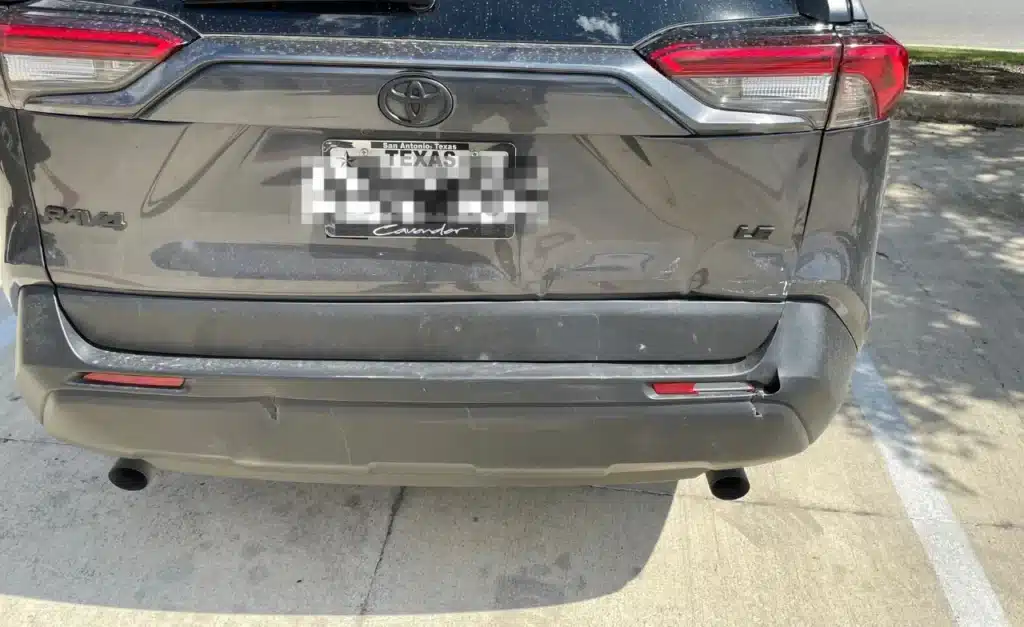
I have seen insurers argue that a vehicle with little damage means the people inside could not have been badly hurt. Our client's RAV4 had little visible damage. For his claim, our team relied on his medical records to show his symptoms and treatment.
Where to read next
- In a crash claim, you may seek money for treatment costs, pay you missed and pain, as well as payment for emotional distress.
- Bills from doctors often arrive before payment on a Texas crash claim against the other driver. Your own insurance may help with those bills, as we explain in our guide to PIP coverage.
- If the other driver sues, see how to respond to a Texas crash lawsuit.
- In October 2026, a caller asked whether a lawyer could help turn around a finding of fault. We address that question in our answer on legal help after you cause a crash.
- An adjuster may call very early, even before you leave the crash scene. If you get that call before leaving the crash scene, read our answer on adjuster calls for more.
Adjuster pinning part of the crash on you? Show me the crash report and the rule the adjuster cites.
Call 469-807-7480Where are Texas car accident laws written?
Texas car accident laws are spread across several state codes. Think of them as tools kept in different drawers of a workbench. Part of my job is knowing which drawer to open for your crash.
Five Texas codes come into play when I research a crash.
- Transportation Code
This code sets traffic rules, duties at a crash scene and the insurance drivers must carry. It comes up when we look at how drivers behaved, including whether a driver left the scene unlawfully. For a conviction of a misdemeanor under the Texas rules of the road with no other penalty set, Transportation Code section 542.401 calls for a fine from $1 to $200.
- Insurance Code
Your policy's required coverage and the deadlines for handling a claim are addressed here.
- Civil Practice and Remedies Code
This code provides rules on when to sue, how shared fault works and what is required when you make a claim against a government unit.
- Property Code
Hospital liens are covered here, and we look at them before a settlement is paid.
- Alcoholic Beverage Code
This code sets rules that can matter when a business served a driver who was already drunk.
Send me any code section an adjuster or a letter cites. We will read the section to see whether it says what the adjuster claims and whether it applies to your crash.
When a client says they have no PIP or uninsured motorist coverage, I ask to see the signed rejection. Texas auto liability insurers must provide both coverages unless a named insured rejects them in writing. A policy described as "full coverage" does not necessarily include every optional protection. To check your coverage, our intake team asks:
What our staff tells callers
"They're called underinsured, uninsured motorist coverage as well as personal injury protection. Would you know if you have those by any chance?"
A staff member, 2026
Got a letter that cites a Texas code section? Send me the section number and I will explain what it covers.
Call 469-807-7480What is the new car accident law in Texas?
No new law raised Texas insurance minimums for 2026. The limits remain 30/60/25. Drivers no longer file their own state crash report form, and the adult booster seat claim shared online is false.
What changed and what did not
Still the law
The minimums are still 30/60/25
- $30,000each person hurt
- $60,000all injuries, one crash
- $25,000property damage
A bill must pass to become law, so I check its history before saying the law changed. House Bill 4178 proposed 50/100/40 for policies starting or renewing in 2026, but the 2025 bill stalled in the House Insurance Committee.
The minimum remains 30/60/25. With a minimum policy, the injury limits are up to $30,000 for each person and $60,000 in total per crash, plus up to $25,000 for damage to property.
Retired in 2017
Drivers no longer file form CR-2
Drivers used to be able to send the state their own crash report, form CR-2. TxDOT has not retained that form since 2017, so keep your own photos and notes. If an officer wrote a report, our litigation paralegals request a copy.
False
The adult booster seat rumor is false
A 2026 rumor about adults needing booster seats is false. I send families to our guide to Texas car seat laws to learn who needs a booster.
When a client brings me a new law they read about online, I read the statute itself before anyone relies on it. Tell me what you read and what happened in your crash.
24/7 | Free consultation | No fee unless we win
Bring your crash report. Let me match it to the Texas rules above.
J. Alexander Law serves injured clients throughout Texas: Dallas | Houston | San Antonio | Fort Worth | Arlington | Canton. Se habla español.